Online Presentations, CPD and the lots

Presenting at an Online Conference: 
                                                 food for thought

The other day I presented at “The cultures of EAP” online conference and my presentation got me thinking (yay, you get to read another one of my rambles), so,  I now really want to share with you some of my thoughts about online conferences, how I experienced the conference as a member of the audience and my views as a presenter as well.
Why attend an online conference?
  • For continual professional development…. obviously!
  • They offer the option of recordings, so everything is saved. If you miss a session, you can watch it later. 
  • They are convenient. You are at home, in your jammies and learning in the most comfortable of ways.
  • Participants can be from all over the world, so you may hear a talk from someone who would not be able to present at a face to face conference (for presenters who are not key note or invited speakers, face to face conferences can be a bit expensive in terms of travel expenses).
  • The platforms that host online conferences have chat boxes so you also get to interact with the other attendees. There are no ”shhhhh” moments in this case (while they are an an excellent opportunity for some serious chatting, they can be a bit distracting though).
Why present at an online conference?
Well, why not? OK, if you need a bit more persuading, here goes.
  • You, the presenter, don’t have to go anywhere. You are at home, so actually there are no expenses! It is also probably the most comfortable way to present (you are in your slippers, in your own chair etc, etc)!!
  • Because presentations get recorded, you can reflect on what went well in your presentation and what needs to be improved. You can also keep your presentation in some sort of e-portfolio ( I add mine to my blog page). 
  • You may be nervous, but not as nervous as when presenting face to face. So, if you want to start presenting your views, an online conference is less nerve wracking.
  • Your audience is from all around the world!
  • It is good for the CV fellow teacher.
  • Like any conference presentation, you get to dig deeper into issues you are interested in, share your views and even learn something from the audience’s comments. It is a win-win situation.
The PPP of an online presentation: advice to the presenter
Plan
Practice
Promote
If you do submit a proposal for a talk at an online conference, this is what I suggest. Plan your talk, make you slides and then practice what you are going to say. Time yourself because while at a face to face conference someone will probably warn you when you only have 5 minutes left, at an online one that does not really happen so it is easier to lose track of time. Finally, start promoting your talk. If you want people to attend your talk, inform them by tweeting about it (systematically), share the info on Facebook and LinkedIn groups. If you have a google+ button, press it. 
On a more personal note… my talk….. my reflections….
I talked about the impact of presentation skills assessment criteria on syllabus design. This was my first EAP related talk, so I was really enthused about it. I am not going to toot my own horn about the things I think I did well. I am going to tall you what I did do though. I had a lot of things to say and that was mistake numero uno. My planning. I timed myself at home, but lost track of time due to nervousness and stumbling over my own words. I also made a major omission.I talked about presentation skills assessment criteria, learner problems and syllabus design, and how criteria can inform syllabus design. However, I did not mention any implications to such an approach. Ironically, I always tell my learners, you gotta mention implications when you talk about your research. Yeah, practice what you preach, Joanna!!Sadly enough, a friend who attended my talk, spelt this one out for me : (. 
Notes to my future online (and offline) presenter self:
Even though you think you have planned your presentation well, you haven’t, so, plan more.
If you know anyone who knows anything about what you are talking about OR has experience presenting, ask for advice regarding your presentation. You may hear something helpful.
Final thoughts
I am really thankful to everyone at Sheffield university’s English Language Center and Oxford University Press for organising/hosting the “Cultures of EAP” conference and giving me the opportunity to attend and present at the conference. The conference was about the Cultures of English for Academic Purposes (for more information go here). 
If you have presented online and want to share your own thoughts, feel free to comment in the comment section below. 


Till next time…
EAP

EAP Presentation skills: Learner perceptions, problems and an itsy bitsy case study

In this post I am going to talk a bit about EAP (English for academic purposes) and presentation skills in relation to learner problems and students’ perceptions. I will do this by sharing with you a small case study. Before moving on, let me just let you know that in EAP very often students are asked to give a presentation about something they are doing research on. Presentation skills are also assessed as part of many/almost every pre-sessional EAP course.

My experience

I have been fortunate enough to have had the opportunity to teach pre-sessional EAP at 3 great universities (in the UK). Moving around the UK whilst teaching EAP, has allowed me to see how different universities teach presentation skills and how presentation skills are assessed. It has also given me the opportunity to witness presentation skills learner problems. Whether the learner is Chinese, Iranian or Greek, international students do tend to face the same or similar problems.

What do learners know about presentations anyway?

A bit of context: I had a group of four EAP students, all Greek and all post-graduate level learners, studying at a university here in Greece. During our first session, I asked them, ” How do you prepare for a presentation?” Their answer surprised me. They had never had any input whatsoever on how to give a presentation in English, although they were expected to, and had, given one or more presentations in English while attending university.
When I first meet my Chinese students during their EAP courses, I ask them about their presentation skills experience, 99% of the times I get the same response.

What do you consider important when giving a presentation in English?
I asked my (Greek) learners the million dollar question (what do you consider important for a good presentation?) and this is what they thought:

1st Planning
            2nd Language (General vocabulary)
                    3rd  Signposting language
                             4th  Pronunciation

                                       5th  Appearance of visuals


Valid points, don’t you think? All the above are important when giving a presentation. But there are more…..
So, I then observed my learners in order to see what kind of difficulties they had when presenting research in English. I observed them without having given them any guidance on how to deliver a presentation in English. They used material they had actually used at older conferences, material they had presented before. I looked at structure/content of a presentation, language, pronunciation and voice, communicative effectiveness and presentation skills. This is what I found.

Learner Problems
Structure/Content of presentation:

  • Missing slides ( overview/introduction, main body, conclusion format was not followed)
Pronucniation/ Voice:
  • Speech often monotonous, robotic
  • Intonation similar to their L1
  • Mispronunciation of key words
Content/Task Fulfillment:

Whilst all learners knew what they were talking about, there was an over reliance on their research papers. They did not elaborate on their ideas.
Language:
  • Grammar/lexical range was basic (not enough complex structures)
Communicative Effectiveness/ Techniques:
  • Students were not giving a dynamic presentation. They stayed glued to their computer (some did not even stand up as a chair was available)
  • No eye contact with audience
  • a lot of reading from slides
  • Visuals were too wordy with a lot of unnecessary animation
Finally, during their first presentation, my learners plagiarised a lot, but they didn’t know they were plagiarising!
Conclusions
Both my Chinese and Greek learners have similar weaknesses when presenting in English.   Presentation skills in EAP require the bringing together of many sub skills. In order to help the learners, it is essential to know what the individual learner problems are and address them in class. Knowing general learner problems is a good starting point though.

Want to hear about assessment criteria, learner problems and syllabus design?
On Thursday the 15th of January I will be giving a short talk on my experience teaching presentation skills to a group of Greek learners. I will look at assessment criteria (used by 3 universities) and learner problems, and how they inform syllabus design.
The conference is free, online and hosted by Sheffield University and Oxford University Press.
If you are interested in hearing the talk, press here for more information.

Till next time……


Blog Challenge

What’s Your Story?
I read about this blog challenge on Vicky Loras’ blog and thought, “I want to take part in this challenge”. So, here is my story.
I grew up in Sydney, Australia and at the age of 12, my parents decided that it was about time to move back to the mother land, Greece. So, we did. We moved from Sydney to Crete. At the beginning, my Greek was very very bad. So bad that my Greek teacher wanted me to repeat the class. I would not hear of that cause, well, I was a nerdy student. So, I studied a lot, had private lessons and manged to pass the class. I did always struggle with my Greek though. Anyhow, years went by, I got into university. I got a BA in English from the University of Athens and after finishing my studies I was ready to become a public school teacher. And I did. And I hated it. I was miserable. I actually resigned from a teaching job one year! So, I thought, ” What will I do now?” I stopped teaching in the public sector and spent more time teaching as a freelance teacher and at different private language schools in my hometown. I also decided that it was about time to do an MA and I did. I got a M.Ed in Tesol. In my mind, at that time, I was a qualified teacher, a super duper one, and I wanted more.
In 2007, I decided to open a language school and I did with my sister. I was going to be a language school ‘owner’ and a DOS. Thirty years old, with an MA and a language school. I was doing something right (or was I?).
In 2011, my friend Anna suggested we apply for a summer school job in the UK. As she had experience teaching at a University she suggested we try applying for pre sessional EAP jobs. And we did. And I got an interview. My interview was successful and my first uni job was at Newcastle University. I loved it! I went back the next year and met Deirdre. We became very good friends and kept in touch. During the winter of 2013, she suggested I apply for a job as an online Business English tutor and I did. I got the job. I loved it!
I actually needed a second job because recession hit very close to home and my langauge school was not going well. During the winter of 2013, I was teaching business English online in the mornings and general English at my language school in the afternoons. EAP courses in the summer. Oh! That is when I also decided it was time to do the Delta (and I did). I also started blogging (yes, that is when this monster was born : p) and presenting at conferences. All was going as I had planned.
And then everything changed.
Septemeber 2014, my language school stopped existing. My sister and I decided that we could no longer run the business and that it was better to close. We did. I was very sad. I had spent 7 years of my life putting effort into something that did not succeed.
I still think about what else I could have done, but I am not going to dwell on the past any more. Everything happens for a reason. I do know one thing. I am not cut out to be a business woman. 
The present: I am still teaching Business English online, I have my one to one lessons and will probably be going back to Sheffield university this summer, so workwise I am alright. I blog and present at conferences. I am also writing my first article (yay). I have much more free time now as well. I am content with how things are.
Final thoughts…..
Today, what I really want to share with you in this blog post are my conclusions. Having been a teacher for 17 years, I think that it is important to learn and get qualifications. They make us better teachers and open doors. With these learning and teaching experiences, come people, and these people become our friends, they make our lives richer and help us when we need help. Finally, if there is one thing I have learnt this year, it is that you gotta take risks and if you fail, eh , who cares? You will get over it and move on. That is what I am doing.

Till next time…..

What makes a good teacher?
One of my last lessons of the year was with two boys who are about 12, and I asked them that same question. It was actually part of a reading task but I thought I should start with a bit of a chit chat about teachers and hear their views. So, I posed the million dollar question.” What makes a good teacher?’ They told me their opinion which is what I am going to share with you. Interestingly enough, I had asked a similar question to a group of Chinese students, my EAP group, during the summer and I will share their views as well. Do you think that my learners agree or not?

My Young learners:
A good teacher:

  • makes you laugh
  • answers your questions
  • doesn’t shout
  • makes the lesson interesting
  • helps us relax when we are tired (didn’t see this one coming!)
  • gives good grades (this one is kinda saddening cause it shows me that from such a young age, my learners focus and chase grades)
Now, according to my EAP (adult) learners:
Boring is a teacher:
  • who is not funny and does not have a sense of humor.
  • who only does things from the book/ reads everything from a book.
  • who is strict (?!) not flexible.
  • who does not show any facial expressions, stands still.
  • who doesn’t have a lot of knowledge.
  • who doesn’t tell us stories about her/his life.

So, looking at their answers, a few conclusions can be drawn. Humor is always important. So, find ways to make your learners laugh and have fun during your lessons. Lessons should be interesting, which is why it is important to connect with your learners and find out their likes and dislikes. It is important to be informed and well prepared. When you go into class, you need to know what you are talking about and be able to answer questions. Not being flexible, and shouting are no, nos.

So, as 2014 is towards its end, time to reflect and think about how you teach and how your learners would like to teach. I know I am.


See you in 2015!!

Delta

DIY*- Delta module 1
Continual professional development is very important for me as a teacher. That is why, after 15 years of teaching experience, a BA in English, a M.Ed in Tesol, I decided it was time to do the Delta and I did. But my way. As the Delta is quite pricey and after some of my friends suggested it, I thought, “why not try studying on my own for module 1?”  I did. I passed. This is my story.

What is module 1 of the Cambridge Delta?
Module 1 is Understanding Language, Methodology and Resources for Teaching. It is a written exam and there are two papers ( for more information go here and here).

Person specifications
Well, I had been teaching for fifteen years and I already had an MA. So, I did feel a bit comfy in my ‘teacher’ skin.

                                                   DIY-module 1

How did I prepare? 
Well,

  1. I found a center that would be willing to take me on as an external candidate. In my case it was Celt Athens
  2. I googled Delta module one suggested reading list and I found loads of websites with suggestions on what to read in order to pass module one.
  3. I looked at my bookshelf and found books I already had from my BA or MA and made a Delta module 1 shelf.
  4. I searched online to see if any of the suggested reading material were available and saved them in a folder on my desktop. The My Books folder (Scribd and Google books do have some of the books from the reading list).
  5. I found all the examiner reports and past papers available. This took some time but Google was my best bud those days. I saved everything in a different folder. The exams folder.
  6. I found blogs with tips on how to pass module one and put them on my favourites list.
and then I started studying……..
The books I read from cover to cover:
About Language by S. Thornburry
How to teach English by J. Harmer
The Practice of English Language teaching by J. Harmer
Teaching English Pronunciation by J. Kenworthy
Testing for the language Teacher by A. Hughes
Second Language Acquisition by R. Ellis
and I made notes. Loads of notes. this is actually how I learn. I underline or highlight stuff and then I make notes in my notebooks. I like using different colours, and  I try to make things look pretty. Do not ask me why. It just makes studying and note taking much more fun for me. 
Exam papers
As I said earlier, I found all the exam papers available online and I printed them. I know this is not very eco-friendly, but I like to be able to circle and underline rubrics so that’s why I printed everything. I then started doing the tests by myself and tried to mark myself based on the examiners reports. I looked very carefully at the examiners reports and made notes of the suggestions the examiners made. If I was unhappy with my performance, I would do the test again. Most improtantly, I timed myself!

When I found theories I had never neard of before or knew nothing about in the past papers, then I would do a new Google search and try to find information to add to my notes.

My weakness
Phonetics. I did not like phonetic transcriptions. I found it very difficult and I struggled a lot with this during my module one exam prep. I would phonetically transcribe words and then go to the Canbridge online dictionary to check the phonetic transcription. Connected speech was harder which is why I went back to my uni modules and found everything I had done on connected speech and tried to figure out how to write a whole script. This was the most challenging Delta topic for me!
                              /ˈwiːk.nəs/
Study hours
I work full time, so mornings and afternoons. I usually finish work at 9 pm. I did the same while I was preparing for module one. That meant that I squeezed in a few study hours during the week but most of the studying went on during the weekends. I started preparing in Septemebr and took exams in the first week of December.
Is this for you?
Do you need…….
✓ to study with others?
✓deadlines?
✓feedback?
✓pep talks?
                  
Then, nope, this solution is not for you. If you decide to prepare by yourself for the Delta module 1, you need to be self-disciplined and quite organised. You are on your own. No one is around to help you. May I also mention that I only got a pass. I did not get a merit or a distinction and maybe the fact that I prepared by myself did affect my grade, meaning that maybe  I would have got something higher, had I done a course. I still learnt a lot though, about myself and teaching. So, what do you think? Is it worth a shot?
*DIY: Do It Yourself

Till next time……

Holiday season fun activities

Rudolph the red nosed reindeer

Picture from:http://www.123learncurriculum.com/
Holiday season everyone, and may I just point out the obvious…. I love all the Christmas-y stuff, so here is a blog post about Rudolph!! You will find Rudolph themed activities and ideas on how to use them in class. I hope you enjoy this post and happy holidays everyone : )
Project writing activity: Get your students to do some research on Rudolph and then write a project. They can either give a poster presentation or a PowerPoint presentation. I would suggest you do this with older students. Helpful links: The story behind Rudolph: Wikipedia or from Altogether Christmas

Colouring:   Online colouring Yeap, your students can color Rudolph online. I tried this page out and used the water brush. This website also gives the option of starting over and saving. It is a really fun website so check it out.
Colouring sheets: If you prefer more traditional coloring pages, then click here for an example.
You can practice colours with your learners or even animal body parts during this colouring activity. Once they have coloured their Rudolphs, they can make cards for their loved ones or little Rudolph streamers and decorate the class.

Picture from http://www.coloring-page.net/pages/rudolf.html
Games:

Pin the nose on Rudolph: How do you play? Your students have to pin Rudolph’s red nose onto his face. If you want to make it more fun, you can blindfold your students and tell them to turn round in circles for a few seconds. Once they are twirling for 6 seconds they can then pin Rudolph’s red nose. 

Online game: Where is Rudolph? If you press the link, you will see a picture of a snowy house and a Christmas atmosphere. Rudolph is missing. Your learners need to guess where he is (spoiler: click close to the chimney. That is where he is hiding!!). You can use this as a guessing game and learners can practice using prepositions whilst you are the one doing the clicking on the computer screen.


Rudolph the movie: You can watch the movie Rudolph the red nosed reindeer in class and get your students to summarise it or write a review of the movie (this would be great for an exams class)!!

Screen shot from the movie

Listening:

You can find the YouTube video here but be careful, the lyrics are on the video, so use the sound only as part of the listening task. You can then use the video to check the answers. If you do not want to use YouTube,  I am sure you will be able to find the Rudolph song somewhere on a Xmas carols CD.

Gap filling task A1/A2 level students

You know Dasher and Dancer and Prancer and Vixen,
you know Comet and Cupid and Donner and Blitzen,
But do you recall?
The most ———- reindeer of all?
Rudolph the Red-Nosed Reindeer
Has a very ——— nose
And if you ever saw it
You would even say it glows.
All of the other reindeer’s
Used to laugh and call him ………
They never let poor Rudolph
Join in any reindeer games
Then one foggy Christmas Eve,
Santa came to say,
Rudolph with your nose so bright,
Won’t you guide my sleigh tonight?
Then all the reindeer’s ——– him,
As they shouted out with glee,
Rudolph the red-nose Reindeer
You’ll go down in ———-!
Rudolph the Red-Nosed Reindeer
Had a very ———- nose
And if you ever saw it,
You would even say it glows,
And all of the other reindeer’s
Used to laugh and call him ——–,
They never let poor Rudolph
Join in any reindeer games,
Then one ——- Christmas Eve,
Santa came to say,
Rudolph with your nose so bright,
Wont you guide my sleigh tonight?
Then how the reindeer’s ——— him,
As they shouted out with glee,
Rudolph the Red-Nosed Reindeer,
You’ll go down in ———–!

B1 + level students: Get them to guess the lyrics of the song. delete a whole chunk of it and ask them to write down the missing lyrics. Then listen to the original song and see if anyone was close to it.
You know Dasher and Dancer and Prancer and Vixen,
you know Comet and Cupid and Donner and Blitzen,
But do you recall?
The most famous reindeer of all?
Rudolph the Red-Nosed Reindeer
Has a very shiny nose
And if you ever saw it
You would even say it glows.
All of the other reindeer’s
Used to laugh and call him names
They never let poor Rudolph
Join in any reindeer games
Then one foggy Christmas Eve,
Santa …………………
You’ll go down in history!
Rudolph the Red-Nosed Reindeer
Had a very shiny nose
And if you ever saw it,
You would even say it glows,
And all of the other reindeer’s
Used to laugh and call him names,
They never let poor Rudolph
Join in any reindeer games,
Then one foggy Christmas Eve,
Santa ………………

Answers (from metrolyrics.com)

You know Dasher and Dancer and Prancer and Vixen,
you know Comet and Cupid and Donner and Blitzen,
But do you recall?
The most famous reindeer of all?
Rudolph the Red-Nosed Reindeer
Has a very shiny nose
And if you ever saw it
You would even say it glows.
All of the other reindeer’s
Used to laugh and call him names
They never let poor Rudolph
Join in any reindeer games
Then one foggy Christmas Eve,
Santa came to say,
Rudolph with your nose so bright,
Won’t you guide my sleigh tonight?
Then all the reindeer’s loved him,
As they shouted out with glee,
Rudolph the red-nose Reindeer
You’ll go down in history!
Rudolph the Red-Nosed Reindeer
Had a very shiny nose
And if you ever saw it,
You would even say it glows,
And all of the other reindeer’s
Used to laugh and call him names,
They never let poor Rudolph
Join in any reindeer games,
Then one foggy Christmas Eve,
Santa came to say,
Rudolph with your nose so bright,
Wont you guide my sleigh tonight?
Then how the reindeer’s loved him,
As they shouted out with glee,
Rudolph the Red-Nosed Reindeer,
You’ll go down in history!

If these ideas are not enough, you may want to visit this site for more on Rudolph themed activities (suitable for young learners).

I hope you enjoyed this post. Let me know in the comments section below how the activities went!

Till next time……..

Thoughts

D for Delta
When I first heard about the Delta, I was in the UK teaching Pre sessional English (EAP). A lot of my colleagues had a Celta or a Delta. Me? Nada. No, actually scratch that. I had a BA in English, 15 years of teaching experience in various contexts, and an MA in Tesol. Not bad, eh? Well, that’s what I thought, but then everyone would ask me, ” So, have you ever been observed? What about the practical side of teaching? How do you know you can teach?” ” Huh? I dunno. I just know I can teach. I have been doing it for like fifteen years… duh!”
(Note to reader:brief context. In Greece you can study at university and  get a BA in English language and Philology.This is a four year course, during which you either major in literature and minor in linguistics or vice versa.  You then take state exams, or at least that is what used to happen before the recession, and when you pass the exams, at some point, you start teaching at a state school).
After my first summer in the UK, I started thinking about the Delta. I read about it on the Cambridge website and then decided I was gonna do it.  I was going to do the Delta at my own pace though, slow and steady (emphasis on slow). Oh! By the way, if you are looking for tips on materials and what books to read, stop reading. This is my personal take on the Delta, how I did it, and how it has affected me.
My Delta Course
I did one module at a time. In the order mentioned below.
Module 1- DIY 
I started with module 1. I studied for module one by myself. I asked Marisa Constantinides from CELT Athens if she would accept me as an external candidate, she said , ” Yes”.  So, I was able to sit for the exams! I passed.
Module 2
I did a blended course at Celt Athens. I had online lessons on the weekends and face to face observations at CELT in Athens over the months I was doing the course. This was the best option for me cause the lessons were on the weekends, so I did not have to cut back on my teaching hours, and they were online, so I did not have to move somewhere to do the course. Of course, I had to go to Athens for the observations, but that was a chance to go to the capital as well, so win -win. I passed.
Module 3
Module 3 came after a big break (I think about ten months). I did a distance course at Bell. My specialisation is on EAP and the results are pending (fingers crossed people!).
So, that’s my story. Now, let’s move on to the story, behind the story. How the Delta changed me.
Little things
The girlie stuff:
  • I was fifteen kilos lighter when I started the Delta. Thing is, when you are thinking about starting the Delta, you ask about the workload and the modules, where people did the course and so on. No one really tells you the ‘other’ stuff. My daily habits changed. I stopped reading fashion magazines and started reading methodology books. Instead of riding my bike, I would think to myself, “I can’t ride my bike now. I have to study” and I ate a lot of food for the brain- carbs and chocs. Forget about healthy smoothies and fruit. Gimme coffee and a cupcake!! So, Delta + sitting in a chair + fatty foods = 15 kilos. This of course takes a toll on your wardrobe as well : (
  • Personal life? Huh? No, actually, let me put things into perspective. If you take time off and do just the Delta, I think you are fine. If you work full time, then something has to go. The thing that goes is mingling time. I have spent many Saturday nights working on my Delta instead of drinking a mojito or a pink…. cider!
Other side effects
  • I was whining a lot. I was also talking about the Delta 24/7 and when I wasn’t, I was thinking about it.
The bigger picture

So now you may ask me, ” Why do the course?”
  • You learn a lot about your teaching style and yourself. Planning sessions on your own, teaching them, being observed and then getting feedback, makes you look at your teaching very closely. You put more thought into your lesson plans, you try to find links between your tasks, everything has to happen for a reason! ” Why am I doing this? How will this help my learners? Will this work? What about that?” Also,the fact that other people watch you teaching and give you ideas on how you can improve or give you thumbs up on things you are doing well is SO important.
  • You try out new things. I, for example,  had heard and read a lot about TBL, but had never made a lesson based on it, I did during the Delta though.  I had been teaching the conditionals for ages, but only when I wrote an assignment about the 2nd conditional, did I realise that there was so much more about this grammar form!
  • It is practical, what you learn, you can use.
  • You reflect and then reflect some more.
  • So the workload is heavy, but the reading you do is so interesting, especially if you are a ‘nerdy’ teacher. You will really enjoy reading the books!! 
  • You meet people. I have made so many new friends cause of the Delta, friends who share the same interests as me and who were my study buddies. Now they are my buddies.
  • Marisa, my Delta tutor, got me into blogging and twitter. I actually wrote my first blog post for the Celt Delta blog. Now, I love blogging (I guess you figured that, eh?) and I really enjoy taking part in twitter chats as well. Also, because of the Delta, my professional learning network has grown and I have ‘met’ people from around the world and am sharing ideas with them. Because my PLN grew, I heard about conferences, started presenting at them and now I will be writing my first newsletter article as well (yay!).
  • The Delta opens doors and is a great teaching qualification (truth be told, it looks good on the CV). I teach EAP in the UK, and the Delta is one of the qualifications the unis ask for. You can also use the Delta to teach all around the world!
  • Your writing skill improves greatly and because of word count, you learn to tame the wordy teacher inside you! I really struggled with word count, but now I know tricks to reduce the words used in my writing (current post excluded!).
In hindsight my biggest regret is doing the Delta while working full time at the same time (I had a morning job and an afternoon one!). My advice to people thinking of doing the course would be make sure you have time. If you want to get good grades, then this is a MUST. The Delta course is such an interesting course and it is a shame if you do not have the time to enjoy it. Should you do the course? Definitely!!! Just keep in mind, no pain, no gain or as the ancient Greeks said,  

              τα αγαθά κόποις κτώνται


If you want to share your own experiences, please do so in the comments section below.

Till next time…….

The Dominant one strikes again!

               Classroom Déjà vu
I have been wondering the past few days about my online teaching style. I am actually starting to think that I am a softie online teacher, or am I just going with the flow?! For the past few weeks, I have been teaching a student who is the type of learner I fret…., the dominant one!

Blast from the past
About a year ago, I wrote a blog post about my Dominant Eap student. This is what I wrote:
We all have or have had one of them in our class. The student with all the answers, the one who happily shouts out the answer to the question sometimes before you even ask it! Now, in an EAP class, a class full of adults, who in my case are usually post grads students, dealing with the dominant student can be a tough cookie.
EFL tricks that may work in a classroom setting.
So, how do you deal with the dominant student?

  • Nomination: The easiest way is to actually nominate students when asking questions. Avoid addressing the whole class with classroom questions, and just use names.
  • Paperclips: The idea is you give each student some paper clips and tell them that they have to use the paper clips during an activity. Each time the student speaks, he hands in a paper clip. That way your dominating student will only speak a few times and the rest of the ss will also have to contribute to the conversation/task.If you do not like paper clips, then you can use pieces of paper, postit notes, or whatever you wish.
  • Paper boards: This is quite fun! In order to know everyone is on task, give your students a sheet of paper (a paperboard). ask a question and tell them to write the answer on their paperboard. When everyone has finished, ask them all to show you their board. That way everyone answers your question. The limitation here is that you cannot use this paper board when you are practicing a long turn and it is not very practical during speaking tasks.
  • Group/work/pair work: Group or pair work minimises the problem because your students are in pairs or groups so there are less chances of the dominant student to dominate the whole class.
  • Role reverse: Actually, you could always ask your dominant student to be the teacher for a few minutes and ask questions instead of answer them!
A ‘thorny’ issue
Back to the present

All these ideas worked. My dominant student was less dominant and my classes ran smoothly.
BUT……….
What happens when you are having a one to one session with a very dynamic/dominant student and this is online? To make matters worse, what happens when the dynamic teacher is paired with a dynamic learner? Well, then ,fellow teacher, welcome to my world!
When teaching online, not everything you do in your nomral class works, so scracth everything I said in the previous section. I cannot give paper clips, I cannot give paperboards, this is a one to one session so, well, there are no groups or pairs. My student is an adult. He is always interrupting me and speaking over me! This learner does not like instructions, and enjoys to jump into things and do the tasks… his way. What can I do? I can’t exaclty mute this learner (although to be totally honest, this has crossed my mind : P).
In this online classroom this is my solution
The talk: Of course, I have had a discussion about how different online learning is and how turn-taking is very important etc, etc.
Other solutions:
Problem: Learner speaking over me—–> I let the learner say his piece, and then I repeat what I said. I sometimes even write some of the things I said in the chat box, just to make sure my learner is aware of what I am talking about. I also laugh it off, because talking over each other is frustrating, so  being a bit light hearted, good willed can help.
Problem: Jumping into tasks —-> Instead of letting the learner read the instructions of the tasks (like I normally do with all my other online learners). I do the reading and then I ask the instruction checking questions.
AND some more ideas
Lesson notes When I teach online, I make lesson notes of corrections, grammar points, vocabulary and important lesson-related topics. I always make sure that everything I want to correct or give suggestions on is in these lesson notes. I highlight the points I may not have been able to highlight during the lesson.
Politeness and hedging: I am assertive, polite and use a lot of hedging with this learner. I very often say, “You may like to…, I am just suggesting……. You could also….”

Out of all the challenges I have faced whilst teaching online, I think this has been the biggest one. In the online classroom your posture, your non-verbal communication cannot be effective and  the Elt tricks do not work. You need to be even more creative and very patient. One to one sessions are also more delicate cause if you lose the student, the class is lost as well. If you have any suggestions, please DO share in the comments section below.

Till next time……


ELT Calendar

Holiday Season ELT Calendar
Taken from dreamstime. Link found  here

It is my favourite time of the year! Christmas and New Year’s is right around the corner, so time to start planning for the Holiday season. In this blog post you will find an ELT Christmas calendar. Why so early? Well, some of these tasks need a bit of preparation.I have suggested different types of activities which can be used with your students. Everything I have suggested can be accessed for free online. Some activities are short and others can take up a whole teaching hour! If you do not teach the same learners every day, then you can mix and match. If you do have the same learners, then you have an idea for each day of the week : D

Monday 1st of December
Christmas project. Get your learners to do research and make a project about Santa, Rudolph the red nosed Reindeer, Gingerbread men, the origin of the Christmas tree, the Holidays in different countires and so on. Put them in groups and give them ten days to complete their project. Once they have finished their project, they can give a poster presentation and you can decorate your class with the projects. If you or your students are tech savvy, why not make it a PowerPoint presentation? Don’t forget to look at Tuesday the 11th.

Tuesday 2nd of December 
Christmas gingerbread men streamers. Get a string of paper and get each student to draw a ginger bread man. Then cut out the men and make a hole on the top of the paper and hang it in the class. 
Picture from http://www.enchantedlearning.com. Found here

Wednesday 3rd  of December
Time to make a Chritmas/ Happy Holiday card and write greetings in the card. Your students can make their own cards from scratch so bring out the paper, tinsel, colouring pens and the scissors. The sky is your student’s limit. You can also find a website and use the templates there.

Thursday 4th December
HO-HO-HO  Time to write a letter to Santa or get your students to write their New Year’s resolutions! 

Friday 5th December
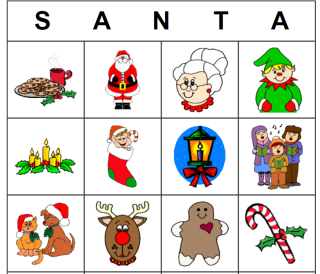
 Play Chritsmas Picture or word Bingo. There are many websites to go to and make your  own different set of bingo cards


Monday 8th December 
Time for some Christmas songs/ carols. Find a Christmas song you like, search for the lyrics and start singing with your students. My suggestion: Santa Claus is coming to town.
                              You better watch out

                                  You better not cry

                                          Better not pout

                                                   I’m telling you why

                                                               Santa Claus is coming to town


Tuesday 9th December 
Secret Santa time. Write all your students’ names and put them in a little bag. Then, ask each student to pull out a piece of paper. They must not reveal the name of the person that is on that piece of paper. Each student is that student’s secret Santa.This means they must buy or make a present for their classmate. I would suggest you make some sort of guidelines. You can either suggest students buy something but give them a price limit or that all students make something for their classmate. Allow your students at least a week to make or buy the presents. Once all the presents are bought or made, the Secret Santa needs to put the recipient’s name on the present ( also see December 19th).
Wednesday 10th December
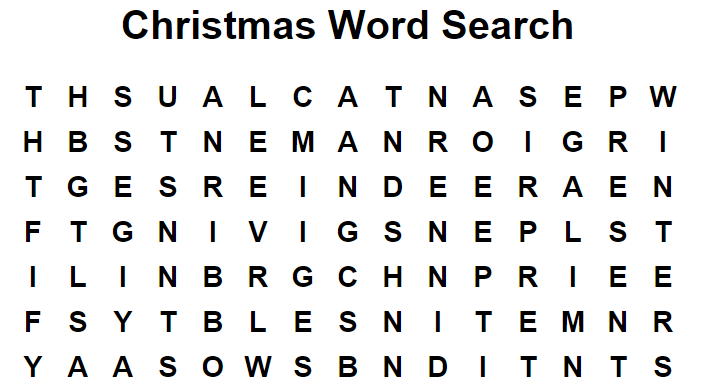
Christmas word search. Get your learners to look for and find words related to Christmas. Depending on their age, you can choose hard or easy word searches. You can even give them a time limit to make it even more challenging for them.


Thursday 11th December
Poster presentation Day/ Powerpoint presentation Day (also see Monday the 1st).
Friday 12th December
Time for some Christmas songs/ carols. Find a Christmas song you like, search for the lyrics and start singing with your students. Suggestion: Rudolph the red nosed reindeer
                    
                  Rudolph the Red-Nosed Reindeer (reindeer)

                            Had a very shiny nose (like a light bulb)

                              And if you ever saw it (saw it)
                                 You would even say it glows (like a flashlight)
                                       And all of the other reindeer (reindeer) 

Monday 15th December
Pin the nose on Rudolph. How do you play? Your students have to pin Rudolph’s red nose onto his face. If you want to make it more fun, you can blindfold your students and tell them to turn round in circles for a few seconds. Once they are twirling for 6 seconds they can then pin Rudolph’s red nose. 


Tuesday 16th December
Christmas word snake. How is this played? Each student takes turns to write a word connected to holiday season on the board. The final letter of student A’s word is the first letter of student B’s word.
                                      Christmas
                                                       Santa
                                                                 Angel
                                                                           Lantern                                            
                     
Wednesday 17th December
Holiday Season hangman. Time to play hangman with your students! The words again have to be related to the holiday season.
Thursday 18th December
How about watching a movie with your students? What you choose depends on their age and level.
Holiday season movie suggestions:
The Polar Express 
Home Alone
Frosty the Snowman
Miracle on 34th Street
The Muppet Christmas Carol
A Charlie Brown Christmas
It is a wonderful life
Friday 19th December
Secret Santa Day (also see December 9th).  The teacher has collected the presents and starts handing them out. The recipient student then guesses who bought/ made him the pressie. 
Any other teaching days:
Carols+ Party= Happy teacher+ Happy students

Keep in mind that you students get to practice their English whilst doing all of these activities. If you want to add ‘EFL’ twists to the activities, you could make the Christmas carol singing activities into gap filling tasks. You can also ask your students to use the bingo words in the email they send to Santa or make them write a summary after they watch the video. The Secret Santa can be the production stage of a lesson on hypothesising and the ginger bread man can help you teach vocabulary connected to body parts or clothes.What you choose to do with this ELT calendar is up to you!!! 

I hope you enjoyed this blog post. If you have any other suggestions, please add them in the comments section below so other teachers can read them!!!

You can download everything here
It is my favourite time of the year.docx
http://viewer.docstoc.com/
var docstoc_docid=’173140315′; var docstoc_title=’It is my favourite time of the year.docx’; var docstoc_urltitle=’It is my favourite time of the year.docx’;

 Dear reader, if you do any of the activities and have comments or pictures, please let me know. Some of my teacher friends have already shared pics of some of the activities on facebook and I will be making a post about them later on this month!! I would be really interested in seeing how these tasks went for you.

Till next time……….

Business English homework

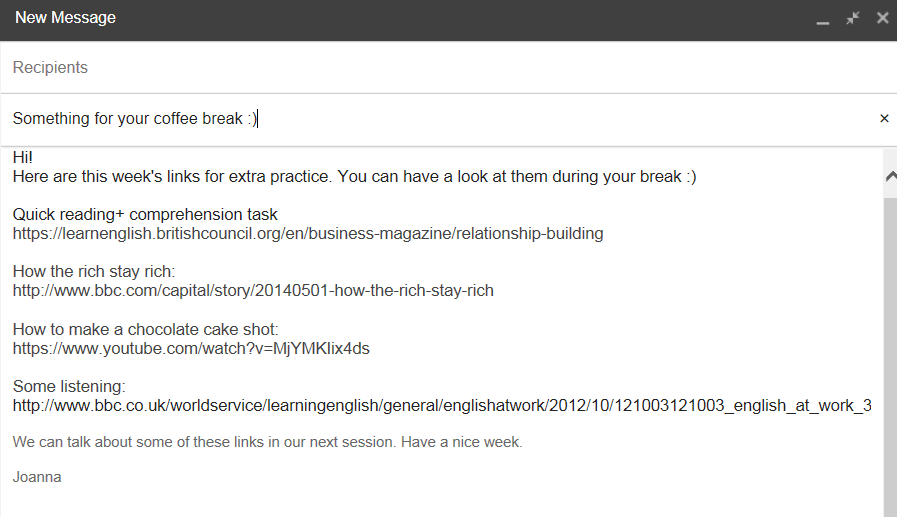
Something for your coffee break : )

I teach business English online and every week I send my learners an email. The subject line reads: something for your coffee break : ).
In this email, I send links to articles my BE students can read, short videos they can watch and quick listening tasks. I also send them links to websites with quick grammar or vocabulary building exercises (self-access links). I always choose tasks they can do quickly and articles they would be interested in. The links I send are varied and not always business English focused. I do this because they are already at work so maybe during their break they may want to read something non work-related. If my learners do the extra practice, we talk about it during our next session. If they don’t, it is OK. I avoid using the word homework in these mails because I do not want them to feel they have to do it and anyway, it is not homework… it is coffee break work : ). If something I have found, is something I really want to do with them, then I do it during the next lesson.
Why do I choose this type of work/extra practice? Well, my learners are adults who are almost always busy, and asking them to do loads of homework doesn’t really work (well, it hasn’t worked for me anyhow). That’s why I choose tasks that do not take more than 10 minutes to do. You may now ask, “Is that enough?” “No, it isn’t, but it is better than nothing.”
I send this email almost every week and my BE learners have given me positive feedback which is why I still send the coffee break practice email.

Where do I look for material?
Of course, there are loads of places. I am going to mention my go to places in this part of the post. Keep in mind that everything I mention is sent to them in an email, so they are links to websites.

  • Twitter/ Facebook

Type  #BusinessEnglish on Twitter and there you will find loads of ideas from other BE teachers. If you are not in any Business English Groups on Facebook, then I would suggested joining some because teachers are always sharing something there as well! So, some of the links I send to my students come from blog posts, websites other BE trainers use.

  • BBC capital

There are lots of articles to choose from. I also like the fact that there are articles that are accompanied by videos, so they can read and then watch something and that is great practice!

  • British council-Learn English

I go to two places 6 minute English (this has been archived and does not get updated any more but it is great for some quick listening tasks) and Business Magazine where you can find short articles followed by a quick reading comprehension task.

  • YouTube
You can find a lot of videos in the 6 -10 minute range and just send the learners the link to the video.
  • Grammar and vocabulary websites

Once again, there is a plethora of websites with free access to grammar and vocabulary exercises. I often send links from Grammar bank .This site is free and your students can do quick exercises online and see the answers straight away.

Final thoughts
If you are interested in BE English lesson material suggestions, have a look here. I hope you enjoyed this post. If you are in France in November (14-16), come to the TESOL France conference! My talk will be about teaching online (Business English).

Till next time…..