Exam prepapration for the teacher

The teacher tells all… the BIG B2 level exam
Tomorrow my students are taking their first big B2 language exam and I thought I’d write a post about how I prepare myself and them for the big day. My focus is not on exam prep per se, but on how I help them deal with emotions of stress and anxiety. Before moving on, it is important to mention that learners here (in Greece), take B2 level exams at a very young age (my students are 13-15) and this is their first official langauge test (ever!).

The day before
So, they know what they know, they are not going to learn something new the day before their test, so I never teach anything new on this day. I tell my students to come to my language school and we sit around a table and just talk about what we did and whatever else pops in their heads. It is more of a chit chat session! If the want to answer any test or langauge related questions, I answer them. We have some jouice or ice cream. They then almost always start to panic and I try to calm them down by saying, what every teacher would say, ” Everything will be fine. Don’t worry. You have done your best”. They talk about their fears and we just try to relax, make jokes and feel a bit better. I also give them my checklist.

Checklist? Say what?
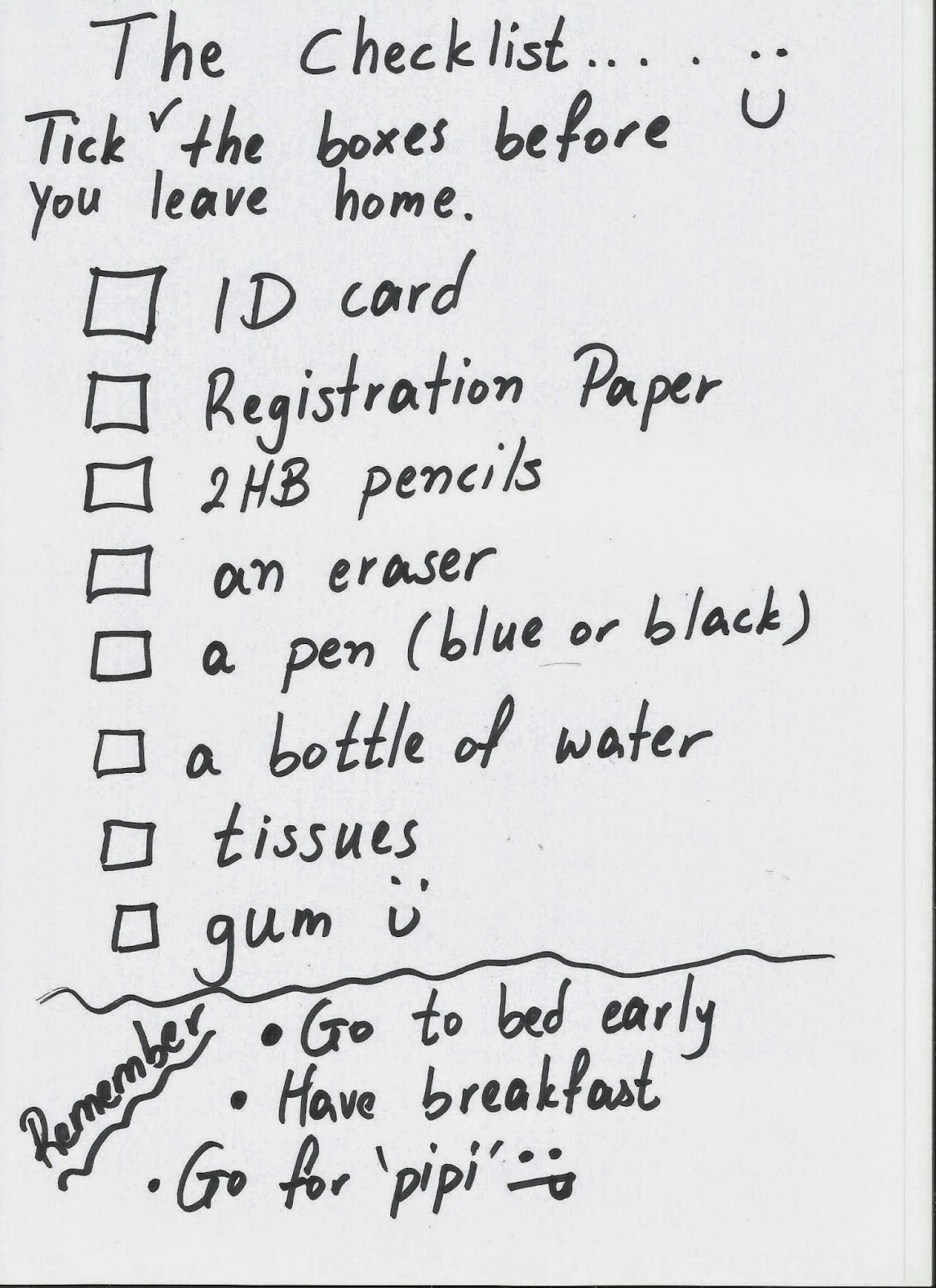
I make a big A4 handout with the things they need to bring and do on the day of the test. I tell them they need to tick everything and then come and meet me so we can go to the exam center together. I do not know about you guys, but over the years, I have had students losing papers, ID cards, not bringing pencils , the lots! So I now take my measures- the check list!
What’s in the checklist?

  • Bring your ID card.
  • Bring your registration card.
  • Bring a 2HB pencil.
  • Bring a c ouple of  black or blue pens.
  • Have a bottle of water and some tissue paper on you. 

I also add some tips (or orders :P) like:

  • go to bed early
  • don’t sit in front of your computer too long.
  • have a good breakfast before going to the exam center.
Exam day
I meet my students and we all go to the exam center. I try to make the conversation as least exam-oriented as possible, although there may be a few exam related questions which I do answer so that they feel at ease (I do discourage this though). I give them their final pep talk and then send them off. They spread their wings and I now I am free to stress and worry about them!
I worry about the weak student who has tried a lot, the good student who panics or is over confident and of course the relaxed one, the one who doesn’t review what he/she has written. I have been their teacher for so long and now this is their moment. I know that even if they fail to pass the test, it is not the end of the world. They will still have learnt English! In an exam oriented culture, where knowledge is proven very often by showing a certificate, this B2 level exam is a big deal for my students and me, their teacher. I try  to make it  as stress free as possible for them… and for me 🙂

Good luck to all! Learners and teachers 🙂

Till next time…..

    EAP resources

                                    My Top (online) EAP resources

    After writing my EAP course overview post, I thought to myself, “why not write about my go to EAP websites?” So, here are a few of the websites I use when I teach my English for academic purposes classes. If you have never taught EAP before, I think these links are a great starting point. If you have, still read this post cause you may find something you haven’t used (you can also add your own choices in the comments section).
    Spoiler alert: not all the websites are focused on academic English, I do mention how I use them in an eap-ish way, though. So, here goes!

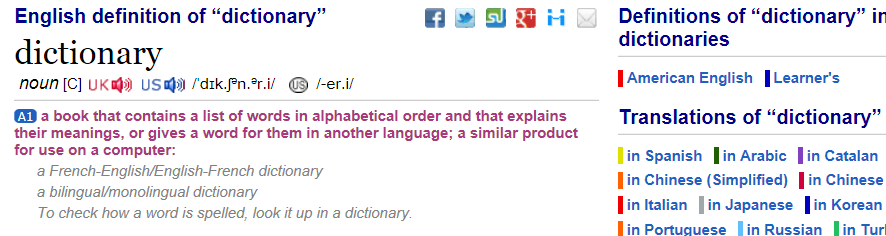
    • The Cambridge Online Dictionary
    It is an online dictionary of course! What I like about it is that you can press the little speaker buttons (on the webpage) and hear the AmE and BE pronunciation of the word you are looking for. 
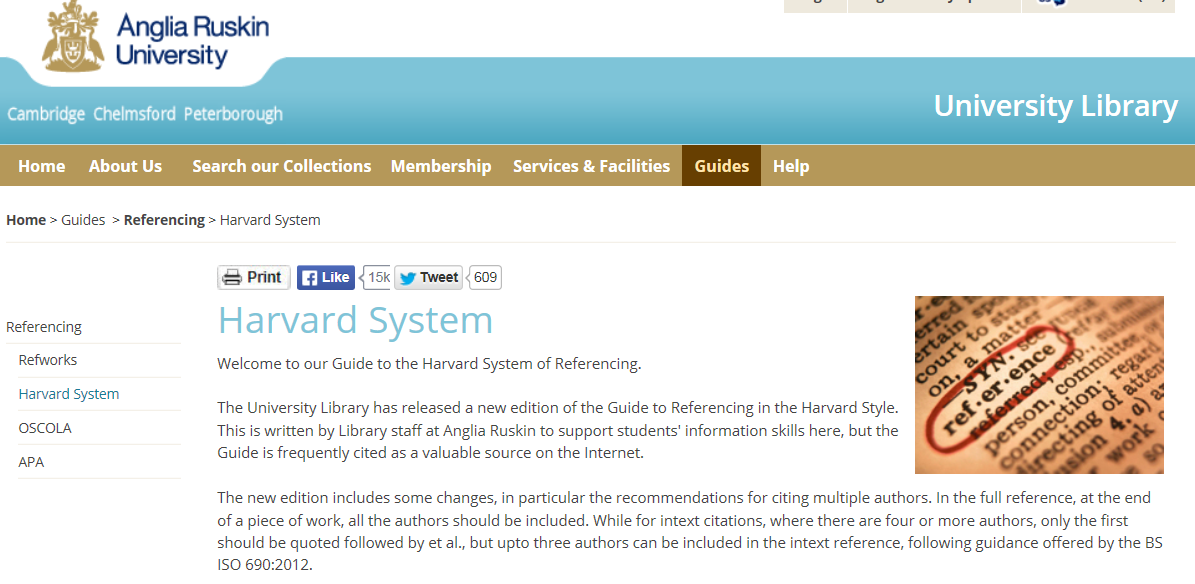
    • Anglia Ruskin University Library (Harvard referencing)
    I like this site because if the reference system you are using is the Harvard referencing system, then you can find clear examples and great guidance of in-text citations and how to write the reference list as well.
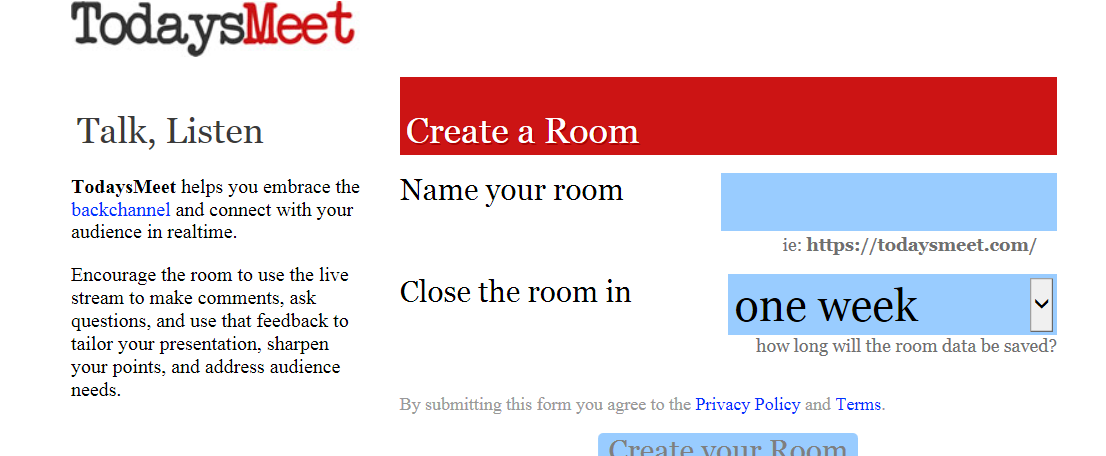
    • todaysmeet
    You can use this site to hold short discussions with your learners. Use it like a discussion board (especially when blackboard’s discussion board is down during the summer). It is similar to twitter as there is a characters limit. It is great for starting threads. Just go ahead and create a room and share the link with your students!
    • Ted talks/Ted-Ed
    There are many talks from subject specialists which you can watch in class with your students as part of a listening or presentations skills class. There are many videos to choose from. Two of my favourites: Jamie Oliver’s award talk on obesity and Amy Cuddy’s talk ” your body language shapes who you are”. You can also go to TED-Ed and create a lesson!
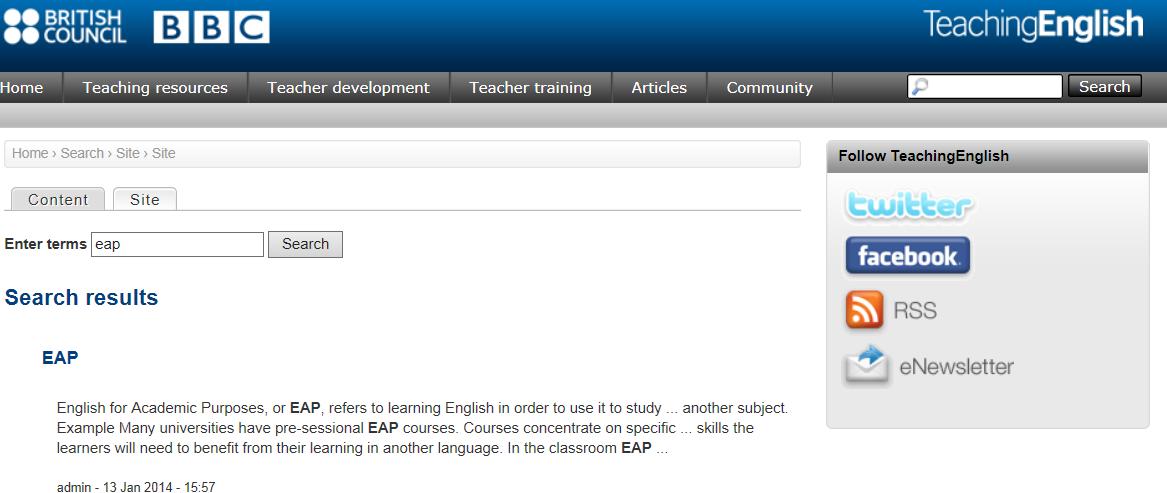
    • British Council BBC
    You have probably visited this site many times. Press EAP in the search tab and you will find many interesting links. You can get many ideas from this website about how to teach EAP, discussions about EAP and lesson ideas.
    • British Council-Learn English
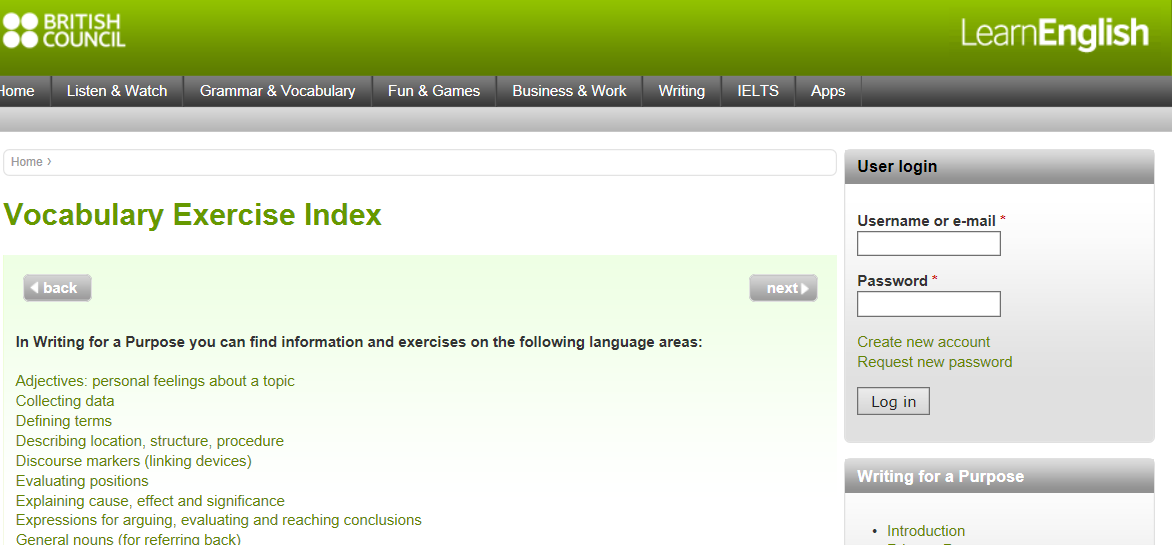
    Here you can find the Writing for a purpose resource with lots of information on how to write assignments, exercises and examples of assignments (there are many different types of genres to choose from so it is great no matter what field your students are in). There are lots of tabs to choose from, and the information is very clear for us teachers and for our students as well ( they can look at this at home or in class)! Very well organised and easy to click through and find what you are looking for.
    • turnitinuk
    This is the software you can use to check your students’ writing for plagiarism. You just need to create an account and submit the papers. After a while, you get the plagiarism results as well as the initial source of what was plagiarised. 
    So, if you have heard of the Academic Word List, then this is a go to website. You can find the AWL (a list of words that researchers have concluded appear very frequently in academic texts) here. There are also tabs that focus on all the skills. You can either do some of the tasks with your students if you print them out or you can send them to this site as part of a self study task. Tell your students to press the materials tab and get down to work : ).
    This is where you students can upload their presentation and record themselves speaking while changing their own PowerPoint slides. They then send the presentation to your email account and you can listen to them talk whilst also looking at their PPT. You need to press the home tab, sign up for free and then you start. Registering can be quite tricky but do try it out. My students loved using it.
    • Academic writing-Routledge website
    If you have taught academic writing, you probably know Academic Writing: A Handbook for International students by Stephen Bailey. I often use material from this book especially for my lower level students. This book has a webpage and on this website you can find the answer key to the exercises of this book. There are also tabs with extra material, quizzes etc. Have a look at the plagiarism quiz tab!
    • Dvolver moviemaker
    Your learners can create movies and send them to you. You may wonder what the connection to EAP is, though. Well, I use this as part of my seminar skills class. Very frequently, I suggest/teach expressions my students can use when holding discussions, negotiating etc. I then tell them to send me little movies with these expressions in them. So, apart from practicing during a speaking task in class, they also get to write them down and make their own dialogues whilst having fun!
    • One Stop English
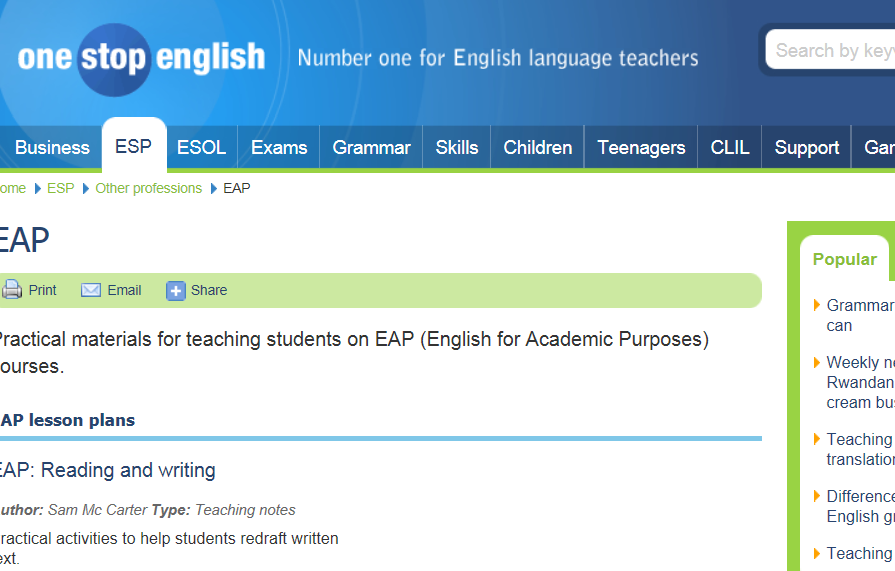
    You all probably know this website! There is an ESP tab and lots of material, some free, others you have to sign in for. Teaching tip: find the pdf file adopt Ivan. It is a great file to use when teaching seminar skills!
    I hope you enjoyed this post. I know that there are many websites out there that you can use. I will be back with more suggestions in the near future. I look forward to reading any of your suggestions!: D
    Till next time

    EAP course

    EAP courses: a short overview for the newbie : D

    A couple of teacher friends who will be teaching EAP (English for academic purposes) have been asking me questions about what to expect and what it is like. Well, first of all, for me, EAP courses are fantastic (I have taught on 3 pre sessional courses and am going to Sheffield Uni this year for my fourth course, yay!) and a chance to go from my everyday General English classes to something different and challenging. Yes, it will be challengeing but don’t worry you can do it!
     So, for all you newbie EAP tutors congrats on the new job, this one is for you!This post is a very brief but quite a concise descrioption of what to expect when teaching an EAP course for the first time.

    What will I be teaching?
    Syllabus of course may differ, from course to course, due to duration, learners’ English level and many other factors but at core they are the same. Here is a brief description of what you will be teaching:

    • Academic writing

    Forget about the Ielts academic writing you have been teaching so far. Now, you will be helping your learners write research papers, assignments. You need to train them to use strategies like paraphrasing, summarizing information, synthesizing information and many others. They learn what a thesis statement is, a map, how to show their view in a research paper as well as how to support their main argument with other arguments. You also have to help them avoid plagiarism because there is almost next to zero tolerance of plagiarism!

    • Academic Listening

    Your learners will be attending lectures so part of academic listening is to prepare your learners for that.  Your learners will attend, listen or watch a lecture. Your role is to ensure your learners make use of the strategies that will help them identify what information is important, and what  is not. You will probably have to devote some time on teaching them how to take notes. May I suggest brushing up your knowledge on Cornell notes?

    • Academic Reading

    Here you will practice reading with your learners and engage in tasks that help them recognise the rhetorical functions so as to understand a text, skim, scan, understand the main and supporting ideas and guess the meaning of unknown words etc. so that they are able to understand complex academic texts, journals and books that are relevant to their studies.

    • Presentation Skills

    In your presentation skills classes you will be giving guidance related to how to give a presentation. You will teach them what to include in a presentation (usually PowerPoint) and what not to include. You will give advice on the appearance of their PPT slides and their delivery of a presentation. You will also practice Q & A segments so they are prepared to answer any questions that come their way and are relevant to their chosen topic.

    • Seminar skills
    Your students need to be able to express their views on issues related to their subject skills in study groups and in their classes. They need to hold discussions with their peers, negotiate, come to mutual decisions, argue their views and so on. This is what you will be doing in this class. You will equip your learners with the speaking micro skills that will enable them to do so.
    • Assessment?
    This depends on the EAP course you are teaching. You will definitely be assessing in one way or another your learners so be prepared for a heavy workload : )

    What about technology?
    The university you will be teaching at will probably have smart boards and computers everywhere. You will also probably have to use MOODLE or Blackboard as a learners’ management system. I have never used MOODLE so I cannot talk about that, but as far as Blackboard is concerned, it is easy to use. You can share things with your colleagues and students. You can use it to email, use discussion boards, get your learners to submit research papers etc.

    Buzz terms you may need to read up on

    • critical thinking
    • autonomous learning
    • peer evaluation/feedback
    • plagiarism

      Feel free to add whatever you feel is missing. I have also written a post about top resources when teaching EAP so have a look here.
      Till next time

      Learner autonomy?!?

                             The Mama bear teacher

      For a couple of days now I have been wondering about my dedication to the job regarding how much I, should I say facilitate (?), my students’ learning. I have come to terms with the fact that, yes, I am a spoon feeder (not in the evil spoon feeder way though, don’t get me wrong). I often consider myself a mama bear teacher who in an attempt to help my learners, ends up making them over reliant! I am talking about simple things, things they should be doing on their own but in the end, I am the one doing these things for them. Where is the line between helping your learners and nipping learner autonomy in the bud?
      Here is my list of sins. If you find yourself ticking the same boxes as me, join the club fellow mama bear teacher!

      •   My students (young or older) continually come to class without pencils, erasers, notebooks. My solution: I go buy pencils, notebooks and erasers and give them to them.
      • I schedule extra lessons with my learners. I tell them 100 times. I even ask them CCQs (: P) but what do I do in the end? I text message them a reminder a few minutes before the session.
      •   My EAP students have difficulty finding sources for their research projects. My normal teaching method: Show them how to search the Uni library/show them how to search Google scholar, muse etc. My learners are still frustrated (?!) My solution: I look for books myself, in my own time, and give them some titles.
      •   My Business English students: I suggest reading an article and talking about it together. “Time to talk about your interests”, I say. ” Read something you like and send it to me” But only rarely do they send me something. My solution: I ask them,” what are you interested in?” They tell me. I find the articles and send them to them.
      •   Project time for my young learners. They have decided on what they want to write about. They write it. They bring it to class. Sometimes their work is incomplete though. They haven’t found pictures to accompany their texts. My solution:  I find the pictures for them.              
      Am I actually helping my learners or am I cutting their wings, making them over reliant? Is this part of the job or have I turned into a control freak teacher? If you ask me, it is part of the job. But is it?When does caring turn to overbearing?
      I love my job. Sometimes I think I even do it well, but I do wonder, “When do I draw a line and let my students be? Am I supposed to be a mama bear teacher?”
      Tell me what you think!
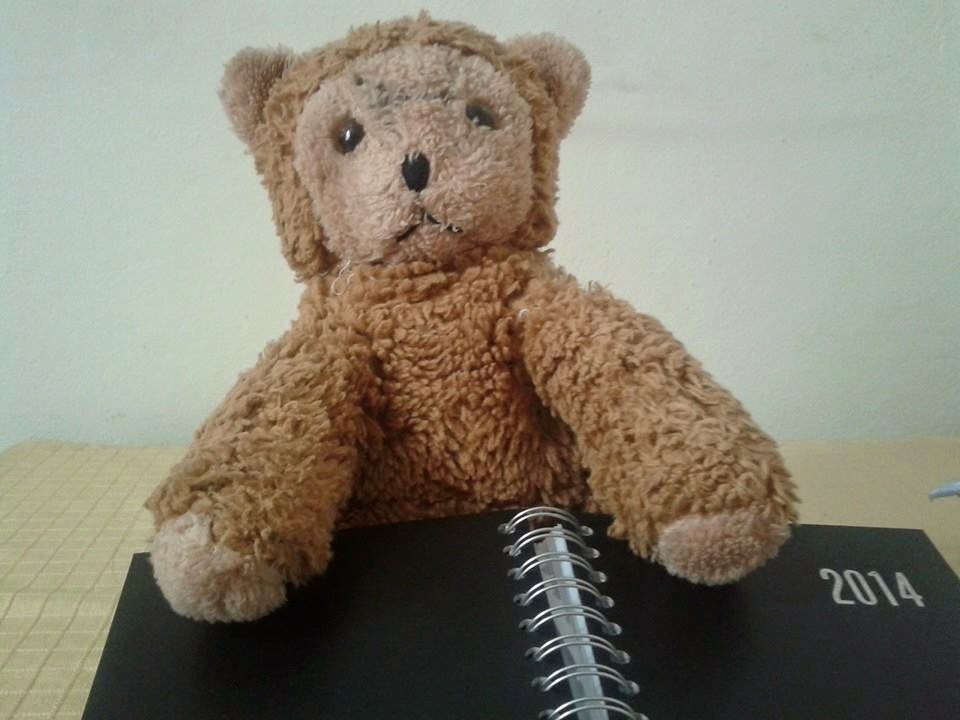
      Self made pic. Meet the mama bear teacher.
      Till next time…….
                                     

      My first MOOC

      The MOOC that went wrong: confessions of a learner.

      So, here I am going on and on about the advantages of online teaching and then came the slap in the face. This is a story about an online teacher who became an online learner and failed. Anyway, let’s take things from the beginning.
      During the Easter break a friend of mine, Lia,  sent me a link for a free online teacher development course, a MOOC. Now, before moving on, I will tell you what MOOC stands for. It is a Massive Open Online Course. So, as an online teacher, I thought to myself, “Hey, what a great opportunity! I am in.”
      In fact, attending a MOOC, in my mind, at that point, was the best option for me for many reasons.

      Reasons why the MOOC was a great choice:

      • I could study from home.
      • I could study whenever I wanted to.
      • There were deadlines so I did have time limitations.
      • There was a learner management system (LMS). I got to introduce myself and meet other students attending the same course as me. I got to make a profile, so it was not anonymous.
      • There was a discussion board with loads of Q & A threads and people asked and answered questions. The tutors also contributed to these threads so there was a lot of interaction.
      • There was an abundance of material available at the just the click of a button. No need to search for anything. I could also access further reading material if I was really interested in what I read.
      • There were videos related to the theme of the week. Follow up questions related to these videos were also there.
      • I could take a pre-knowledge test and see what I already knew about the material covered each week and if I had unknown terms the definitions were available immediately.
      • I would get a certificate of attendance and it would have looked great on my CV.
      In fact, this MOOC had all the ingredients that were necessary to make it the perfect MOOC. The perfect (?) online course. Yet, I failed to complete it. I dropped out. Why?
      Upon reflection, I think:
      • I was not motivated enough. The course was not on something completely new or something I needed to learn more about. It was not really connected to my needs as a learner.
      • I started it during my holidays. Bad, bad, bad idea! Holidays mean free time, time to relax and recharge your batteries. As a teacher who works all day long, I needed my free time and I had not acknowledged how tired I was. I seem to totally shut down when I actually find some free time.
      • I have realised that in order to attend distance courses, I also need some sort of face to face interaction with other learners and my tutors. I do not have to meet them in person, but some Skype time, some real time interaction, is necessary for me. It gives me the opportunity to express my concerns, my thoughts on whatever I am learning. I do not feel cut off.
      As someone who teaches online, experiences the benefits of an online course and who knows the prerequisites of what makes a successful online course, I have not given up on the idea of MOOCs. I need to become a better online learner though!
      I am really interested in seeing what you think about MOOCs so please feel free to share your thoughts in the comments section below.
      Picture taken from: http://en.wikipedia.org/wiki/Personal_computer

      Till next time…

      Writing Feedback Idea

      What does your essay feedback look like?

      I was correcting my student’s essay the other day and started writing my feedback for her essay, and then I thought to myself, “Will she read all this? Will she benefit from it?” So, I racked my brain a bit and then came up with a brilliant idea! Feedback Q & A for my student. Have I grabbed your attention yet, fellow teacher? Great! Now, read on. So, let’s take things from the beginning.

      Background information
      The learner: My student is a C2 level learner who has been learning English for approximately 7 years now. She will be sitting for C2 level certificate exams at the end of the year. She is a studious learner. She had to write an essay about the advantages and disadvantages of using the internet.
      The teacher’s feedback track record: Although my feedback style varies, often when I comment on my students’ essays I : 
      • Circle/mark/correct things on the essay.
      • Follow up with feedback comments where I rewrite/ correct some of the mistakes/ give grammar comments/talk about organisation-content and so on.
      • I follow the sandwich method (strength-weakness-strength OR you did this-you didn’t do this-you need to do this).
      • I use the learner’s L1 when my student is a bit weak and when I see L1/L2 transfer errors.
      • I do not comment about every single mistake in the essay.
      • I try to make my feedback page one page long (A4).
      • I do not squash everything up. I like space!
      • I use bullet points not numbers.
      • I use smiley faces : ) and sad faces : ( (sometimes there are even tears!).
      • My comments are handwritten. The good old-fashioned way.
      • I never use a red pen!
      Why do I do this?
       Well, I have been correcting essays like this for many many years so, it is only natural for me to write my feedback page! I feel like I haven’t corrected an essay if I do not state their mistakes/ strengths clearly or if I do not make suggestions on what they could have written.
        
      My students’ opinion of my (lengthy) feedback:
      Some learners read it and like it. They learn from their mistakes. I often tell them to go over the feedback from all the essays they have written to check if any of their mistakes reoccur. Others don’t bother reading it. They just take their notebook and chuck it in their bag. The latter for me, as a teacher, is demotivating. I then think of all the students who do read and do learn from my comments, so I keep writing my feedback comments page.

      What did I do differently this time?

      Feedback Q & A?

      As I said earlier,I get discouraged when my students do not bother to read what I have written and I also want to check to see if they have learnt something from what I wrote. I also want to see if they can reflect on what they have written. So, I thought, ” Hey! What if I ask them questions about the feedback? Something like a feedback questionnaire? ” and I did. I made a feedback quiz/drill/reflection page!See picture.OK, so it ain’t the best thing you have ever seen but it is a start and I do think it will benefit my learners.

      What did my learner think?

      She said that she liked the idea (implication: would she have told me if she didn’t? Hopefully, yes). My questions were focused on the mistakes she had made in her writing task. She also had an opportunity to amend some of her errors. She got extra practice on some of the things she got wrong in her essay. I asked her a question about the strengths of her essay. She found pinpointing them quite hard. I was expecting the latter because upon reflect, I do not know about you guys, but whilst I write down the positive points of my students’ essays, I do not often ask them to tell me what they think is good about their essay.

      Why should a teacher try this?
      Well, if nothing else, you ensure that your learner actually looks at the written feedback you have given him. They notice their mistakes! Your learner, depending on the questions/tasks you put on this Q&A form will get a chance to correct any mistakes/ make new sentences with the language he got wrong and so on. It is also a great opportunity for him to reflect not only on his strengths but also the weaknesses.
      BUT…. and there is always a but….
      this is VERY time consuming for you and the class. I would not make a little feedback Q&A page for every single piece of writing my students give me but I would do it from time to time because it does help my learners. I think I would be more eclectic as to when I make these feedback Q&A pages and branch them out to different genres so that my learners can look closely at different types of texts.

      You can do this with any writing class and with all learners, so try it out. Will your students’ writing be impeccable? Maybe not. Improved? Yeap!

      Downloadable writing feedback Q & A idea. Step by step

      Feedback Q.docx
      http://viewer.docstoc.com/ var docstoc_docid=”171634780″;var docstoc_title=”Feedback Q.docx”;var docstoc_urltitle=”Feedback Q.docx”;

      I really enjoyed this blog post. I hope you did too. Feel free to comment below. I am interested in seeing if you do this in your writing classes and how effective you think it is.
        A few days later… note to the reader… This post was shortlisted for this month’s (June) Teaching English blog post award, so if you like it, go to the Teaching English via the British Council Facebook page, scroll down to where it says this blog post has been shortlisted and press ‘like’. Either way, thanks so much for reading : ) and thanks to the Teaching English Facebook page for shortlisting this post : D
      Till next time…..

      Ideas on where to look for material when teaching BE online

      Ideas for material for my BE classes…. my favourite stuff : D

      I teach business English online for some time now, so I thought it was about time I wrote a blog post about where I look for my material. These suggestions are geared towards boosting the speaking skill. I will not talk about material available in print, my focus is on material I access online. The websites that I use are open and offer their material for free. I am not going to give you any lesson plans but I do have some VERY simple warmer tasks/ideas and some ideas for follow up activities.
      One of the benefits of teaching online is that it is easy to go from one page to another as you can send different links to your learner based on his needs and by just pressing a button! So, here goes! I hope you enjoy going from one website to the other!

      Material for open/conversational sessions

      Very often I have lessons that are more laid back and engage my students in conversations about their interests or kinda work-related issues. Since my learners are attending business English sessions, I do try to use material that is more business English friendly. So, where do I go to look for articles and what are some of my favorite articles?
                                Articles/reading material
      I think the language is easy to understand and I like the business tab. Some of my favourite articles from here: 
      Change offices from sitting to standing: http://www.bbc.com/news/magazine-26937454
      Warm up questions: What do you think about standing up while working instead of sitting down? Do you have stand up desks in your office? What are the benefits of having them in your office?
      Follow up task: Send a memo to your colleagues informing them that your company has decided to order stand up desks. Mention why the company has reached this decision (use information from the article) and briefly describe the stand up desks.
      Nap pods at work: http://www.bbc.com/capital/story/20140108-daydream-believers
      Warm up questions: What kind of facilities would you like your company to offer its employees in terms of well-being? What do you think a nap pod is?
      Jobs for smart but lazy people (this one causes quite a stir). http://www.bbc.com/capital/story/20140228-jobs-for-the-smart-but-lazy
      Warmer; Start with this quote which appears at the end of the article.
       “I will always choose a lazy person to do a difficult job, because he will find an easy way to do it’.”
      The Guardian:
      Top ten satisfying jobs: http://www.theguardian.com/commentisfree/2014/mar/21/top-10-most-satisfying-jobs
      Warmer: Get your learners to list the top three most satisfying jobs/top three factors that make a job satisfying. If you are having a one to one session, get your learner to make this list and you, the teacher, make one too. Once the lists are ready, have a short debate about satisfying jobs and what makes a job a good one or not. Then read the article and… do whatever you want to with what’s in it : ).
      Work from home: http://www.theguardian.com/small-business-network/2014/apr/24/how-to-lead-workforce-works-from-home
      Warmer: Tell your learner he is the manager of a company that has decided to get its workers to work from home. How would he/she set this up? What are some of the difficulties and what are the benefits of such an idea?
      Follow up: get your learner to make a PPT presentation introducing the idea of working from home and the steps that need to be taken for this to work.
      Speaking about non job related issues
      Good spinoff for book conversations:
      http://en.wikipedia.org/wiki/List_of_best-selling_books
      Even if you do not want to use this with your learners, do have a look at the top 5. Have you read them?
      and something about health and well being:
      I like this article because it gives ten tips on how to boost your metabolisms and you can get your learners to summarise the paragraphs into bullet points whilst also telling you if they follow these tips or not.
      Of course,there are loads of other websites where you can find interesting articles like Forbes, The Wall Street Journal and so on, but most of the time I use the Guardian and the BBC. There is also a cool (am I allowed to say cool, now that I am writing a materials blog post?!? Sure!) site called newsmap http://newsmap.jp/. This site is updated regularly and you can send your learners the link and then a big collage of news from around the world appears and they can choose the article they want to read.
                                                                                                            Screen shot of newsmap

                                             Videos

      Everybody knows Youtube of course. this is the place to go to for free videos. One of my favourites is this documentary. It is one hour long, so I suggest you tell your learners to watch it as homework (WHAT? Homework?). The video is quite surprising for my German and French learners and it does generate a lot of discussion about internships, inequality in education etc. It is also a great way to start a discussion about different cultures and the job scene. I have prepared a simple lesson plan for this video (I will upload it in a blog post in the near future …… hopefully).
      Who gets the best job? http://www.youtube.com/watch?v=6bD7U8kqI8A

      Another website with loads of videos which can be used with your BE students is The Australia Network http://australianetwork.com/businessenglish/ . You need some time cause there are many videos connected to conducting meetings, business socials/small talk etc. Click the tab The Business of English and watch the videos with your learners.

      That’s all for now. I do know that there are loads of articles/videos you can use with your learners but I wanted to share the ones I use. Apologies if the links do not work where you are but hopefully by knowing where I got the article from and what it is a bout you will be able to find it… or not!

      Till next time…..

      The perks of being an online teacher

         
      http://en.wikipedia.org/wiki/File:Sunflowers.jpg

      The perks of being an online teacher

      If you have read my posts before, you will probably know that I teach Business English online for some time now, and I am really enjoying it which is why I got the idea to write about some of the advantages of teaching online. Before I move on to talk about the advantages of being an online teacher, I will tell you what I mean by online teaching. When I teach online, I use the Internet of course. My virtual classroom is in Adobe connect. There is a white board which is also the area where I can upload files and share the lesson material, a chat box section and an area for the web cam. There are other pods in Adobe connect but I do not use them. Sometimes, I  also use a land line or Skype when Adobe is acting out and the sound is all over the place.
      So, after this brief but succinct definition, let’s get down to business. First of all, you may ask me, ” Is it better than teaching face to face?” My answer is, “Of course not!” But there are some perks, some are serious… others a bit more humorous…” and here goes!

      Perk No.1
      I have students from all over the world which is probably the thing I like most about online teaching! One minute I am in Stuttgart, the next Paris. I see how my students view things and how their educational background blends into my teaching practice and choice of techniques. The classroom is not my limit, my internet connection is!

      Perk No.2
      To all you weather freak teachers, at last a chance to talk about the weather with not one, but ALL your students. When teaching online, you get real life weather descriptions from all over the world. I often ask….. “So, how is the weather over there?” I always smile after asking this question, cause of course, my weather , here in Crete, is much better than theirs : P.

      Perk No.3
      It is green teaching (kinda…). Paper free to the core. I use no books, no handouts, nada. Just my computer screen.

      Perk No.4
      I save money on transportation, snacks and coffee. I am at home. I make everything myself. On the plus side, it literally takes me one minute to get to work : D.

      Perk No.5
      When my students are late, I do not have to sit around doing nothing. I go to my kitchen make some coffee,  tidy up my room….the lots!I can do whatever I want whilst waiting for the late comer.

      Perk No.6
      I have access to material with the click of a button. I do not have to go through different folders of handouts, books, magzines etc. I just send my learner a link and he has the material I want to share. I can also change my material very quickly if my learner is not in the mood for what I have planned. I once had a learner who said to me, “Joanna, I am tired. I have had so many meetings today. I do not feel like doing a grammar lesson. Let’s do something else.” We did. I sent her some links to interesting articles and we had a great conversational session.

      Perk No.7
      I can record my lessons (remember: you should get the permission for this!). My learners can listen to the lesson again if they are uncertain about something . They can also see how they have improved over time (my learners actually DO do this). It is a great way for me to reflect on my lessons. I get to listen to my weaknesses and my strengths.

      Perk No.8
      It tests and challenges my time management skills. The tech problems always interfere with my time management. Online teaching has challenged me in relation to the time I spend on tasks. I have to be time effective!

      Perk No. 9
      I think that online teaching is becoming a practical solution for learners who are very busy and we, as teachers, need to keep up with the changes. Technology is everywhere and now it is becoming a way to deliver lessons.

      Perk No.10
      It is easier to coordinate the use of video, music, the net in my lessons. I no longer need a computer, a cd player, books and a TV. I only need my computer.

      Perk No.11
      I get to wear my pyjama bottom. What else can a teacher ask for, people?

      (November, 2014) New entries……

      Perk No. 12
      I am hip, a tech savvy teacher and it looks great on the CV.

      Perk No. 13
      You sound cool when you describe your job to other people. No one can get their head around using a computer to teach and everyone asks, ” So, what about a board?”

      Perk No. 14
      Your time zone is NOT your limit. If you want to teach at 12 o’clock at night, you can. It is day time somewhere else in the world!

      Perk No. 15
      It is a teaching context that has not been researched enough, so if you are into the whole publishing (academic research etc) scene, well, maybe you should look into online teaching.


                                 Picture taken from: http://flowers.babaklix.com/flowers-garden-seeds/

      Till next time…..

      Wacky teaching ideas

      Wacky ideas: Success stories and flops!

      As  teacher, I very often try to keep my students interested in the lessons by trying out weird but lovely ideas. The thing is that sometimes the weird ideas that pop into my head, turn out to be a great lesson but other times, well, they turn out to be a flop : p.

      Wacky idea No.1
      I had started teaching in the public sector. I had been assigned to a primary school in a village. My students were a group of ten 8 year olds so I thought,” What can I do to keep them interested? Love English?” I decided I would play a song. “Heads, shoulders, knees and toes” was the song I chose. I got them to repeat the body parts, they also showed me where their head, their shoulders etc were and then I played the song. We did the song’s moves and everything was going smoothly. They loved it. So, I had the brilliant idea to play it again. They were having a great time, weren’t they? I said to my students, ” Ok, since we all had fun, let’s do it again!” Then an eight year old boy stands up and in a heavy Cretan accent says,” No, we don’t want to do this again! Now, we want to do tsalimakia!Sirto!” and he started dancing and clapping. It took me ages to get him to stop dancing and go back to his seat and back to business. For all my non Greek readers, please press the link to see what he started dancing. Pay attention to the lead dancer and imagine a 8 year old trying this!

      https://www.youtube.com/watch?v=zACulAjHPwI

      Wacky idea No.2
      Authentic materials,,, I love using them. Back in the days, when MP3s were non existent (I know, I am quite old) I decided it was about time I used songs my students liked, in class. I asked them to bring in their favourite songs. We were going to do some listening based on the songs they chose. I ended up with ten CDs, bits of papers with scribbles on them and a big headache! I did not know where to begin?!? I had no track number, no song titles and no, no , no! I ended up (I am ashamed to admit this) losing some of the bits of paper and I never realized this oh, so brilliant idea. Next time round, I need to plan this better. Get them to bring in the single on their MP3 players, know the artist’s name and the title of the song. Then, I make a big file with everything and do some cool listening activities with music.

      Wacky idea No.3
      Adult learners and haribo gummy bears…. is that a Do or a Don’t?After being on the 7th week of an intensive pre sessional EAP course, and in the middle of drafting and redrafting a research paper, my students started to be a bit less motivated. They were mostly sleep deprived and without much energy (if you have taught on these courses, you will know what I am talking about).  Before I move on, I should let you know that during EAP courses I do tend to walk around with Haribo gummy bears  in my bag just to get a boost. So one day I said, ” I know you are all tired, but let’s do this, and then I will give you some Haribos” Most of my students were from China and did not know what a Haribo gummy bear was so that kinda added some extra incentive. Once we had finished, I passed around the bag of Haribo and they munched away happily. The next day, we were going through the material as normal, and then one of my students goes, ” So Joanna… no candy today?” I ended up being one of Haribo’s best customers in those final weeks.

                                              Picture credits: http://et.wikipedia.org/wiki/Pilt:Packets_of_haribo.JPG

      Wacky idea No.4 
      Story telling and adult Business English students. Normally, when you teach business English students, your lessons have do with negotiating, email writing, telephoning and so on. I thought that when business people socialise, they do tend to talk about their lives and even tell stories.This gave me the green light to do a story telling lesson with some of my learners. I think that it is a good idea when your adult learner likes role playing, likes telling stories or is doing something that is creative. If they are not in any of the categories I described, then this can turn into a disaster especially when your learner does not want to use their imagination and is always asking you “So is this right? Am I close to the story?” ” So, the father was sick? “

      Wacky Idea No. 5
      It is carnival season. Wherever you look there is a mask, feathers, a costume! I always wear something festive and try to be in the carnival mood and every single year I say, ” Never again!” Seriously! Why do I do this? This year, I had the brilliant idea of wearing big tinted glasses and a hat with pom poms hanging off it. It is so hard to teach in those. So, yes, my lesson was planned, my materials were ready, we were going to talk about costumes and carnival. The only thing I had not included in the anticipated problems section of my lesson plan was flying pom poms. So, of course my lesson was more on the “Haha! Miss you look funny” side and not that much about grammar and vocabulary. Lesson to be learnt. ….next time I want to dress up… I won’t!

      Picture taken from: http://www.iidudu.com/chic-crafty-pom-poms-for-party-and-home-decorating/cute-diy-pom-poms-with-striking-colors-for-cheerful-decoration/

      Final thoughts
      I like trying out new things. I think that sometimes I get caught up in the enthusiasm of something new, and my planning skills go down the drain. Some of my best lessons have been a result of trying out something new, something out of the ordinary. So, go ahead, plan a nutty lesson (emphasis on plan).

      I enjoyed writing this post and I hope you liked reading it. Please do share some of the unusual stuff you have tried out in class. I would really like to hear some of your stories.

      Till next time….

      The poster presentation

         End of the year event for my young learners

                           The poster presentation project

      So, it is that time of year again. The end of the academic year is right around the corner and you may be thinking, “what can I do at the end of the year with my students?” How about holding a poster presentation event?
      I did this with my students two years ago and they loved it.
      What is a poster presentation?
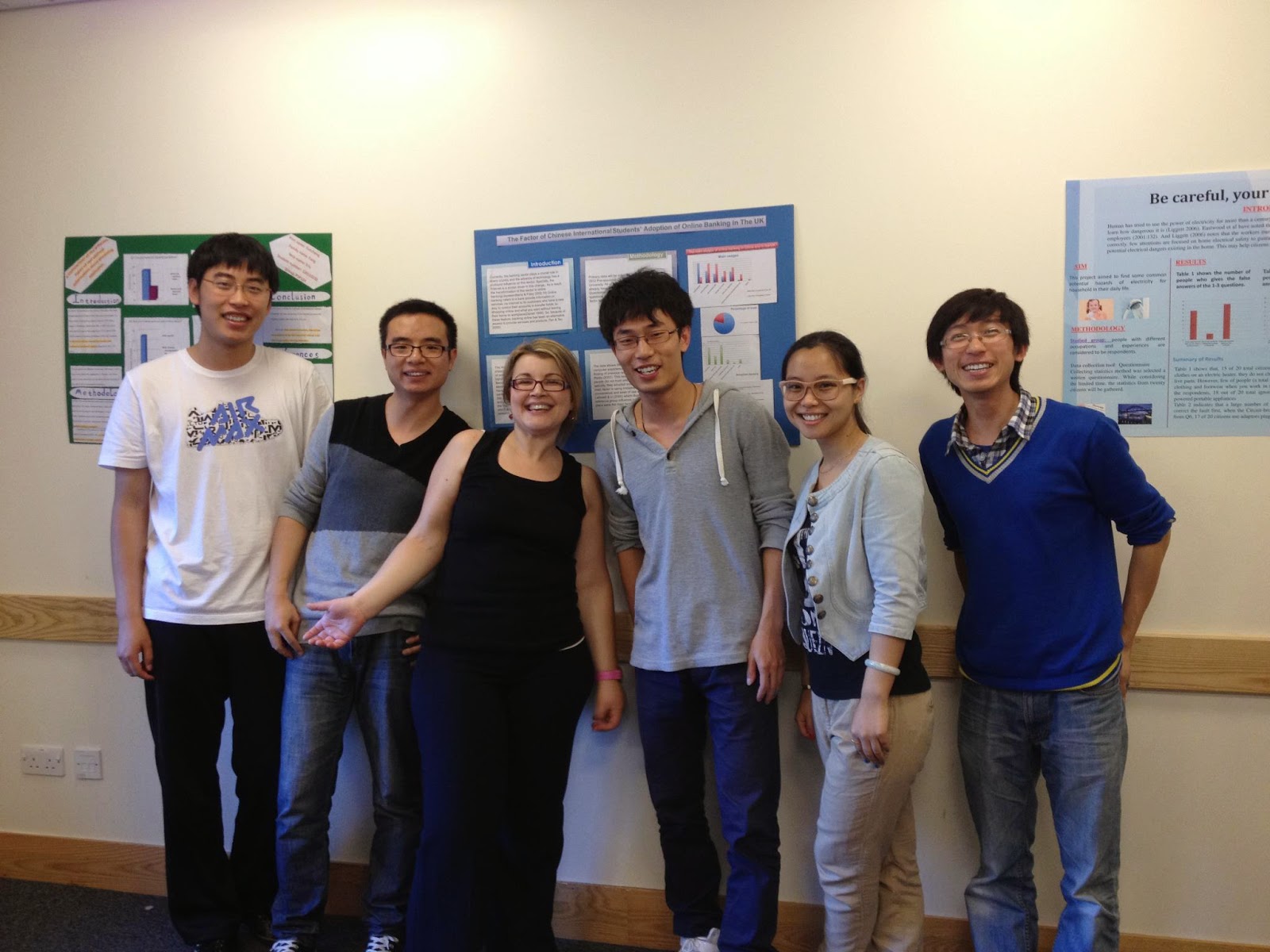
      If you have been to a conference or taught on a pre sessional English course, you probably know what it is, but for those who haven’t, a poster presentation is when somebody makes a poster and then talks about it. I first attended a poster presentation when I was working at Newcastle University as a pre sessional EAP tutor. My postgraduate students had to make a project based on an idea related to their research project, they then presented their projects to their classmates, and finally answered questions related to their posters/projects.
      Making the poster presentation suitable for my young learners.
      After seeing how this works in the EAP context, I thought, “Why not try it with my younger learners?” and I did!Here is what happened!
      STEPS before the end of the year poster presentation event.
      1.Each class chose a theme. My students chose to write projects with the following titles:
      • the things I like
      • music
      • chocolate
      • space
      • the sea world
      • the hip hop culture
      2. After choosing a group theme, my students had to find pictures and information about something related to their theme. For example, in the sea world project, each student had to find information related to a sea animal.
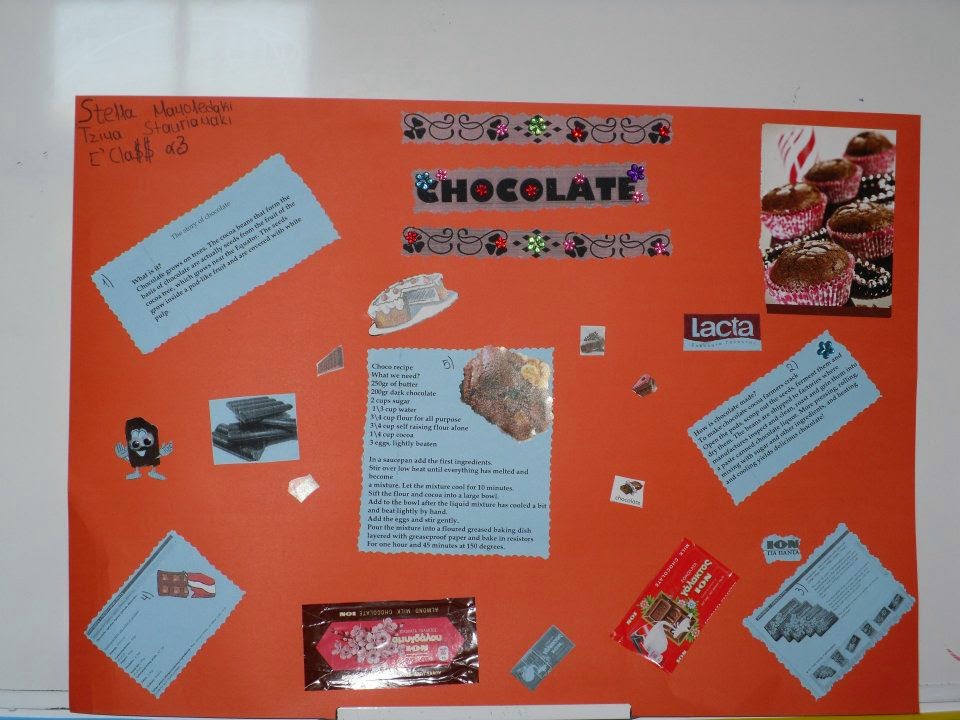
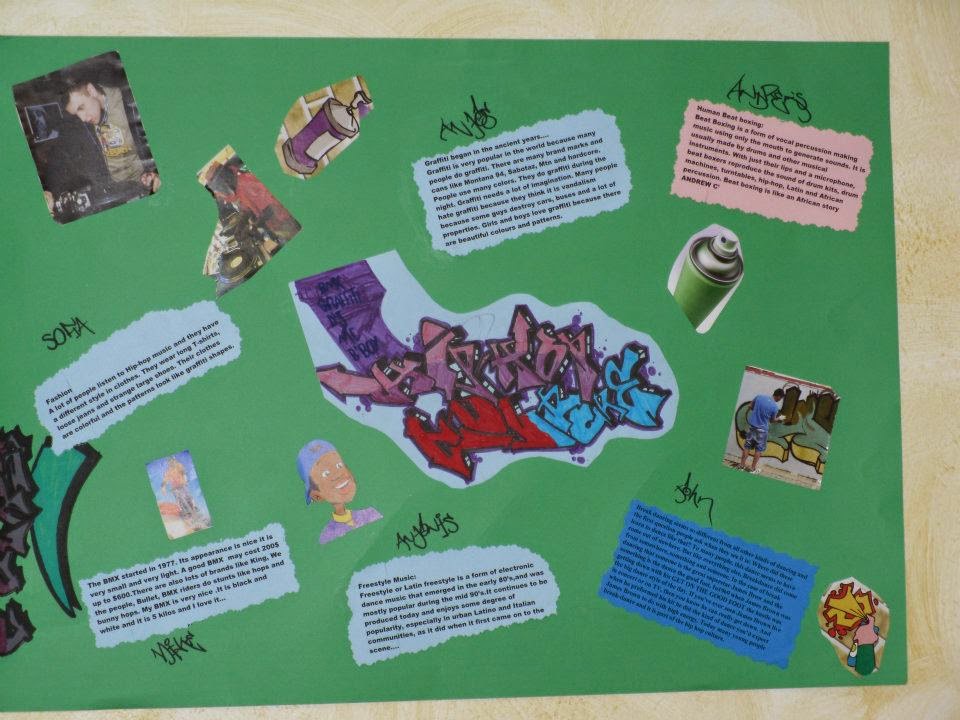
      3. When they each wrote their own texts and found pictures, we looked at their texts and made any corrections that were necessary. My students then rewrote their texts on colourful paper which they then stuck to a bigger cardboard sheet. The end product was a colourful poster full of students’ contributions and pictures (scroll down to view some images).
      4. Once the poster projects were ready, the students prepared little mini presentations based on their texts and they all collaborated so as to be able to give a whole presentation based on their theme. Each student spoke for about a minute and they decided on when each of them would speak. They rehearsed their presentations quite a few times until they felt comfortable presenting.
      5. A few days before the event, the students were given invitation cards to give to their parents.

      On the day of the event.

      The parents came to my language school and went to all the classrooms and heard all the students presenting their projects. The students got lots of rounds of applauds and there were a lot of smiles going around. All the parents voted for the best two presentations and at the end of the event the project with the most votes got a toy cup. All the students got a certificate of participation and a little present. We ended the day with drinks and snacks.
      Why will I do this again?
      First of all, the students and parents are asking me if we will do it again because they really enjoyed it. So, that’s one good reasong to hold such an event again.
      I also appreciated the fact that my students researched themes they liked, were able to talk a bit about them, did group work and prepared a project with a lot of enthusiasm.
      What would I change?
      I would make a little map of the language school and write down which group is in which class.This will make it easier for the parents to know where their kids are. I would change the voting system to three votes (cause with the previous system, all the parents voted only for their children. Now, they will have one extra vote). At this point, I would like to say that I asked the parents to vote for the best projects so the whole event could be a bit more challenging for the learners and it does serve as some form of assessment. I had a group that was not very motivated last time, but this year they are already telling me,” Miss, we are going to try harder because our project was not well-prepared last year.” I would also get the students to ask each other questions about their projects so they feel more comfortable talking about their projects. I will ask my learners and the parents to give feedback about the event and my stduents to reflect on the whole process as well. I am really interested in seeing what they think of the whole process, the stages and so on.

      This is a great end of the year event (you can even do it with just one class). I really think you should give it a shot!

       Till next time…
      EAP poster presentation. Newcastle University 2012
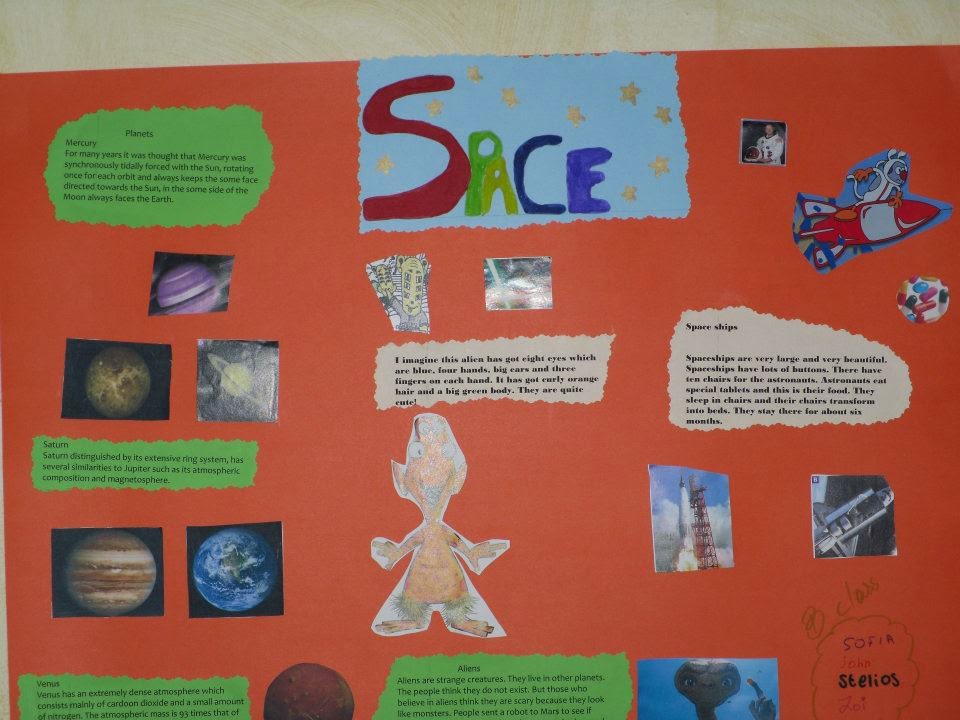
                                              2012 Poster presentation at my language school