Why am I studying at 38?!?!

Why am I still studying at 38?!?!

Every single decision we make regarding our career, every single diploma, certificate or degree we get, defines us as teachers. I am a firm believer of whatever we learn, even the most useless piece of information, may be useful in the future. It may open a window where a door has closed. So, this is me, talking about some of my choices, the teachers I met, and how they have made me the teacher I am today. Am I a a grand educator? Nope. Am I trying to improve? Definitely!

I spent my childhood in Sydney and moved to Greece when I was thirteen I did not speak much Greek at the time, I thrived in English though, so it was only natural that I studied the language. I got a B.A in English language and Philology. My minor was linguistics and my major was literature. After four years at uni, I thought, “Ok, now I can teach!” It is what the  ministry of education says anyhow. Most of my modules were theoretical and I didn’t have much practical knowledge or was I observed during the course but “hey, I got my degree” so “yeap, I could teach” and I did for a few years. Then, I felt that I needed to learn something new, my degree was not enough after all, so I decided to do a Master’s of Education in TESOL. I was lucky enough to have a great supervisor, Dr. Nicos Sifakis, during my final year and a person who still helps me when I ask him something. I finished my M.Ed. and thought again, ” Now, I have a Master’s degree… I am a researcher.. I know loads… I am going to be a Queen Bee in my classes”. It was easier to find jobs and I felt much more comfortable in my classes. My M.Ed. actually gave me the courage to apply for pre sessional EAP courses and I got my first job working at Newcastle University during the summer of 2011. EAP courses in the UK were a whole new experience. I had great managers, Darran Shaw and Nicky Collins, who believed in me, and helped me a lot, and lovely colleagues who now are dear friends. I also met my lovely friend Deirdre at Newcastle. She introduced me to Wefit solutions, where I am currently teaching Business English online. This is a whole new experience.
Newcastle was also the place where I heard about the Delta for the first time but remember, I was a super duper teacher now with an MA so.. did I really need the Delta?
After long talks with colleagues, and seeing the requirements and reading lists, I decided to do it. And I did. I passed module one by myself and then took a blended online course at CELT with Marisa Constantinides.   Apart from all the great things I learnt during this course,the observations, the feedback, Marisa got me into blogging and tweeting. Blogging allows me to just keep talking : P and tweeting is a way to stay informed and meet lovely people, grow my PLN. I also met Angeliki, my Skype support buddy and the person who got me interested in TESOL conventions (my first presentation ever was at TESOL Greece, this year!), Lia, who is the person who shares stuff with me all the time, and Ola who said, ” Go Jo! You can do it” when I was on the verge of giving up cause I was too tired to continue studying. I didn’t quit. I passed module two and will be taking a little break before module 3 cause I need a break people!
Now what? Now, I know that I still have things to learn. I want to do a Business English trainers course as soon as possible and I am also thinking of doing a PhD.
Why? As I said at the beginning, you may be the best teacher in the world, but ELT changes and you got to keep up. What you, as a professional choose to study and invest your time and money on, will only help you excel. You cannot lose! So, continual professional development it is! You also need to be open to meeting people and learn from your colleagues! Be open to people and keep your antennas up for study opportunities!

                                    Picture credits: http://arcsofia.org/node/393

There are many people who I met during my studies and work but unfortunately I cannot fit everyone in a blog post. It is wordy enough as it is… : )

Till next time…..

Students choosing material

Students choosing the material… a Do or a Don’t?

I asked my C1 level students the other day to choose some articles they would like to read and use in class and then it hit me… is this a good idea or a bad idea? Well, in this case (the first stage of this choose your own material part of my C1 sessions) it was a great idea cause my learners sent me some really interesting articles : ), on issues I did not think they were interested in! I am providing the links: 

Why get your students to choose articles they want to read and talk about?

1. They are online 24/7 anyway (well, mine are!) so getting them to do one more thing online is not really asking for too much on their part.
2. They will have to read a few things before they actually send you the article (or atleast I hope they will…) and truth be told the more they read, the better! The more exposure they have to reading texts, articles in this case the better. Even just reading a headline can be helpful!
3. They choose articles they find appealing. This means that they will be more motivated to:
  • find unknown words.
  • present a short summary of what they read/ talk and elaborate about something THEY are interested in.
  • use their article as part of another task like a project.
4.  Authentic material like newpaper articles, give them exposure to real language. It may be dense in language they are unfamiliar with, full of colloqualisms, idiomatic expressions etc but it is a great opportunity for them to learn new words if they come accross something they are interested in. On the plus side, they will feel great content when they manage to understand a real web article.

Things to be careful of:

1. Give your learners some sort of word limit. You don’t want some of your learners bringing in a mega giga article and the rest itsy bitsy ones!
2. Ask them to send you the link to the article before they bring it into class so you can check it for any inappopritae material. You may also want to make some further reading tasks, vocabulary tasks and so on. Having the articles beforehand is useful for you as a teacher.
3. Choosing articles may be better for students who have a good control of language. Students who are not above intermediate level will probably struggle when given authentic articles. Instead of being motivated they may end up being discouraged.
4. Give your students clear instructions as to what you want them to do with the article. In my case i told my students to read the article and prepare a short oral summary of what the article says. I also told them to make word cards with their unknown words on one side and the explanation on the other. As homework, and after we have read the articles in class, I am also going to ask them to write their own reading comprehension questions based on the text and we will revisit these articles+ their reading comprehension questions in the next lesson.
Screenshot of newmap. Link to this website: http://newsmap.jp/
I am really looking forward to this session. I will back with a new post about how it went.
Till next time…..

Challenges of teaching Business English online

Challenges of teaching Business English online

I have been teaching business English online for some time now, and thought it was about time I wrote a few posts on some of the challenges of teaching online and how I deal with them. Today, I will focus on challenges connected to technology and make some suggestions regarding how they can be dealt with. Before I move on though, I will explain what teaching online is for me. The learning platform I use is Adobe Connect and a phone line/Skype. So, what are some of the technology related problems that may lead to anxiety on your or your learners behalf (anxiety is a very soft term , may I just say)

  •  Connection problems.

You or your learner may have difficulty connecting which is why it is necessary to have very fast internet connection as well as back up plans in case something goes wrong. You could use a phone line or Skype when your online classroom/internet connection is not working. So you may not be able to have a lesson in your online classroom, but you can still have one via phone.  Remember always get your learner’s contact info on different types of media (phone, mobile, emails).

  • Problems accessing the virtual classroom+technology related web notifications popping up.

I think it is a good idea to create a document or a podcast regarding the tech glitches connected to the software you are using to hold the sessions. Have some sort of reference list related to any notifications the learner may get and explain the steps he needs to take in order to deal with the notifications.This can be your learners’ go to document or video when something comes up. Also, during the first lesson, guide your learners through the steps related to connecting to the classroom and the different buttons in the  online classroom. You may even take a picture of the virtual classroom and add notes to what does what.

                                            Example of document with guidance for learners (Pic of Adobe Connect)

  • Recording sessions

One of the advantages of teaching online is that you can record the session and upload it to your chosen learning management system  (LMS). This is great but you also need to be careful and always ask your learner for permission to record and upload the sessions because there may be legal issues or just simply out of respect of your learner’s privacy. I have had learners who did not want their sessions to be recorded so you must know this beforehand!

  • Time management

Managing time online can be quite difficult especially when there are connection problems. Imagine a situation where you are teaching and half way through the session the phone line drops or your learner vanishes from the online classroom. You spend minutes trying to get connectivity back, you ask all the TRQs (technology related questions) and time flies without you noticing. Very often when you are trying to reconnect, you lose track of time, since you are more focused on checking to see if you or your learner are back instead of what time it is. In this case, the only suggestion I can make is realizing that connection problems may be a problem and checking the time is something that has to be done consciously and frequently.

  • Passiveness

This is the biggest challenge! According to Pelz’s principles of effective online teaching (2004, cited in the Hannover research council, 2009) visibility is essential as lack of visibility may lead to passiveness on behalf of the learner. As online sessions are not face to face, it is important that the sessions are carried out whilst using a webcam. I believe that teachers delivering online sessions should encourage their learners to get and use a webcam. Teachers should also always have their webcam on so that the learners see the teachers face, gestures etc. When using the webcam, the teacher is not just a voice coming from far away but someone the learner can see!

  • Distractions

I think this is difficult to tackle. You use your computer as  the medium to deliver the session. Apart from your online classroom, your learner is also connected to his email account, Skype or an internal communication system which means that someone may be emailing your learner while you are having a lesson with him. So, you may be going on about negotiation skills, and your learner may be emailing a colleague about a meeting! What can you do? Not much. Try to explain to your learner that the English session is very important and that him being preoccupied with something else during the session, may lead to missing out something important! You could also suggest that the lessons be held in another room and not his/her office.

  • Group sessions

One of the benefits of online teaching is that you access your learners workspace with the click of a button. This can turn into a nightmare though when trying to hold group sessions. When having face to face sessions, you go to a classroom and everyone meets you there. When delivering a group session, you try to connect with three different people , in three different offices so all the technical issues get multiplied by three! I only have one suggestion here… try to avoid group sessions!

How do all these challenges affect my business English students?

Good question. Well, time is of the essence for your BE students so you really need to eliminate  or at least try to minimize any connectivity problems that may  waste your learners time. They are at work and dealing with connectivity issues may even make them want to cancel sessions. You do not want your learners cancelling sessions. Especially when their schedule is already tight!

You definitely do not want your learners to be passive. Interactivity is core to online teaching and using a webcam is a good idea. Another reason why webcams are necessary when delivering BE sessions is because business communication does require the teaching of paralinguistic features and this is when a camera can be useful. You can show your learner what gestures and facial expressions are appropriate/inappropriate/not so appropriate in different cultures etc. Of course, this does mean that as a teacher, you do need to feel comfortable sticking your face in front of a camera and focusing on facial expressions. Well, if you do not, you could also use videos from YouTube : ) which you can send as a link when teaching online. Yay! Another advantage of teaching online-immediate access of online material, websites etc.

Dealing with distractions your BE students may have, is not a piece of cake. You could incorporate them into your session though (if you realize your learner is doing something else instead of paying attention to the lesson) and they could be a great  learning experience for your BE student as you may help him/her with a real email he/she may need to send. Bottom line is that distractions do occur and  I am still wondering about what the best way to deal with them is.
Dealing with the problems that arise during group sessions is easy. Just discourage group sessions. Group sessions in my experience are more easily cancelled so if possible stick to one to one lessons when delivering business English sessions online.

My final thoughts….
I only touched a few of the problems related to teaching online and how they may affect the delivery of a business English session. Of course, these challenges apply to any online session. I am really interested in what you think so do feel free to comment or make other suggestions. I will be back with more posts on teaching BE online.

Till next time…

    References
    Hannover Research council (2009) Best Practices in Online Teaching. [pdf]: Washington. Available at <http://www.uwec.edu/AcadAff/resources/edtech/upload/Best-Practices-in-Online-Teaching-Strategies-Membership.pdf> [Accessed 27 February 2014].


    A few days after Belta Day

    A few days after Belta Day

    Last Saturday (22nd March) I attended and presented at the Belta Day in Brussels, Belgium. The day started with a warm welcoming from the Belta president James Taylor and  was followed by an inspiring talk by Jeremy Harmer. After that, there were some very interesting breakout sessions. The second plenary by Luke Meddings  gave me a lot to think about regarding the material I use in the classroom and Dogme. Then came another round of talks. These breakout sessions were followed by some swap shop sessions where teachers exchanged views about what they heard during the conference. The day concluded with a small goodbye reception and then we all went home.

                                                          A closer look

    The plenaries:

    The plenaries were thought-provoking and very interesting. They made me reconsider some of the things I do in class but also validated some of my practices.

    The breakout sessions:

    There was a variety of sessions so you could choose and attend the ones that you were more interested in.

    The people:

    Wonderful! Everyone was very helpful and friendly. I can say that I met some really nice people which I hope to see again some day in the future.

    My presentation:

    I apologise for sounding like Kermit the frog, but I was recovering from the flu. The people who came to my talk were very encouraging and highly interactive. I hope those who attended felt it was a good talk. I would like to thank some of the teachers who actually emailed me or sent me a message on Facebook regarding my talk. They put a smile on my face : )

    The swap shop sessions:

    They were great! At last an opportunity to talk about everything you heard at the conference! I loved them! They also informed me about sessions I did not attend.

    The raffle:

    What can I say? I won Jeremy Harmer’s book and he signed it too : ) Yay!!

    Thanks to everyone at Belta for making it a wonderful experience!

    Till next time….
     

    The newbie tells all

    The newbie tells all- The 35th TESOL Greece annual convention

    I only have one word: FANTASTIC! Attending the convention and being a presenter at the 35th TESOL Greece annual convention was a very rewarding experience.
    The people
    Everyone there; the board members, the organizing committee, the other presenters, the volunteers and of course the people attending were so friendly and helpful. I met some remarkable people from all around the world and this is something I will always treasure! I made new friends who I will definitely see in the future : )
    The presentations
    I attended lots of presentations. Some were a pleasant reminder of things I must do in class, others gave me ideas on how to introduce new techniques in my classes. Some had a very hands on approach and were highly interactive, others were more academic oriented. All the talks I attended though, were given by enthusiastic teachers!
    My presentation
    I would like to thank the people who attended and listened to what I had to say. My audience was very encouraging and applauded me at the beginning so as to encourage me (this was my first presentation ever, remember?). In the beginning, I was nervous and trembling but as time went by I felt more comfortable whilst finally, I was in what I call “in the zone”. I tried to make my presentation as interactive as possible. I hope the audience felt it was quite a good talk. I tried my best. I also made some new friends with whom I am really looking forward to exchanging views and ideas on how to teach Business English online.
    The social events
    They had everything:
    great company+
    music+
    food+
    dancing+
    view of the Parthenon+
    What else can a gal ask for?
    Note to reader: the + symbol means checked! I have no idea where the tick symbol is on blogger : P
     
    My final thoughts
    I highly recommend attending the TESOL Greece conference. It is educational, informative and fun. I also suggest you submit a proposal and present. You learn a lot as a teacher while preparing for the conference. You also learn on the day of your presentation from what you hear from the people attending your talks.
     
    Where do I go from here?
    Well, I am going to be presenting at two more amazing conventions.
     Belta Day-22/3 in Brussels http://www.beltabelgium.com/belta-day-2014/ (this weekend people!!!
     : D ).
     ELTforum.sk 6-7/6 in Bratislava http://www.eltforum.sk/index.php?page=index&lang=en ( see you in a bit!)
     
    I have a few ideas on what else I need to include in my presentation and how I can make it more interesting for those who will come to hear me talk.
    Goodbye Athens… I will definitely see you next year : D
    Brussels… here I come! See you all at the Belta Day! I am really looking forward to another great weekend!
     
     
    This is my badge and the Tesol Greece convention booklet. I have no pictures of my presentation cause… um … I was so anxious… I forgot to take some : p
     
    Until next time
     

    Some really cool conferences ahead

    Some really cool conferences ahead : D 

    This time I am not going to talk about a task and what happened during it. Instead, I will talk to you about preparing for a conference. I got this idea after receiving an email from one of the 35th TESOL Greece convention interviewers (Julia Aliverti) but instead of focusing on one event, I will talk about something more general.  I have never presented at a conference before, so this is me sailing in unchartered waters. The newbie conference presenter 🙂
     

    Preparing for a conference presentation on Teaching Business English online. What have I been up to? 

    • Loads of reading.
    I have spent many hours trying to find articles, books, webpages, videos, and anything else related to online teaching and Business English. It is quite hard cause there is a lot of information out there on online teaching or BE but not much on teaching Business English online. I must say that my connections on LinkedIn and twitter were very helpful!
    • Drafting and redrafting.

    Although I have been teaching students, for some time now, how to deliver a PPT presentation, I have come to realize that including all the information without squashing everything or having loads of blank pages is HARD (how do you do it lovely pre sessional EAP students?). Then, there is the whole deciding what should go on the slide and what not? Should I have pictures or not? What about animations?

    • Rehearsing.

    I really don’t want to mess up, so I have been practising what I will say over and over again. I sometimes forget some of the things I wanted to say, but I think that by the day of the presentations I will be ready (fingers crossed :0).I also want to avoid going into lecture mode, so I am trying to find techniques to keep the audience engaged and make the presentation as interactive as possible. I have made some note cards just in case though….

    • Handouts for the audience.

    I will have two different handouts. One will have links to all the sites I will mention during my talk and the other will have the PPT slides for my audience to make notes on. I think the latter is really helpful cause the people watching you get to keep your presentation and take notes on the things they really found interesting. I also believe this is appreciated by people who can’t see well! It is awful when you are unable to see the slides!

    • Letting my teacher friends know I am presenting.

    They will encourage me and give me a sense of security. I am a newbie, remember…..??

    Finally, there is all the girlie stuff I have to consider, but I would need to write a whole new blog post regarding the do’s and don’ts of looks at conferences :).

    My final thoughts
    I will list the conferences I will be presenting at in chronological order. I am really excited about all three and I cannot wait to meet all the wonderful people I have been in touch with regarding the conferences. I really appreciate the opportunity the people hosting these events are giving me: )

    15-16th March  Tesol Greece 35th Annual Convention  (Athens, Greece)
    22 March    2014 Belta Day (Brussels, Belgium)
    6-7 June    Eltforum.sk   (Bratislava, Slovakia)

    Links to these events:
    http://www.tesolgreece.org/index.php/en/events/forthcoming-events/convention
    http://www.beltabelgium.com/belta-day-2014/
    http://www.eltforum.sk/index.php?page=index&lang=en

     I will definitely blog about these events in individual blog posts later on. : )

    Till next time…..

    Teacher in LaLa land

    Teacher in Lala land

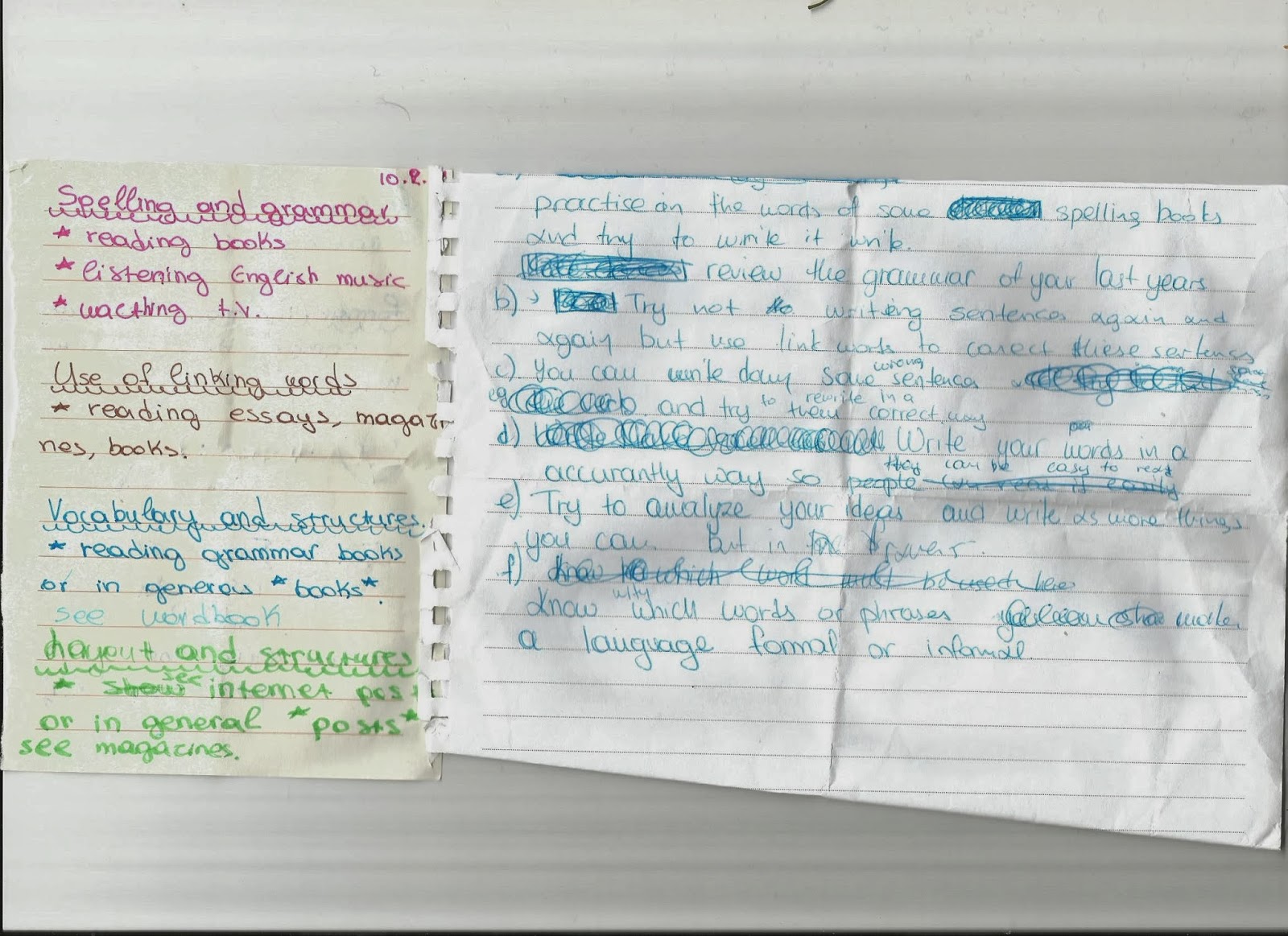
    How I think my learners will improve their writing skills and how they think they will improve is a completely different story. I ask CCQs and ICQS, but I don’t really ask them much about how they think they can improve their English.
    I had a CAE writing class the other day, the focus was on writing an essay.  The students were asked to suggest ways they can improve their writing skills and in particular:

    • vocabulary
    • structures
    • grammar & spelling
    • punctuation
    • layout
    • formal/informal language
    • developing paragraphs
    • linking words and linking sentences together

    Now, before I move on to tell you what their answers were, I would like to tell you that my learners are C1 level learners, in their teens, and they have been taking English classes for quite some time now. They have written tons of essays and we have spent hours discussing what makes a good essay and what to avoid when writing one. We have also spent time doing exercises that help improve their writing skills in the areas I mentioned earlier BUT I have seldom asked them ” How do you think you can improve?” Don’t know about you guys but I usually tell them how they can improve!
    So, I gave them about five minutes to make notes and tell me what they think they can do to help them improve in writing.
    Here is what I got.

    Spelling and grammar:

    • read books
    • listen to English music
    • watch TV
    • go through word lists and copy the spelling
    • review your grammar books

    Use of linking words:

    • read essays, magazines, books
    • try not to write the same sentences again and again but use linking words and try to connect them
    • practice writing on a daily basis (yay!!!)

    Vocabulary and structures:

    • read grammar books (huh?!) or in general reading books
    • correct sentences that are wrong
    • write your words in an accurate way so they can be easy to read

    Layout:

    • search the internet for magazine posts/posts in general (I think she meant essay examples)

    Formal/Informal language:

    • compare formal and informal essays
    • know which words phrases are formal and which informal

    Now, this is the point where I pour myself a glass of wine and reflect.

    What I have not been doing

    • I have been telling them you need to do this and that but I have not been connecting it to the real needs and explaining why and how the exercises we do in class or at home will help them. I have not got feedback from them on the effectiveness of the tasks we do.

    What I need to do

    • I need to give them more opportunities for natural or native like exposure to the language and give them more books, magazines and internet posts to read and make notes. Use what they read to learn new words and use the new words.
    • I should do more error correction in class with them. I think I ought to use their own material in this case to connect it with their language needs.
    • I really need to help them with features of writing that have to do with layout.

    Things that made me happy

    • They know how to improve register and are conscious about formal and informal language.
    • They suggested reading as an answer to almost every problem connected to writing. So now I can say, ” Well, we are doing this cause you suggested it as a way to improve, hehe” (I would drop reading grammar books! Who does that any more?).
    • I realized that I need to ask these types of questions more often.

    Where do I go from here?
    This week I will tell my learners that we will try to improve vocabulary on a daily basis. Every day they will read an article from a newspaper. They will look for any new words, write these words on word cards and bring them in to class. We will practice making sentences/paragraphs with the new words. They will also keep a journal of how this is helping them improve in vocabulary and spelling. I will also make tasks and exercises based on the new words they bring into class.


    Till next time….


    ELT Chat summary-Teaching English in the corporate world

    #ELTchat summary (12/02/2014)

    I started attending the #ELTchat on tiwtter (Wednesdays 12.00   or 21.00 GMT) after my tutor, Marisa Constantinides, suggested it. It is an hour well spent on Wednesdays, so when I was asked to write the summary of this Wednesday’s chat, I gladly said, ” sure!” So, here goes!
    The topic
    Teaching English in the corporate World: which is the best approach and which activities work best with in-company classes?
     A similar topic had been discussed before, so it is a good idea to read that summary too  http://t.co/UJly7MdvLj  as it taps into what was discussed during this chat as well.


    Challenges of teaching in-company classes

    “What are some of the challenges you face when teaching in-company classes?” (@Marisa_C). This was the starting point of the chat and what was discussed during the hour was connected to the answers given to this query.

    Challenges of teaching in-company classes:

    1. Managers don’t want to attend classes with their underlings(@OUPELTGlobal).Bosses and secretaries having sessions together, especially when the secretary’s English may be better than the boss’s, may not be such a great idea.
    • Random attendance,late comers (@rapple18) or no shows due to busy or not so busy schedules.
    • Motivation and mixed classes (@CotterHUE).
    • Poor assessment and people who are forced to attend these classes (@HadaLitim).
    • Working during classes (@ Marisa_C).
    • Homework or actually lack of homework.
    

     Ideas on teaching in-company classes & some solutions to the challenges

    How should the students be grouped?
    Most people agreed that it is better to group people based on language needs, topic, and position due to the fact that some employees find learning with the boss intimidating or because some managers ‘pontificate’ and the rest of the class remains quiet.
    Words of wisdom;”Easier to do mixed level teaching than try to reconcile the irreconcilable”(@Marisa_C).
    Another idea was to offer one to one classes so as to avoid intimidation and deal with different learner needs etc.
    How can we avoid absenteeism?
    Students need to see that what they get from classes as more valuable than work. Another idea was that companies should give extrinsic motivation and even charge students if they are absent too many times! It is necessary to keep the students engaged and motivated so as to avoid absenteeism. It is essential to show students that what you are doing with them is directly linked to their work!
      A bit about methodology
    @teacherphili asked if there was a “particular methodology or approach applied to these corporate classes or if depends on the situation?” “It depends on learner expectations of education experience, but I tend to use more output-feedback” (@teflgeek).
    What tasks are appropriate for our learners?
    Before deciding on tasks, the importance of needs assessment came up. Teachers need to understand their learners’ needs before deciding on what to do in their classes and what homework to assign.
    Everyone agreed that learning in this case should be task based. The focus should be on tasks and not just exercises.
    • Role playing(@Marisa_C/@joannacre/@teflgeek).
    • Tasks applicable to work, work related. Business students do not want to waste time!(@CotterHUE).
    The chat about tasks overlapped with what to assign as homework so read further on for some more ideas on tasks/homework.
    What do I do about homework? 
    The first question that arose was whether to give homework or not. Most agreed that it is a good idea to assign it but it is necessary to make it related to their work so that they can be more motivated to do it. Ideas regarding homework:
    •  PPT/ Prezi, which help students practise their presentation skills*.
    • Newspaper articles, which learners can read during their coffee breaks : ).
    • Pecha Kucha can help them improve fluency skills (Marisa_C).
    •  A reflection of a daily work done in the context of a job (@jankenb2)
    • Reports, emails, telephone conversations.
     * @Nouella89 asked the very interesting question of whether students are learning or playing with the technology and there was a bit of a discussion on the benefits of PPT vs Prezi and vice versa(@teacherphili: “PPT can be repetitive/Prezi style over content, mind you”/ @ Marisa_C :”Prezi can be a fun tool for presentations”) .
    On the whole, there was consensus on the fact that homework needs to be mandatory, something that doesn’t take long, is interesting and challenging!
    Assessment was briefly discussed during this chat. It is important that there is assessment and different types of it (@HadaLitim). Maybe this is something that can be discussed in another #eltchat?
    My final thoughts
    On the whole, this was a very interesting chat. A lot of useful ideas and thoughts were shared. I think that, in this summary, I covered the main points discussed.  I tried to include the names of  as many of the contributors to this chat as I could. Apologies if something/someone has been overlooked. This is the first time I have written a summary for #eltchat so please be lenient on the newbie : ).

    Till next time…..
     
     
    Links shared during the chat:
    Mixed ability teaching: http://thesecretdos.wordpress.com/2014/02/11/how-to-teach/   (@teflgeek)
    Pecha Kucha: http://scottthornbury.wordpress.com/?s=Pecha+Kucha  (@HadaLitim/ @Marisa_C)
    Presentations software: http://www.powtoon.com/

    The 11 blog challenge

    The 11 Blog Challenge

    I was asked to take part in this blog challenge by my sweet friend and colleague, Ageliki Asteri, and I am really excited to be a part of this challenge.
    How this works:
    1. I need to acknowledge the nominating blogger.
    2. I share 11 random facts about myself.
    3. I must answer the questions the blogger who nominated me asked.
    4. I will list 11 other bloggers
    5. I post eleven questions for the bloggers I nominated. I must let the bloggers know that they have been nominated (that actually took some time) and I cannot nominate the person who nominated me.
    I got all this information from the Datenglish blog (Deborah Debovich):
    http://datenglish.blogspot.com.ar/2014/01/the-11-blog-challenge-by-ageliki-asteri.html

    So, here I go!

    Eleven Random Facts about myself.
    1. I grew up in Sydney, Australia, and left when I was 12. I have not been back since then.
    2. I love the UK, which is one of the reasons I go there during the summer and teach pre sessional EAP courses. I always get asked, “You leave the sun and the Greek beaches to come to the rainy UK?”. Yes, people I do, cause I like it and I can!
    3. I hate bridges!
    4. Dream holiday? I really want to go to New York City… hopefully I will one day : ). My most romantic city in the world (out of the ones I have visited that is) Strasburg. So pretty. Seriously.
    5. I do not really cook, but I really like going to fancy restaurants and trying out food from all around the world.
    6. I have never had tasty fish and chips in the UK. Too greasy. I will pass.
    7. I once boiled a spider and without knowing it drank tea out of the pot (with the dead spider’s remains). After that I was anxious to find out if, in the UK, spiders were poisonous. I guess not cause I live to tell the story : P
    8. I find teaching people from around the world both challenging and stimulating. I have learnt so many fascinating things from my Chinese students whilst in the UK. My online teaching job has given me the chance to learn a lot about the French and German. It is mind blowing how you can use a computer and teach someone, somewhere else in the world.
     9. My favourite colour is pink… oh and I am colour blind so.. yeah.. go figure.
    10. I love crumpets. They are so tasty!
    11. My facvourite song and motto Should I stay or should I go-The clash.
    http://www.youtube.com/watch?v=GqH21LEmfbQ

    Now let’s see Ageliki’s questions
    1. Can you tell one weakness of yours?
    I am not spontaneous enough.
    2. What do you most enjoy in life?
    Travelling and having fun with my friends and family.

     3. How do you deal with injustice in life?
    I don’t like it. If I have the opportunity, I say what I think.
    4What flowers do you like and why?
    Pink roses. They smell nice.
    5. What book have you read recently?
    Eap essentials. I do not have time to read novels and stuff. Most of my reading is work related.  I am reading a lot about BE and online teaching at the moment cause I am presenting at the TESOL Greece conference  http://tesolgreeceblog.org/2014/02/13/an-interview-with-joanna-malefaki/   and Belta day http://www.beltabelgium.com/belta-day-2014-meet-the-speakers-joanna-malefaki/
    6. Why do you teach and what part of teaching do you enjoy the most?
    I studied the language at university so it was only natural for me to teach it to others. I love it! I like everything! I have been teaching for many years and as my friend, Lia, said, “got my fingers in many yummy pies” so cannot say one specific part.
    7. What do you do to help the unmotivated student?
    I try to make the lesson memorable. I also try to find the reason why he/she may be unmotivated.
     8. What are two things in teaching that have problematized you in particular?
    Students who are not motivated.
     9. What do you do to develop as a teacher?
    I am doing the Delta. I will also start a course for teachers of Business English. I am currently looking into a second MA.
    10. What have you found interesting about blogging?
    I love it! It is like talking, writing a diary about teaching. I hope someone apart from me reads what I write and finds it interesting too!
    11. What is your view on social media and professional promotion?
    It is fascinating how the internet allows you to meet people from all around the world. LinkedIn and twitter, especially #eltchat on twitter,  have given me the opportunity to meet lots of interesting people from around the world.
    My questions to the bloggers I have nominated:
    1. Describe a good teaching experience you have had.
    2. Describe a difficult teaching experience you have had.
    3. Do you have a teaching mentor? If yes, can you tell me how this person has affected your teaching?
    4. Where do you see yourself in ten years from now?
    5. How do you deal with students who dominate the sessions?
    6. How do you deal with shy/introvert students?
    7. How much time do you spend on you work and how much on your personal life?
    8. If you won 1 million euros, how would you spend it?
    9. What’s your favourite food?
    10. What do you hate doing around the house?
    11. Describe your ideal day.

    Look forward to hearing from you guys.
    Till next time……..

    Bloggers I have nominated:
    Sally Fryer
    Deirdre McKenna
    Chara Machairianaki
    Christina Malefaki
    Ola Bakri
    Evangelia Kallianos
    Marina Daskalaki
    Maria Mihelaki
    Eri Mihelaki
    Angela Fradelaki
    Georgia Psarra

    Pre sessional EAP courses

    Pre-sessional EAP courses….. bits and bobs

    This post gives just a few tips on the whole pre-sessional EAP experience in the UK. So, before we move on you may ask, ” What’s a pre sessional EAP course?” In a few words, it is a summer course run by universities (usually their language centers) and the students attending these courses are international students (mostly Chinese) who have been accepted on an MA (or undergraduate program) by this or other universities. The aims of these courses are many but in a nutshell, the goal is to prepare learners for the university experience and help them improve their academic English. The courses are usually 4, 6 or ten weeks long.
    I have taught on three courses at great universities with lovely managers and colleagues. It is a demanding but rewarding experience and I strongly suggest you try it. Some of my friends though ask me ” How can I do it?” which gave me the idea to write this blog post. Here are a few suggestions:
    Where do I begin?

    • Draft a CV which is connected to your studies and teaching experience. Apart from a CV, it is important to write a cover letter too with a more detailed description of what you have done and how it is connected to the EAP job you want to get. Some universities have application forms and a CV or cover letter is not necessary, but having one always comes in handy, even if you just copy paste stuff from your CV to the application form!

    Where can I find job adverts?

    I go to two websites:

    How can I prepare for an interview?

    You can’t really prepare but if you want to read a bit on EAP, I would suggest reading EAP Essentials: A teacher’s guide to principles and practice by Alexander, Argent and Spencer. Of course you can always do a Google search and reads loads about EAP.

    What should I expect before/during an interview?

    First of all, don’t worry if you do not live in the UK because many universities hold telephone or Skype interviews. I only have experience of Skype interviews as I live in Greece. If you do live in the UK, well then you go to wherever the interview will be held : ).
    If you get an interview invitation, some universities may ask you to do some tasks prior to the interview like provide a lesson plan of an EAP session you taught or assess a research paper.

    What kind of questions do they ask?

    Loads! Here are a few to get you thinking.

    • Describe a difficult situation with a teacher or student and how you dealt with it.
    • What are your three best teaching features?
    • Tell us about your education/qualifications and how they have shaped your teaching.

    and some EAP questions…

    • What are the aims of a pre sessional course?
    • What’s the difference between an EAP course and an Ielts academic English course?
    • What do you consider plagiarism and how do you deal with plagiarism? How can you help your students avoid plagiarism?
    • What are the differences between EFL and EAP?
    • What technology do you use when you teach EAP? Tell us a few of the EAP websites you go to when you teach your students.

    they may also ask

    • Why do you want to work for………. university?
    • What could you bring to our university? (yes, I got that one)

    and many more questions.

    So, that’s all for now. Good luck with your interview : ) Feel free to add any other suggestions and tell me how you did!

    Till next time……