Book Review: Presentation Lesson Hacks and some hacks for the EAP classroom

Phil Wade was kind enough to send me a copy of his book Presentation Hacks Book. I also read Helen Waldron’s post about the book and it is excellent ,so I started panicking. What can I add? Phil suggested writing a review/post about which hack I would use in the EAP class and voila. Here it is.

Using the book Presentation Lesson Hacks in my EAP classroom

Phil talks about various hacks that can be used to improve the learners’ presentation skills. Before we see which hacks can be used, let’s see what Phil means by hacks. They are:

activities at the micro-skill level designed to engage the students to raise awareness of their current abilities and to help become more productive in a low stress, engaging, student-centred and encouraging environment. The hacks are like short-cuts or back doors to gaining better presentation skills and becoming a real presenter rather than just someone who repeats memorised phrases or reads off a tablet or sheet. Presentation hacks incorporate teacher to student, student to teacher, student to student, pair and group activities as well as single student work, reflection and mental preparation. All of these are aimed at hacking the problems and weaknesses students have.

                                                                                                     (Wade, 2015)

Among the hacks Phil mentions, the ones that stand out to me and have relevance to my context, have to do with Voice (these are in the Body chapter or Phil’s book). In EAP, most of the students are international students who have a different L1, they often have difficulty with pronunciation, intonation and stress patterns (I call all these micro skills voice). My students are usually Asian and when Asian students present, their intonation seems to be, for the majority, quite flat, and they often sound quite ‘robotic ‘. Intonation is what I will focus on.

Intonation hack

Phil has a great idea for a hack that can address intonation. First of all, it is necessary to elicit students understanding of different intonation patterns.So, it is a good idea to practice a word like ‘really” with rising and falling intonation.  Then, the teacher can draw a line on the board and ask students to draw another line which goes up, down, or up and down depending on the intonation the teacher used when saying something. This will allow students to actually visualise the intonation pattern. After drawing different intonation patterns, the teacher and the students can discuss which one is the best in each circumstance! I am definitely going to use this hack next time I am teaching intonation to my pre-sessional students.

For more information about Phil’s book and how to order go to  smashwords!

cover

Happy teaching everyone!!

Till next time……

A fish, a thesis and ibid: Teaching (academic) writing through drawings

Drawing in the EFL class is something many teachers do in order to explain something like a grammar point or to have some fun like getting your learners to make a picture composition. I usually draw when I am teaching young learners, and I also draw when I want to show my emotions. For example, I will draw a smiley face after the Homework tasks have been written on the board to show my students that I will be happy when they do all their work.

But what about English for academic purposes? Do you draw in your EAP classes? I do, especially when I am teaching writing. I thought I’d share two of my favourite EAP pics which are on the wall somewhere in almost all my EAP classes. Keep in mind that these drawings can be used in any context where thesis statements and sources are part of a writing class, so these drawings can go beyond the EAP classroom.

The fish, the thesis and the arguments

It is quite hard for international students who are learning EAP for the first time to understand what a thesis statement is. They come from different educational backgrounds and they are trying to do a post-graduate degree in an English-speaking (that’s my teaching contexts) country. They probably have never heard or written a thesis statement before. Add the term argumentative essay, and things become even more complicated. This applies to any student who is first introduced to terms thesis and argumentative essay. That’s when  the Picasso in me takes action. I draw a fish.

The fish

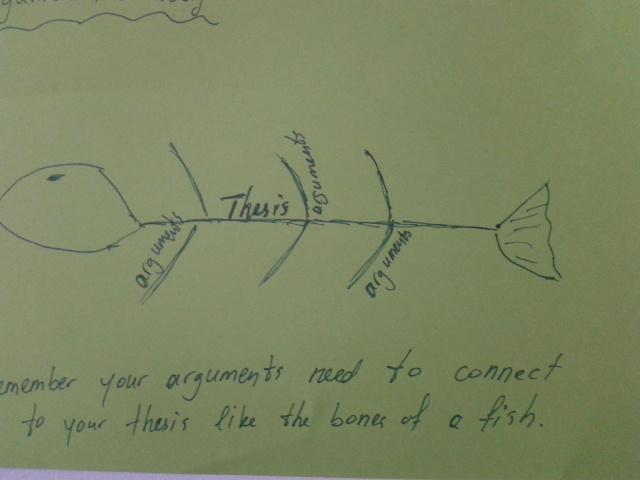
Why a fish? Well, it gives a good representation of the connection between the thesis and the arguments. The back bone of the fish is the thesis statement, and the arguments are the fish’s bones, all the bones are connected connected to the backbone. I often tell my learners that if a bone breaks, then the fish is in trouble, Just like their essays. I say, ”Your arguments need to be linked to your thesis statement and what you are trying to prove”.

Fish

Follow up task: When I am teaching writing and students have written a thesis statement and have a draft of the main body of the  essay, I ask them to go over the main body and write down the arguments (main ideas). I then tell them to look at their thesis and see if there is a connection and what that connection is. They can even draw their own fish if they want to!

The ‘referenced’ drawing

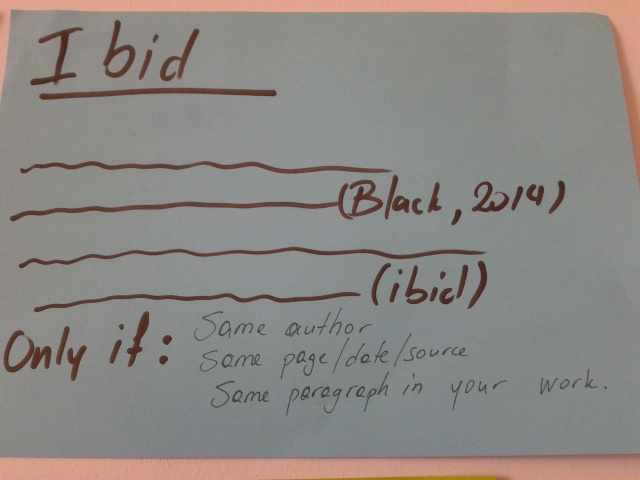
In-text citations are also quite hard for students. I find that my students get overwhelmed by the hard vocabulary in paraphrased sources or quotes (especially in academic texts) that they lose sight of the mechanics of referencing. Very often I show them how to do in-text citations by drawing. Below you can see two examples. One shows how I explain citing a secondary source and the other shows them what ibid means. So, after going through all the websites that are dedicated to referencing, I turn these concepts into visuals.

                      IBIDblack and Jackson

These pictures are all on my wall and help me explain in a very simple way some really hard things!

What do you use drawing for? Feel free to leave a comment below and share this post if you like it! Thanks for reading    🙂

Till next time…..


Iatefl 2015 Chris Smith’s talk

ERROR CORRECTION FOR SPEAKING: AN EVIDENCE-BASED APPROACH

Christopher Smith

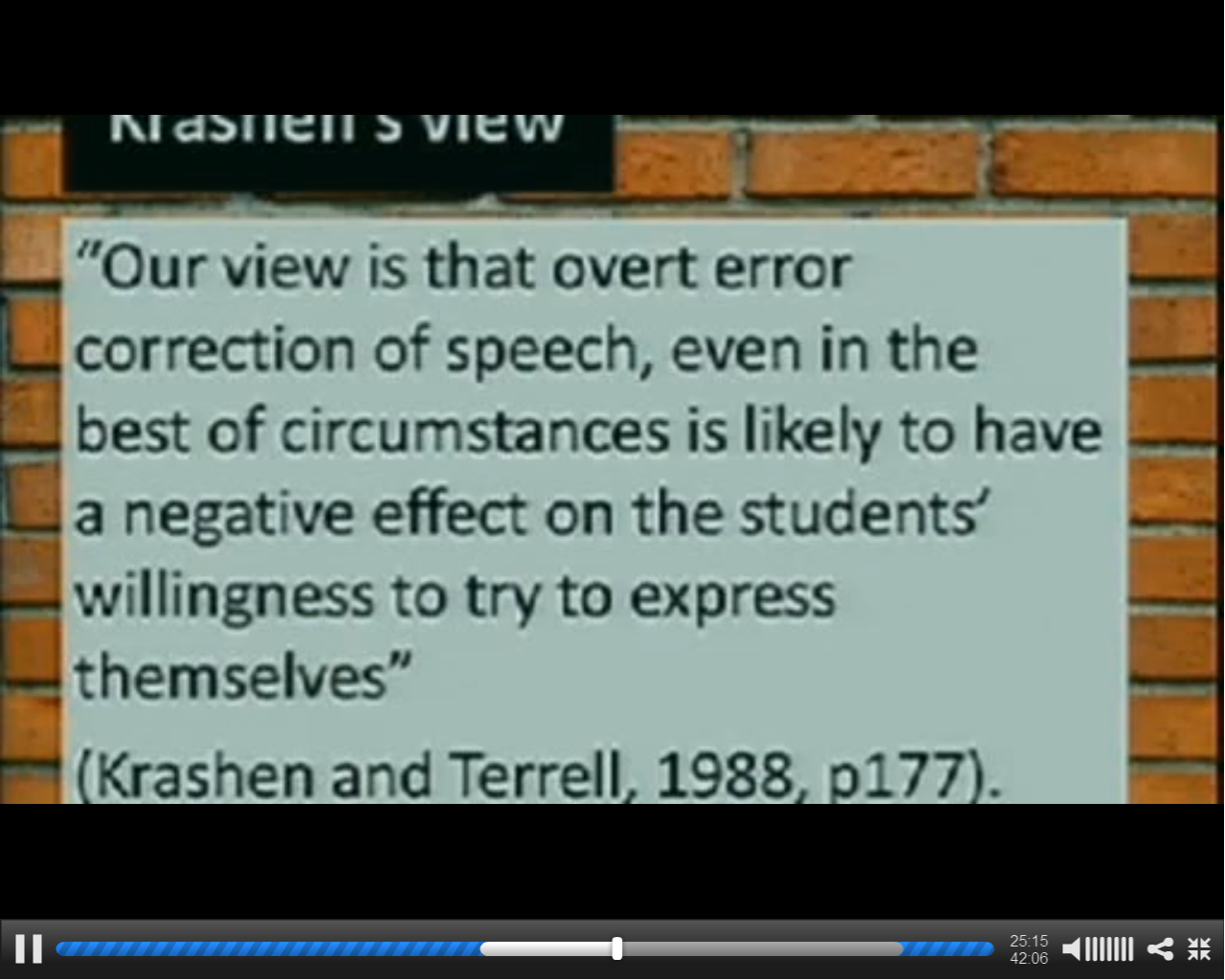
Chris Smith started his talk with a bit of information about the history of error correction. He mentioned how different approaches viewed error correction. He gave the example of Audiolingualism, where the teacher used to correct everything and Humanistic approaches where the notion is to correct nothing . Chris did point out that these statements -correct everything/nothing- are a simplistic /caricature view of how the approaches dealt with error correction. He then moved on to talk about Krashen and Terrel’s approach towards error correction. According to them, error correction did not work due to the affective filter (students got scared and embarrassed and this hindered their learning). This kind of attitude affected communicative language learning greatly.

Screen shot of Chris Smith's slides: Krashen and Terrel quote

Screen shot of Chris Smith’s slides: Krashen and Terrel quote

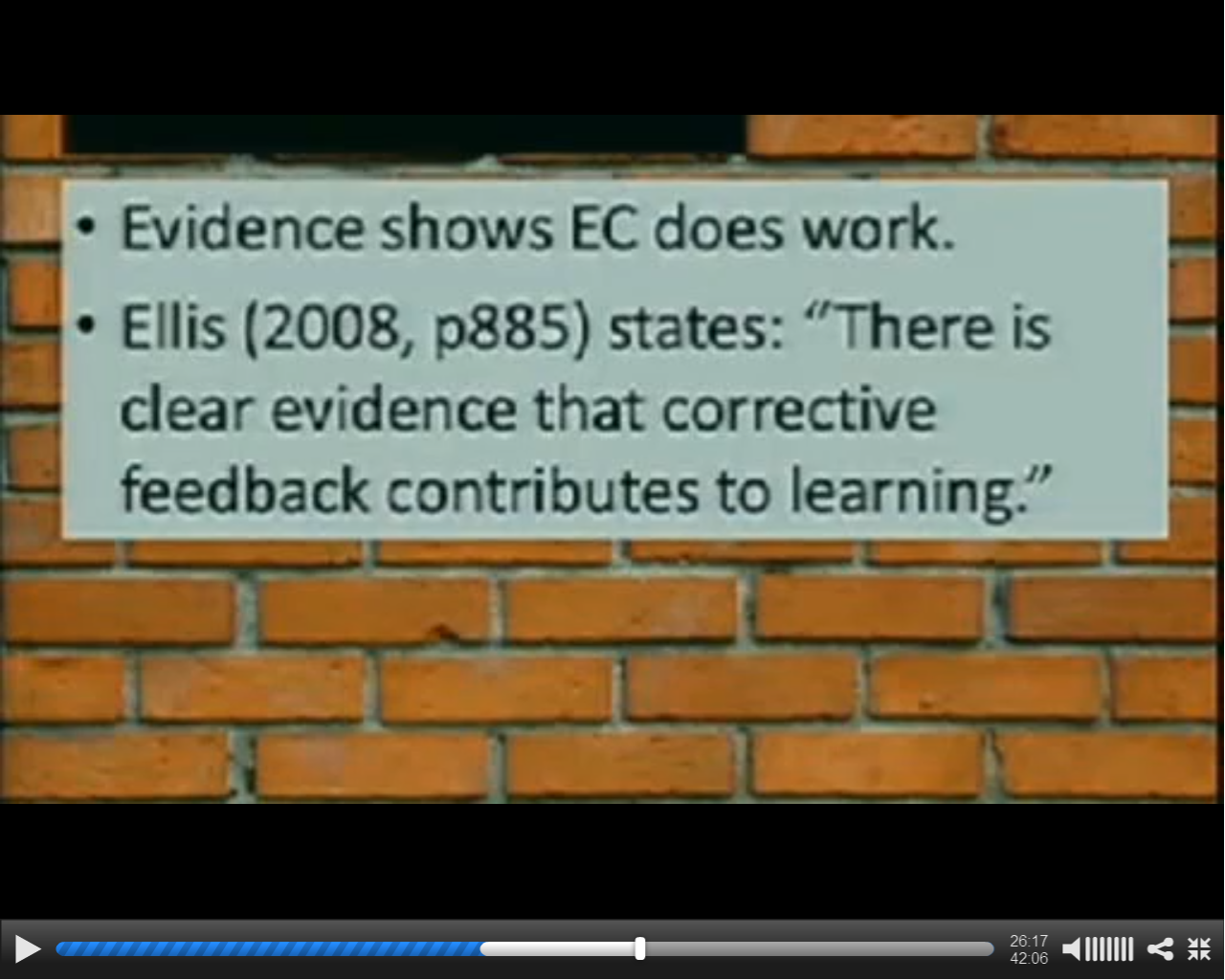
BUT research shows that error correction does work. Students who receive error correction improve.

Screen shot of Chris Smith's slides: Ellis' quote

Screen shot of Chris Smith’s slides: Ellis’ quote

Chris Smith then moved on to the main part of his talk which was his research. He  carried out research regarding error correction on speaking.

Chris Smith’s research

Learner Profile

200 EAP students (pre-master’s students). 2/3 of the learners were Chinese and the rest from the Middle East, Iraq. Kazakhstan. Most learners were in their mid-twenties. Language level: upper-intermediate.

Chris’ research started with general statements/research questions about error correction.

1). I believe error correction helps me improve.

Very strong agreement.

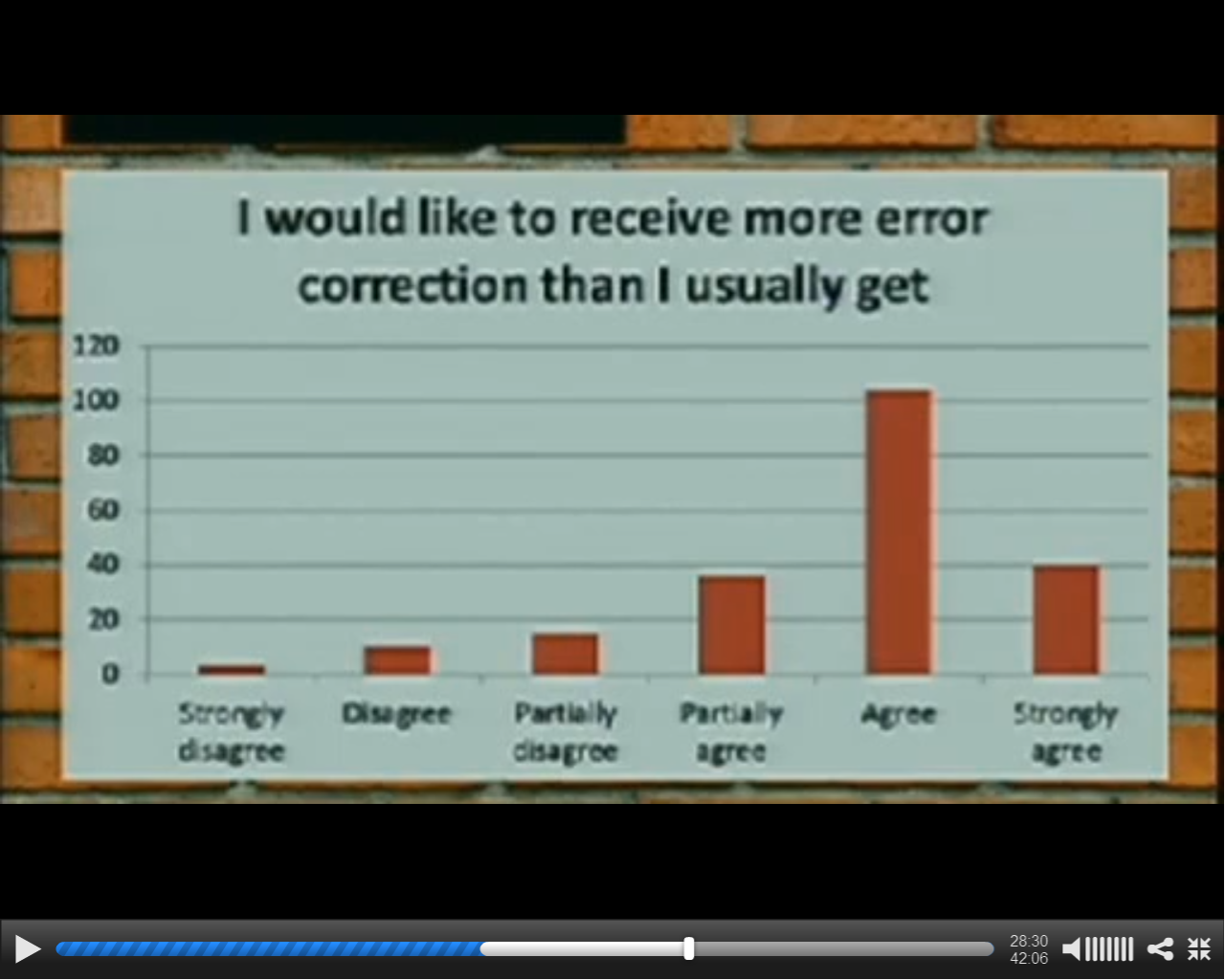
2). I want more error correction than what I get.

Agree (students, in general, want more error correction than what they receive).

But some people say you have to be careful with the amount of error correction you give. You might scare/upset your learners. This lead to Chris’ third statement/research question.

3). Being corrected by a teacher about speaking is embarrassing.

Strong disagreement.

Techniques for Error Correction

What kind of error correction technique do students prefer?

Student to student dialogues: Suggested techniques

  • Interrupting students and giving error correction.
  • Emailing students with error correction.
  • Writing errors on the board and then doing group error correction.
  • Giving bits of paper with individual feedback.

The most popular technique was giving individual feedback on bits of paper.

Recommendations on how to do that:

  • Use Postit notes so they can stick the bit of paper somewhere and because it is neat.
  • Cover the whole class. All the students must receive individual error correction on a Postit note.

What kind of error correction technique do students prefer?

Student to teacher dialogue: Suggested Techniques

  • Teacher elicits self-correction.
  • Open the error correction discussion to the whole class.
  • Repeat with the correct feedback.
  • Stop, correct and explain.

The most popular technique was to stop, correct and explain. Students prefer direct correction. Eliciting answers came third and the least popular technique was opening error correction to the whole class. According to Chris’ findings for these students, it is OK for the teacher to correct, but if the teacher tells another student to correct a mistake, this may mean that the mistake was a simple one, a mistake that another student can correct. This may make a learner feel more embarrassed.

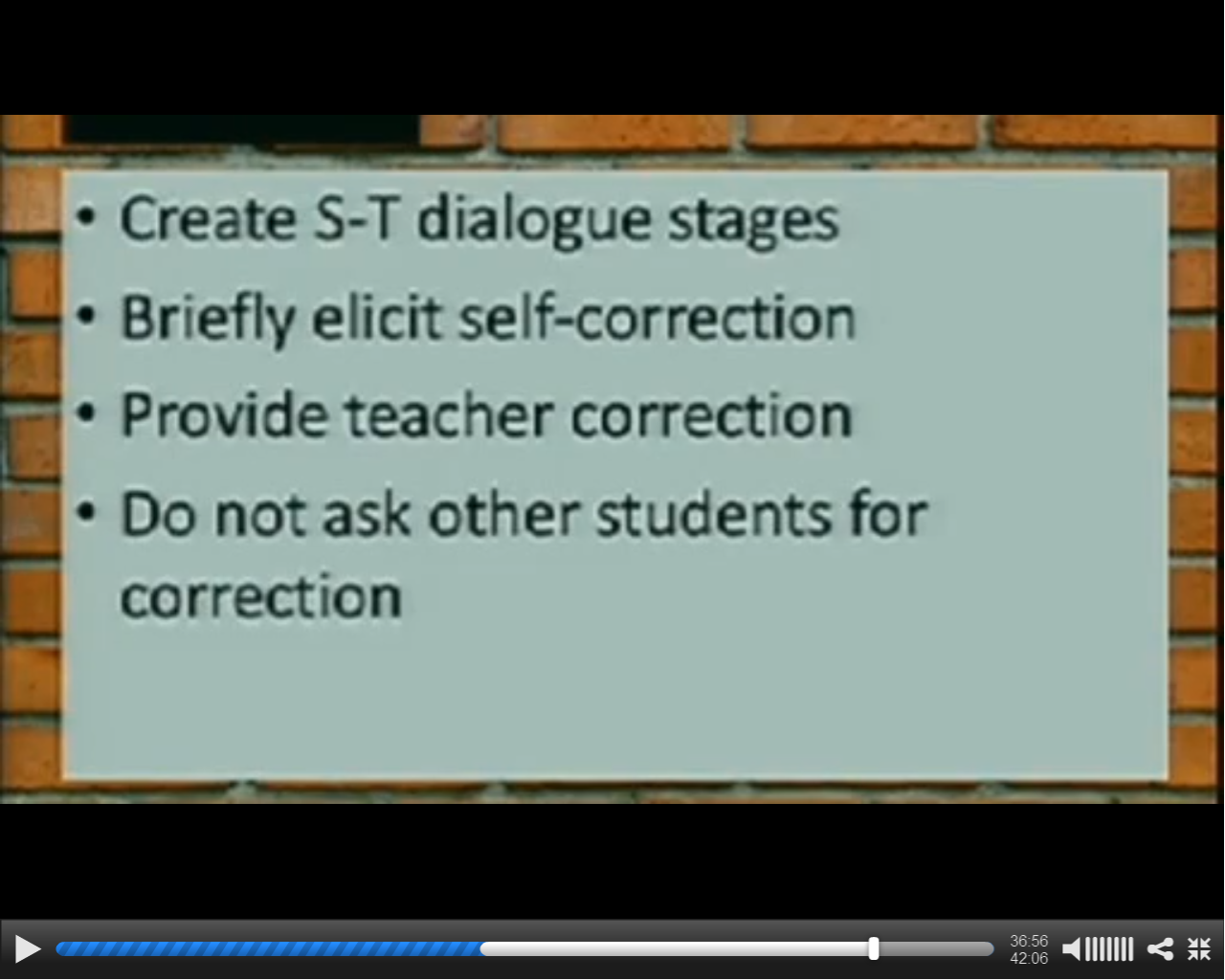
Recommendations

Screen shot of Chris Smith's slides

Screen shot of Chris Smith’s slides

Final thoughts

The teacher needs to think of the time s/he will do error correction, plan it and use the most suitable techniques. Error correction does work and students want more of it!!

Screen shot of Chris Simth's slide. More error correction.

Screen shot of Chris Simth’s slide. More error correction.

Chris Smith works at the English Language Center of Sheffield University. You can watch his talk here More Iatefl 2015 posts Donald Freeman’s talk Joy Egbert’s talk   Till next time……….

Module 3: EAP specialism

Since I completed and passed the  Cambridge Delta, I thought it would be a good idea to share with you my module 3 assignment. Module 3 is the long assignment. You have to write up to 4500 words on anything you want to specialize in. I chose EAP. When writing this paper, you need to write a  sort of literary review/background of whatever you are specializing in, you have a needs analysis section, you write about assessment and you design a course. I decided to focus on Academic Speaking and my course was going to be a presentation skills course.

When I shared my thoughts with my tutor, he expressed a few concerns about academic speaking because there is not enough bibliography around it. I thought though that if I was going to spend this much time on something, I should do it on something I really enjoy. Out of all the EAP subjects I teach in the UK, the one I enjoy the most is presentation skills. After starting though, I realized that it is not easy to find sources and research on EAP presentation skills. So, while I did enjoy it, it was a tough cookie.

I was unable to find samples of module 3 papers online and academic speaking/presentation skills was not really out there. This is why, here, on my blog, you can check out what I wrote. My grade is PASS. This is what a pass looks like. I am not going to share the appendices, only the essay.
My silver book

My silver book

THE PAPER

Academic Speaking: Developing an EAP presentations skills course for a group of international students

  1. Introduction

1.1. Reasons for choosing this topic

I have been teaching English for many years now and for the past four years I have been teaching English for academic purposes (EAP). In the UK, I teach pre-sessional EAP courses, whilst in my hometown, I teach EAP to students who are studying at the Technical University of Crete and need help mostly with their academic papers and their oral presentations. I chose EAP as my specialization because I want to extend my knowledge in this context. I chose academic speaking and specifically presentation skills as my focus because from my experience in the UK and here, I find that more emphasis is placed on academic writing and less on speaking and presentation skills resulting in poor presentation skills.

1.2. Defining EAP

According to Dudley-Evans and St. John (2001, p.34) “English for academic purposes refers to any English teaching that relates to a study purpose”. Contrary to general English, in EAP, “the teaching and learning context in highly specific” (Alexander et al, 2008, p.2). EAP has emerged from English for specific purposes (Hyland & Lyons, 2002, p. 2). EAP can be divided into ESAP and EGAP. English for general academic purposes (EGAP) refers to “the skills and language that are common to all disciplines” (Dudley-Evans & St John, 2001, p. 41) and English for specific academic purposes (ESAP) refers to “the teaching of the features that distinguish one discipline from others (ibid)”. There is a lot of debate about what is better. My experience is teaching EGAP at pre-sessional courses or as part of private tutoring sessions. EGAP helps my students acquire general academic skills. They can focus on more specialized contexts when they are in their departments (Blue 1988 cited in Dudley- Evans & St. John, 2001, p.42). In fact, I think it is better to equip my students with more general academic skills as their language level is often quite low and their experience is from a different educational background.

1.3. Features of EAP  learner and course

Compared to English Foreign Language teaching, EAP is goal driven and often connected to an academic course (Alexander et al., 2008, p. 3). The students’ motives are mostly connected to getting into or studying at an English medium university and teachers and students are viewed more equal as they are both members of the academic community. The content is limited to academic discourse with emphasis on reading and writing whilst the choice of the texts depends on academic genres. Finally, EAP places a lot of emphasis on study skills like critical thinking and learner autonomy (Alexander et al, 2008, p. 3-5). In order for international students (nonnative speakers) to deal with the challenges of academic study, they need to be competent in different skills and language areas (Bernan & Cheng, 2010, p. 25) than those of native speakers (also see section 1.4).

 An EAP course trains learners in various skills. Core components of an EAP course are:

  • Academic reading where students read different texts, engage in purposeful, interactive reading and may employ skimming and scanning skills (uefap.com).
  • Academic listening during which students listen to lectures, speeches, seminar discussions (uefap.com).
  • Academic writing during which learners may be asked to write, for example, reports, essays, case studies and many other genre types (www.uefap.com).
  • Note taking, using research skills and referencing.
  • Academic speaking which can be divided into seminar skills and presentation skills.

                                                                                                      (Jordan, 2006, p.58).

   1.4. Academic Speaking

Academic speaking has similarities to academic writing as it is “formal, explicit, hedged and responsible” (www.uefap.com). Rhetorical functions used in academic speaking are among others: describing objects, location, structure and direction, reporting and narrating, defining, classifying / categorizing, talking about tables and charts, comparing and contrasting: similarities and differences, arguing and discussing and so on (www.uefap.com). In fact, in EAP, speaking skills are as Hughes (2002, p.57) puts it, “embedded in broader functional areas (such as disagreeing) and in turn presented within real-world contexts and genres” in this case presentation skills.

Compared to academic reading and writing, less research has been carried out on academic speaking. Although limited, research carried out has shown that NNS are often intimidated by speaking tasks like giving oral presentations and taking part in discussions due to lack of linguistic competency or differences in the educational cultures (Ferris & Tagg, 1996, p. 300). Other research has shown that compared to NS, NNS perceive speaking “at least somewhat difficult” (Berman and Cheng, 2010, p. 29). In their research, Berman and Cheng (2010, p. 31) found that graduate NNs consider giving oral presentations the most challenging part of their academic studies. Taking part in conversations, understanding classmates’ questions as well as asking and answering questions are also difficult for NNS graduate students (ibid).

1.5. Teaching approaches in EAP

The approaches in teaching EAP are similar to those used in ELT. According to Jordan (2012, p. 60) there are three broad approaches towards EAP. A content or product approach may focus on language form, notions, functions, situations or topics. A skills-based approach focuses on sub-skills, micro or macro-skills and finally a process or method approach which involve task based syllabi, learner centeredness or negotiation and processes (Jordan, 2012, pp.60-63). In EAP, there is usually an overlap of syllabi which makes the approach towards EAP more “multi-syllabi” approach (Jordan, 2012, p. 63). Basturkmen (2003) argued that there are three types of course design in ESP course design which in this case also affects EAP approaches. One narrow angled which analyses needs in relations to a particular discipline or occupation and two wide angled options. One wide angled which analyses common needs connected to a discipline or occupation and the other which “focuses on characteristics of language use in a variety of English” (Basturkmen, 2003, p. 50).

  1. Needs analysis

2.1.Learner profile

My learners (three females, one male, all Greek) are Master and Phd level students at the Technical University of Crete who have extra academic writing and speaking tutorials with me twice a week. These learners are learning English in order to “access a particular academic community” (Alexander et al, 2010, p.3). They have taken general English lessons before. When asked about their learning style, they all mentioned they prefer watching videos (audio/visual learners) and enjoyed working in pairs and groups and did not really like to move a lot (kinesthetic) during sessions.

2.2. Target Situation Analysis

Target situation analysis looks at why the language is needed, how, where and when it will be used, what the content areas will be and who the learner will use it with (Hutchinson & Waters, 1998, p.59-60). Specifically, TSA identifies “the situation or setting in which the student will have to use the target language. This may be a study or work situation or any context in which the learner needs to use the language” (Richards & Scmidt,2010, 583-584).

In my case, learners want to deliver a well-structured presentation and use the appropriate language whilst doing so (see appendix 2, p.32). Three students will be presenting at a conference on Bio Remediation organised by the Technical University of Crete in June 2015, the other at a 3D animation related conference.

2.3. Present Situation Analysis

Present situation analysis, proposed by Richterich and Chancerel (1997/80, cited in Jordan 2012, p.24) looks at the students’ “state of language development at the beginning of a language course’’ (Jordan, 2012, p.24). In my case, information was gathered through structured interviews (appendix 2, p.32 ), a survey (appendix 5, p.44 and survey results appendix 2, p.35-38 ) and a diagnostic test lesson (appendix 4, p.40-43).

2.3.1.Structured Interview

Learners mentioned they need input on the designing/planning of a presentation, generic language, pronunciation and delivery. They also mentioned difficulty with Q & A sessions. Surprisingly, none of the students had a clear understanding of academic speaking and its connection to presentation skills (appendix 2, p.32).

2.3.2. Diagnostic Test Lesson

I asked my learners to give a 10 minute presentation using material they presented before. Their presentations had to do with their specialization (Phyto Remediation and 3D animating).

I assessed their performance by using presentation marking criteria from the University of Newcastle and Bristol (appendix 3, p.39). These criteria are used as part of the presentation skills exams held at the end of their pre-sessional courses. I used both assessment sheets because I am familiar with them and have been trained on how to use them. I found that although there are similarities in what is being assessed, the wording of the criteria and some subcategories differ. The assessment of the presentations had to do with structure, pronunciation, content, language (lexis and grammar), communicative effectiveness/ technique (see appendix for analysis of assessment criteria and appendix for assessment criteria sheets). No numerical grades were awarded.

Diagnostic test lesson conclusions (appendix 2, p.34 and appendix 4, p.40-44): Structure: Only one student had a presentation which complied with title/overview/main body/ conclusion presentation format. In fact, 3/4 students had no overview slide. They did not give an introduction to their presentation. They did not summarise their points nor use backward or forward referencing skills.

Pronunciation: Students pronunciation was heavily influenced by their L1. Often the pronunciation of key words and simple past -ed endings ([d] versus [t] sound endings) were erroneous.

Content/task fulfillment: Content was well developed and clear and ideas were supported in detail/adequately. The questions were handled well, although students were reluctant to ask questions.

Language (lexis and grammar): Although errors did occur, they did not impede communication. It was generally appropriate and the students used a variety of structures (simple and complex). Most errors occurred with complex structures.

Communicative effectiveness/techniques: This was the area students showed most weaknesses. Students read from slides and did not stand up or point at slides. They did not use signposting language. Visuals were too wordy without citations. Voice/rhythm was monotonous.

2.3.3. Survey

On the day of the diagnostic lesson learners were given a questionnaire before presenting (appendix).The results showed:

  • All learners hold at least a B2 level certificate and they use English every day.
  • Grammar and lexis is what they find difficult about speaking in English (2/4 speak in English at university regularly)
  • They have all given a presentation in English but have never had lessons on how to present in English.

ü  In order to prepare for presentations, the majority said that they practice with the (subject specialist) professor.

 Students also ranked the most important elements of a presentation. The results ranked:

1st Planning

2nd Language

3rd  Signposting language

4th  Pronunciation

 5th  Appearance of visuals

2.4. Priorities for course design

Based on the analysis of the TSA, PSA and DT, the focus points of the course are:

  • Structure: The planning of a presentation, the division into sections, backward and forward referencing will also be addressed.
  • Visuals: focus will be placed on wording of visuals, graphs, citations on visuals.
  • Communicative effectiveness/Technique: Attention should be placed on paralinguistic features (eye contact, mobility during a presentation).
  • Language: Students need training on paraphrasing and summarizing strategies as well as the grammar and lexis associated to the content of their presentation. They also need to practice set phrases which are used when giving a presentation like signposting language.
  • Voice: pronunciation, rhythm and intonation will be addressed.
  1. Course Design

            3.1. Syllabus/Course Type

Although there is an overlap of syllabi, the syllabus I propose is a process oriented approach which focuses on the academic speaking skill (presentation skills) with elements of learner and language-centered approaches (Hutchinson and Waters, 1998, pp 67-68 & 74-76). The course will be a type 2 wide angled course (Basturkmen, 2003, p. 50) which concentrates on common needs with reference to needs of a specific discipline and core academic skills (Basturkmen, 2003,p.53). Generic models of presentation skills can be taught in these types of courses. Some argue though that there is not enough research to prove that generic skills actually exist and that by focusing on general needs, no ‘actual needs’ are taken into account (Basturkmen, 2003, p.58).

3.2. Justification of choice of Presentation skills course

When I first started teaching this group, I noticed that my learners had academic writing input but not much academic speaking and particularly presentations practice. Presentation skills are an integral part of every EAP course. An effective presentation is similar to an effective piece of academic writing. It involves good structuring, visuals, voice, advance signaling or signposting as well as language. (Dudley Evans & St John, 2001, p. 113). Thus, I chose to prepare a course which trained my learners on presentations skills.

3.3. Course Objectives

Students will learn to:

  1. Plan and separate a presentation into sections (an overview, background, a main body, a conclusion and a Q & A section).
  2. Make effective and clear visuals.
  3. Use non-verbal and paralinguistic elements to make their progression effective.
  4. Pronounce key words correctly and use the right intonation/ stress patterns in order to be intelligible.
  5. Paraphrase and summarise their ideas.

They will also

  1. Use critical thinking to evaluate their material and provide peer feedback.
  2. Produce and present a PowerPoint presentation for the Bio Remediation Conference held in June 2015.
  3. Practice using set phrases.
  4. Practice using Harvard referencing style.

Link to students’ needs

 The focus on presentation skills is connected to the students’ lack of prior training and worries about how to give an effective presentation in English. The emphasis on planning and slides has to do with my observation, the Target situation analysis and the learners’ concerns. The Diagnostic lesson and TSA (see sections 2.2. and 2.3.3) showed weaknesses in pronunciation, rhythm and intonation. In particular, non-verbal communication, pronunciation of key words likes phytoremediation or empathy, pace and intonation are areas my learners need to improve in (appendix 2, p.34 and appendix 4, p.40-44). Students also need training on summarizing and paraphrasing as well as building their academic vocabulary because during the DA students were over relying on slides (appendix 4, p.40-44).

3.4. Material used during the course

As I have taught pre sessional EAP courses at three different universities, I have used different materials which allow me to have a clearer view of their effectiveness. Therefore, I will be using material from different sources: textbooks, university handbooks and the internet. It is imperative that the teaching material raise awareness for both the learner and teacher but it is not possible to rely on most texts books to do this at present (Harwood, 2005) which is why adapting material, supplementing material from various books and creating my own material is necessary in this case (appendix 6, p.46-49). Students will also be writing journal entries throughout the course so as to reflect on their performance.

3.5. The Course Plan

This course (appendix 1 materials, p.25 and plan appendix 1, p.26-31) is a ten week course and there are two hour sessions per week. There are four learners attending the course. There are three cycles. The first cycle is concluded with mid-course tutorials. The second cycle offers more input on presentation and the final cycle is exam week.

Weeks 1 to 5

Content: Students will watch videos presenting features of good and bad presentations. They will plan their presentation (title, outline and main body slides). They will give mini presentations. The will receive input regarding the Harvard referencing style. Workshops will gauge learners’ understanding and progress so far.

Language focus: language for opening a presentation, presenting topics & subtopics, summarizing and paraphrasing strategies.

Assessment: students will provide peer feedback and self-assess in their journals. The teacher will offer (oral and written) formative feedback.

Teaching approaches: The syllabus will be skills based (speaking skill).  It is a process oriented approach with focus on the language and the learner.

Connection to learners ‘needs: students mentioned they need help with planning+ structure. DL and observations showed lack of signposting language. Visuals were lacking citation and too wordy.

Weeks 6 – 9

Lesson content: students will look at visuals (tables, graphs, charts), and practice backward and forward referencing. Emphasis will be placed on communicative effectiveness and technique. Students will receive training on intonation, word stress and pronunciation of key terms. They will also receive input about dealing with anxiety. The conclusion slide and Q & A parts of presentations will also be presented during these weeks. Workshops will monitor students’ progress.

Language focus: language for visuals (talking about visuals, comparing data, highlighting data) and signposting. Language for answering questions.

Assessment: students will provide peer feedback and reflect in their journals. The teacher will offer (oral and written) formative feedback.

Teaching approaches: The syllabus is skills based (speaking skill).  Once again emphasis is on the language and the learner (process oriented approach).

Connection to learners’ needs: students requested help with visuals and language for visuals and Q & A sections of presentations. Communicative effectiveness/ technique were areas learners performed poorly during the DL.

Week 10

Lesson Content: Exam week during which students present their presentation.

Assessment: Summative assessment based on presentation skills assessment criteria (appendix 8, p.50).

Connection to learners’ needs: students want to present an effective and successful presentation.

Teaching approaches: The syllabus is skills based (speaking skill).

In session 3 of week 10, I will provide an overview of the 10 weeks + feedback for all learners’ presentations. Input will also be given in relation to the suitability of their presentations for the forthcoming conference (also see section 2.2, p.7).

3.6. Course constraints

Due to time limitations, I was unable to focus on communicative effectiveness and technique as much   as I wanted to. I only focus on pronunciation of key words even though my learners need help with pronunciation in general. As this is not part of an EAP university course, grading does not affect students’ grade. Formal grades would provide extra incentive.  I also believe that the course may be very focused on the conference presentation and as a result my learners may neglect any general core academic skills geared to helping them with the general academic presentation skills but may not seem relevant to their conference presentation. 

  1. Assessment

      4.1. The importance of assessment in EAP

Assessment is an important aspect of the “teaching and learning process and essential to students’ progress towards increasing control of their skills and understandings” (Hyland,   p.99).This everyday classroom practice allows the teacher to understand the strengths and weaknesses of the learners and express them to the students (Hyland, 2006, p.99). The purpose of evaluation is to “collect information systematically in order to indicate the worth or merit of a program or project… and to inform decision making” (Weir and Roberts 1994, cited in Jordan, 2012, p. 85).Skillbeck (ciuted in White, 1998, p. 40) views assessment as a process of  “ determining and passing judgments on students’ learning potential and performance” (ibid) while evaluation has to do with” making judgments about the curriculum including the process of planning, designing and implementing it” (ibid).  Feedback and tests are parts of evaluation that inform the development of a course and the end product (Jordan, 2012, p. 85). Black and William (1998, cited in Harmer, 2013, p. 137) discovered that what affects students’ achievement the most is feedback on their work. According to Dudley- Evans and St. John (2001, p. 210), “the reasons for assessment can be grouped under two headings for feedback to aid learning and for a comparable measure of competence”. Public examinations and tests within educational institutions enable comparable measures whilst assessment can reinforce learning through confidence building or reinforcement (ibid).


4.2. Types of assessment

Assessment can be teacher or student led. It can be:

  • Summative which is a formal type of assessment that can be a one off formal assessment, for example, examinations, portfolios ( Harmer, 2013, p.379).
  • Formative which is a day to day type of informal type of assessment which shows how the students are progressing, for instance, observations, homework, journals, peer feedback (Harmer, 2013, p.379).
  • Diagnostic assessment which helps recognize students’ current, skills, knowledge, and capabilities through pre-tests, self assessments or interviews (facdev.niu.edu).

4.3. Principles underlying choice of assessment types chosen for this course

In order to assess my students’ performance I will use diagnostic, summative and formative assessment types (also see section 3.5 for course plan). Assessment will be reliable and valid and test what they intended to test do it consistently (Hyland, 2006, p.99). ‘’Receptive skills can be tested objectively but productive skills usually require subjective testing’’ (Jordan, 2012, p. 86), therefore testing will be more subjective. The backwash effect which influences what and how everything is taught (Dudley –Evans & St. John, 1998, p.214) will also be an integral part of my course and inform my lesson content. The feedback from the teacher will be (oral and written) formative (appendix 7, p. 49) and summative while students will write in their reflective journal (self-assessment) and offer peer feedback.

As this is a multi-syllabus type approach, all these assessment types shape the focus of the sessions in relation to the topic and the skills/ strategies practiced and the intended outcome of the course. Informal talks during tutorials and (informal) formative assessment workshops gauge students’ understanding of what has been taught and enable me to have a clearer picture of the sessions. They also identify the language (process oriented approach syllabus type with focus on language and the learner) and the micro skills/ strategies that need to be addressed in the lessons following the formative assessment (skills oriented approach). Formative assessment throughout the course will be focusing on different micro-skills/strategies/skills and related to what the students indicated as weakness during their diagnostic lesson. Finally, the learners’ performance will be formally assessed as part of a summative assessment exam at the end of the course in week 10. In order to assess students’ final presentation, I will be using presentation skills assessment criteria and specifically band descriptors (appendix 3, p.39).  Dudley-Evans & St. John (2001, p. 217) state that, “descriptors can be specific to a particular skill or give an overall assessment. For marking and for maximum information, skills based descriptors are desirable”. Although, the assessment of productive skills can be subjective, the use of descriptors makes it more standardized and objective but as Alexander et al (2008 p.328) state when discussing descriptors, “it is difficult to define assessment criteria and standards unambiguously… If they are specified too closely, there is a danger that they will be applied mechanically” (ibid). In order for teachers to be effective and objective when using these descriptors, they need to be well trained and standardized. Apart from the assessment sheets, students will also be given an overall report describing how the students have excelled during the course and an assessment of their progress (Harmer, 2013, p. 140).

4.4.Overview of presentation skills’ course plan and assessment types

Diagnostic assessment: A diagnostic lesson took place at the beginning of the course and identified my students’ strengths and weaknesses (appendix 2, p.34 and appendix 4, p. 40-43). Students were also given surveys (appendix 2. p. 35) with questions related to their academic speaking skill and presentations skill (self-assessment).

Formative assessment: In weeks 3,5,7,9,10 I will observe my students’ performance and give them formative feedback (oral and written). I will also hold one to one tutorials during which I suggest how their performance can improve. My students will also give peer feedback (appendix 7, p. 49). In order for my students to be more reflective, they will also engage in journal writing (weeks 2, 5, 9).

Summative assessment: At the end of the course, I will assess my students’ performance by using the same assessment criteria I used prior to the course (see appendix 8, p.50) which facilitate a comparison between their performance prior and after training. The assessment criteria focus on content, language (lexis and grammar), communicative effectiveness (technique), structure, task fulfillment and pronunciation.

Backwash effect

The different types of assessment will have a backwash affect which will shape the contents of my workshop sessions as well and especially that of the workshop sessions. The weaknesses observed will be addressed in the forthcoming sessions.

The preceeding assessment methods will be employed in order to ensure that at the different stages of the course, the learners are on task and that the end product (their final presentation) will be an effective presentation and suitable for their real world needs which is presenting at the Bio Remediation Conference in Crete (TSA).

Assessment type Test type/Method Week
Diagnostic assessment Informal interview

Diagnostic test lesson which assessed students’ existing knowledge.

Before the course started
Formative assessment Oral presentation (teacher led feedback)

Oral presentation (peer feedback)

Tutorials

Journal (self-assessment)

Weeks  3, 7, 9, 10

Weeks 2, 5

Week 5

Week 2, 5

Summative Presentation Exam (Presentation Skills Band Descriptor used to grade performance) Week 10


  1. Conclusion

Designing this presentations skills course as part of module 3 has been my first attempt to design a course and look closely at the components of course design. Module 3 gave me a clearer view of learner needs and how they can inform the designing of a course. Although, I always carry out needs analysis, I was not aware of the significance of target situation analysis and how it defines the objectives and outcome of a course. From now on, I will be taking more things into consideration when deciding on material and syllabus.

One of my main concerns was to meet my learners’ needs especially as because they have never had any formal presentation skills training. I believe that I have connected the course content to my learners’ needs, making it a very learner centered course. Their lack of prior training also led me to include several workshops.  Unfortunately, due to time and space limitations of this paper, I was not able to offer students as much practice on delivering a presentation as I wanted. The course and its objectives are actually highly related to the target situation analysis and the conference that will be held later on in this town. While this is connected to the objective of the course, it may also be viewed as its shortcoming as well, as students do not practice different topics. Although I feel that this course has taken a lot of the learner needs into consideration, improvements can still be made. I would design assessment criteria myself, instead of using two assessment sheets. I would include more sessions with language input. I will also provide more lessons which targeted pronunciation as this is an area my learners need to improve in.

 The fact that this course is closely related to not only their academic needs but also their real life needs make it even a more rewarding venture for me as a teacher.

 Reference list

Alexander, O., Argent, S., Spencer,  J. (2008) EAP essentials A teacher’s guide to principles and practice. Reading: Garnet Education.

Basturkmen, H. (2003) Specificity and ESP course design RELC Journal 34 (1), p.48-63

Berman, R. & Cheng, L. (2010) English academic language skills: Perceived difficulties by undergraduate and graduate students, and their academic achievement. RCLA  CJAL 4 (1-2)

Retrieved here: http://journals.hil.unb.ca/index.php/CJAL/article/viewFile/19830/21602 .

Dudley- Evans, t & St. John, M (2001) Developments in English for specific purposes: a multi-disciplinary approach. Cambridge: Cambridge University Press.

Ferris, D. and Tagg, T. (1996) Academic Listening/Speaking Tasks for ESL Students: Problems, Suggestions, and Implications Tesol Quarterly 30 (2), 297-320  Retrieved from:  http://www.jstor.org/stable/3588145

Harmer, J. (2013) The practice of English language teaching. China: Pearson.

Harwood, N ( 2005) What do we want EAP materials for. Journal of English for Academic Purposes, 4 (2), p. 149-161.

Hughes, R. ( 2002) Teaching and Researching Speaking. Malaysia:  Longman.

Hutchinson, T. & Waters, A. ( 1998) English for specific purposes: A learning centered approach Cambridge: Cambridge University Press.

Hyland, K., & Hamp-Lyons, L. (2002). EAP: issues and directions. Journal of English for Academic Purposes 1, 1–12.

Hyland, K. ( 2006)   English for academic purposes: an advanced resource book. New York: Routledge

Jordan, R. R. (2012) English for academic purposes: a guide and resource book for teachers. Cambridge: Cambridge University Press.

Richards, C. J. & Scmidt, R. (2010) Language Teaching and Applied Linguistics. Malaysia: Pearson.

White, R. (1998) The ELT curriculum. Oxford: Blackwell.

Websites

www.facdev.niu.edu

http://www.uefap.com

Online Presentations, CPD and the lots

Presenting at an Online Conference: 
                                                 food for thought

The other day I presented at “The cultures of EAP” online conference and my presentation got me thinking (yay, you get to read another one of my rambles), so,  I now really want to share with you some of my thoughts about online conferences, how I experienced the conference as a member of the audience and my views as a presenter as well.
Why attend an online conference?
  • For continual professional development…. obviously!
  • They offer the option of recordings, so everything is saved. If you miss a session, you can watch it later. 
  • They are convenient. You are at home, in your jammies and learning in the most comfortable of ways.
  • Participants can be from all over the world, so you may hear a talk from someone who would not be able to present at a face to face conference (for presenters who are not key note or invited speakers, face to face conferences can be a bit expensive in terms of travel expenses).
  • The platforms that host online conferences have chat boxes so you also get to interact with the other attendees. There are no ”shhhhh” moments in this case (while they are an an excellent opportunity for some serious chatting, they can be a bit distracting though).
Why present at an online conference?
Well, why not? OK, if you need a bit more persuading, here goes.
  • You, the presenter, don’t have to go anywhere. You are at home, so actually there are no expenses! It is also probably the most comfortable way to present (you are in your slippers, in your own chair etc, etc)!!
  • Because presentations get recorded, you can reflect on what went well in your presentation and what needs to be improved. You can also keep your presentation in some sort of e-portfolio ( I add mine to my blog page). 
  • You may be nervous, but not as nervous as when presenting face to face. So, if you want to start presenting your views, an online conference is less nerve wracking.
  • Your audience is from all around the world!
  • It is good for the CV fellow teacher.
  • Like any conference presentation, you get to dig deeper into issues you are interested in, share your views and even learn something from the audience’s comments. It is a win-win situation.
The PPP of an online presentation: advice to the presenter
Plan
Practice
Promote
If you do submit a proposal for a talk at an online conference, this is what I suggest. Plan your talk, make you slides and then practice what you are going to say. Time yourself because while at a face to face conference someone will probably warn you when you only have 5 minutes left, at an online one that does not really happen so it is easier to lose track of time. Finally, start promoting your talk. If you want people to attend your talk, inform them by tweeting about it (systematically), share the info on Facebook and LinkedIn groups. If you have a google+ button, press it. 
On a more personal note… my talk….. my reflections….
I talked about the impact of presentation skills assessment criteria on syllabus design. This was my first EAP related talk, so I was really enthused about it. I am not going to toot my own horn about the things I think I did well. I am going to tall you what I did do though. I had a lot of things to say and that was mistake numero uno. My planning. I timed myself at home, but lost track of time due to nervousness and stumbling over my own words. I also made a major omission.I talked about presentation skills assessment criteria, learner problems and syllabus design, and how criteria can inform syllabus design. However, I did not mention any implications to such an approach. Ironically, I always tell my learners, you gotta mention implications when you talk about your research. Yeah, practice what you preach, Joanna!!Sadly enough, a friend who attended my talk, spelt this one out for me : (. 
Notes to my future online (and offline) presenter self:
Even though you think you have planned your presentation well, you haven’t, so, plan more.
If you know anyone who knows anything about what you are talking about OR has experience presenting, ask for advice regarding your presentation. You may hear something helpful.
Final thoughts
I am really thankful to everyone at Sheffield university’s English Language Center and Oxford University Press for organising/hosting the “Cultures of EAP” conference and giving me the opportunity to attend and present at the conference. The conference was about the Cultures of English for Academic Purposes (for more information go here). 
If you have presented online and want to share your own thoughts, feel free to comment in the comment section below. 


Till next time…

EAP writing

          Going from being a teacher, to being a learner

Isn’t interesting how, sometimes you teach something, and then when you actually do what you are teaching, you see how hard it is? Well, that is what happened to me. I went from a teacher to a learner. I tried to go from what I teach, to actual practice, and this, my friend, was a tough cookie. But what am I talking about? OK, let’s take things from the beginning.
Academic Writing. I teach it. I teach how to do research, how to use the research, paraphrase, summarise, make your voice stand out.I talk about having arguments and supporting them, but today while I was working on my Delta module 3 assignment*, I realised that this is really hard! So, let’s see some typical learner problems, what I tell my learners and what I actually think.

Academic Writing: Learner (and my) problems

  • Finding/ Choosing the right sources
I often tell my learners that they will/ should find a lot of sources to support what they want to say and that it is important to make their views stronger and valid by supporting them with research. I then go on to say, “When you do not have enough sources. Go to the library. Search more. Search, search, search. Be critical. Read what your sources say carefully. Make notes. If there is not enough research, synthesise information from various sources”. 
What I really think: 
  1. There is so much research out there and understanding what and how to use something is extremely hard. Searching online or in a library is time consuming. Not being able to access freely what you want is frustrating. This may lead your critical thinking down the drain and you may end up using what you found even though you now it is not always the best. It is like using a source just to use a source.
  2.  There may not be enough research on what you want to argue because researchers focus on other things or because what you are writing about is fairly new or so on. In this case, you cannot support your views with a source, making your argument weaker than you want.
True story: Today, I wanted to write about some of the challenges NNS EAP students have when giving oral presentations and could not find sources mentioning anything about body language or intonation patterns. In fact, I could not support half of the things, I know as a teacher, are challenging for international students who have to give a presentation.
I often tell my learners that if there is not research out there that must mean something. But what does it mean in my case? Are these not implications or is it that someone has not written about them?
  • Your first draft should not be your first draft
Or should I say, “always redraft before you give me your first draft.” Often when I teach EAP, I ask to see a student’s first draft. I always tell my students, “Please make sure that you have read, re-read everything before you give me your first draft. The better your first draft is, the better feedback I will give you”.
What I really think: Spot on! My first draft was rubbish. I redrafted so many times before handing in my so called first draft. 
  • Plan
I always tell my students, ”it is important to plan, make notes of what you will include in each section. This helps the flow of your ideas. It makes your writing more coherent and concise”. Yes, it is time consuming and requires a lot of thought and coining of ideas BUT the end product is much better than just sitting on your chair and writing.
What I really think: Planning does require time and when you have been reading, reading, reading, the time constraints are really tight, it is much easier to start writing cause in your mind, you think you have your essay all mapped out. Unfortunately, the time you saved planning, is spent on redrafting, so I am adamant about the planning stage. It should be as meticulous as possible actually.
  • Word count
I tell my learners, ”there is always a word count and you need to stick to it. It is important to be able to say what you want to say with fewer words and that is why you need to write and rewrite. Paraphrase and summarise.”
What I really think: Being able to summarise, paraphrase and be in the word limit requires a lot of training. It is not easy. Word count is something I always struggle with, I like to ramble and I am a chatter box (my blog is called myeltrambles for a reason). If I struggle, what do I think my students do? I need to see how I stick to the word count, and try to transfer the strategies I employ to my learners.
  • Citing/Referencing correctly from the beginning
As the reference system I teach is the Harvard referencing system, one of the first things I show my learners is how to cite and compile a reference list. I do this during the first lessons. I do not just teach them how to paraphrase but I also focus on citations. I tell my learners, “if you leave the referencing and citations for the end, then it will be very time consuming (and boring). To make matters worse, you may even plagiarise and forget to cite a source (the word plagiarism always alerts them).Knowing when to use italics or ‘  should be something you do correctly from your first draft.”
What I really think: Get it over and done with. As a writer of an academic text, you need to find out what the referencing system is and use it from the first line. Also start making the reference list when you first use the source in your paper. it saves you the turmoil of compiling a reference list at the end ( I do not like that. It takes so much time!).
  • Tutorials/ Ask questions about your writing
First drafts are often followed up by tutorials. Students get a chance to ask questions about their first draft based on the worries / questions they have or their tutor’s comments. I always tell my students to write these questions down, have a plan and ask, ask, ask. Some do. Others don’t.
What I really think: Asking questions is necessary. Yes, I think I do know what I am writing about but I still need help. There are things I am already on the fence about, which is why I already have 5 questions about some of the things I wrote in my Delta assignment. I have already asked them. I actually sent a first draft with some questions.

Quoting my friend Vedrana, ” being in your learners’ shoes is a great way to see if you are focusing on the right things as a teacher!”

Word count: unknown : )

*Today is world Teachers’ day and this is the day I wrote about what it feels like to do what you teach.Going from a teacher to a learner. If you ask me, a good teacher needs to know what it feels like to be a learner…….


Till next time…..


                     Induction Week
I started working at Sheffield University on the pre sessional English for Academic Purposes course last Monday, and time has flown without me realising it. There were no lessons this week. This week was all about teacher training and getting informed about how the English Language Center runs their EAP course.  It actually got me thinking about how important training sessions are and how useful these induction weeks are. So, my take on inductions in general and this week’s induction in particular.
One Week of EAP input

Having taught English for academic purposes before and having attended 3 different EAP induction trainings, I strongly believe that a week long induction is necessary. Inductions that are shorter are not enough because the information can be so overwhelming that it is impossible for things to sink in in less than a week!
What goes on during the induction?
Well, you learn about lots of things during induction week. You learn about teaching techniques, you become familiar with what you will be teaching, you look at the materials thoroughly, you get Q & A sessions, you attend various workshops with an EAP focus, you learn about the campus, different technologies, assessment criteria and lots more.
And anything else?
There is also the social aspect. You meet the people you are going to be closely working with. You meet your director of studies before the teaching begins (before you start bombarding the poor lad with myriads of questions about how to do this or that! Notice how I am already using lad?!?!). Meeting the people you are going to be working with in a more relaxed setting is great because no one is stressed. Your conversations are  not just about who taught what and when, students and so on. There is a lot of teacher talk going on, but it is the good kind (teachers talking to other teachers about…..other stuff : P).
What I particularly liked about this EAP induction.
The English Language Center of Sheffield University divided the teachers in two groups. there was a group for teachers who had taught EAP before, and a group for those new to the EAPsphere.
So?
Well, instead of being introduced to EAP related issues or reviewing things I already knew, I got a chance to be a bit more reflective and shared my experience with other tutors who had  EAP experience.  It was actually a bit like a swap shop/ a think tank.
Anything else I like about induction week?
As a teacher who lives abroad, I also got a chance to acclimatise myself a bit better before getting into a classroom.
Icing on the cake?
One of the teacher trainers was Jennifer Spencer, one of the authors of EAP Essentials.
 
So, this was a good week. I learnt a lot and enjoyed it even more. Am I stressed? Yeap. A bit. But it is productive stress. The good one.


Till next time………..

Study Groups

Study groups: How, When and Why?
We all  include group work in class, but what about study groups after class? I was first introduced to the idea of study groups when I taught a presessional English for academic purposes course a few years ago. I now consider them a prerequisite for my students’ progress, especially in EAP courses, but before I move on let’s take a step back.

What is a study group?
Well, as you know or can probably guess, it is a group (of students) that studies/does tasks together usually as part of their homework. Although my experience of study groups is in an EAP context, I have used them with my other learners as well, so I firmly believe that they can be introduced to ANY group of learners, no matter why they are learning English.

How do I set up the groups?
Well, in my EAP classes, each group was formed based on where they lived (I wanted students staying at the same hall of residence to be able to work together) and their English level (I try to form mixed ability groups). I also put students of different nationalities in each group so as to deter the use of the same L1 In any other context you can group your learners based on their fluency and level. Also, make sure you designate roles. Someone will be head of the group, someone will report on the progress of their work etc. Make sure everyone is going to be doing something. Also, from time to time switch roles. You could also introduce the paper clip contribution procedure to ensure everyone has done something as part of their study group task. So, if each student has 5 paper clips, then that is how many contributions they must at least make to the group.

A twist: I tell my students to record themselves when they are in their study groups. But…..Why?
Well, back in the days when I first got my students into study groups, I asked them about it The discussion went like this:

Joanna: “So, how was it? Did you enjoy studying together?”
Students: ” Yes, It was great. We really enjoyed it!”
Joanna: ” Did it help you learn? Was it easier to do things with the help of your classmates?”
Students: ” Of course, Joanna!!”
Joanna: “……Were you talking in English?”
Students: ………..
and then came the…”OK, so now I want you to record yourselves while doing your group homework, and……. you need to use English when in your study groups!”

The next day they all came in with big smiles on their faces and all volunteered to share their recordings.  “Here, Joanna!! Listen to us, we are talking in English!!” After that, I did not have to ask for recordings, they just brought them to me and when I forgot to ask for the PROOF they reminded me : )
So, recordings ensure that EVERYONE is using English and give my students the opportunity to listen to themselves and how they did as a group and as individuals in this group.

When do I use them?
Ideas for study group tasks
Well, the sky is your limit of course. Here are some suggestions for tasks:

  • Any kind of project or infographic
  • A research project
  • A poster presentation
  • A peer feedback activity where one student looks at the other’s writing/research paper and offers advice
  • A group play, poem song
  • Reading a text and doing the exercises together
  • many more…..
Why I like study groups:
  • Students work together and learn from each other. Such groups help team building and promote cooperation.
  • Everybody has to contribute which gives a sense of achievement to all learners.
  • They have more opportunities to use English outside the classroom.
So, that’s all folks! Feel free to leave a comment in the comments section below.
Till next time…..
                                         Picture taken from:http://hdw.eweb4.com/out/1088465.html

EAP: plagiarism

Academic Writing: Helping your students avoid plagiarism step one

The post about addressing plagiarism & paraphrasing
The big P word. Plagiarism. If you have taught English for academic purposes, you know this is a buzz term. As an EAP tutor, I am always going on about what plagiarism is, how to avoid it and I thought it was about time I wrote a short post about how I address plagiarism and how I help my students avoid plagiarism when paraphrasing sources. Now, this people is a tough cookie for both the teacher and the student!! This is my approach….

                                One step at a time

1. Address plagiarism
You need to be clear about what plagiarism is from the beginning and how it is important to cite other people’s views and not just act as if they are your own. Show them videos about plagiarism from YouTube, give them definitions from your own sources, from dictionaries, the lots. It is important to inform them. Also, be clear about the tolerance of plagiarism because sometimes it may not be deliberate (if your students mistype a date for example, do they fail or do you give them another chance?). Another important thing you need to keep in mind is that different fields use different referencing systems, so steer your students towards the one they will be using in their discipline.
Fun ideas: get your learners to make little projects (videos/infographics/posters/animations) of what plagiarism is.
Not such a fun idea: Ask loads of Q&As as well as CCQs related to what plagiarism is.

2.The plagiarism police
“You will be caught!” : S. Yeap. Let them know that you will find the plagiarism. Ask your learners to bring photocopies of the texts they used and paraphrased. Tell them hey should highlight the paragraphs they paraphrased. Inform them of the different software you will be using to scan their papers and detect plagiarism. It is a good idea to suggest that they check their papers for plagiarism with the same software as well.
So, now your learners know what plagiarism is expect the following discussion (I know I have had it a zillion times!):

Student: “Ok! I don’t want to paraphrase sources because it is hard and I will plagiarise.”
Teacher: “Hmmmm or ……………”
Student:  “Yes, I will quote. I will use quotation marks for everything I put in my paper and I will copy their exact words and everything will be fine!”
Teacher: “It is not a good idea to have an essay full of quotes and no paraphrases. You also need to synthesise your information. So, you need to learn how to paraphrase and summarise information. Don’t worry. You can do it! That’s why I am here!”
Student: : ( …….turns to   : )

3. The anti-plagiarism toolkit
Time to bring the big guns in. Let’s get down to business people!Your students need their anti-plagiarism toolkit. So, time to equip them with the strategies they need to avoid plagiarising their sources when using sources in their texts and not just quoting directly. Time to talk about paraphrasing.

Paraphrasing
This is the most important skill your students need to develop in order to avoid plagiarising sources. Of course, there are a million ideas out there and loads of activities you can use. I will just mention a few things I do. First, let me tell you though that my motto is start simple and then move on. Brick layering.
Start with some simple activities:

  • Key word transformations

Well, yes, why not use key word transformations to engage your learners in exercises that will force them to paraphrase? You can begin with something that builds their general English skills. Remeber….baby steps. The good thing about key word transformations is that since they are part of the Cambridge language exam (FCE,CAE,CPE) you find loads of books and websites with key word transformation activities. So, if, for example,your EAP students are B2 level learners, you can use any key word transformation activities that are for that level. They also give you the opportunity to gauge your learners grammar knowledge and you can focus on structures they are struggling with. Engaging in key word transformation activities does not mean that your learners are out of the woods, it is just a way for them to practice rephrasing short sentences.

  • The Academic Word List (word families-synonyms)

Your learners should download the Academic Word List and familiarise themselves with The Thesaurus (any thesaurus). Get your learners to write down word families and find synonyms. Enrich their academic vocabulary! The richer their vocabulary, the more lexical choices they have.

  • Nominalisation/Active voice vs Passive voice

Find tasks that practice nominalisation and the two voices. Paraphrasing is not just about using different words, it is also about grammar. In order to avoid plagiarism, you gotta get your learners to change structures, word order, forms. Noun phrases and the passive voice are found very frequently in academic writing, so practicing them will help your students feel more comfortable with these structures, thus they will probably use them whilst paraphrasing.

  • Noticing activities

Show your learners good examples of paraphrases. Use an overhead projector/smartboard and some sort of before and after examples and get them to notice the differences.I think it is better to do this as a group task and then follow up with some activities they have to do individually. Check to see if they have noticed all the changes and the differences in the structures, vocabulary etc. I get my learners to make tables of some common phrases and paraphrases/alternative phrases.

Illustration by Daniel Rhone accessed here

                The bigger picture
So, hopefully, with all this training, your learners can paraphrase at least at a sentence level, now it is time to paraphrase real texts. Time for some group work!
Divide your class into small groups. Give them a text and tell them to paraphrase it as a group. Then, tell the groups to swap their paraphrases. Once each group has another group’s paraphrase, the new group needs to underline/highlight anything they think has been plagiarised and once they have done that, they give the text back to the original group. Each group now has their own paraphrased text with feedback from another group. They use this feedback to paraphrase more. The paraphrasing should go on until each group is happy with their final product.
I then suggest getting your learners to practise in pairs and finally individually.

Advice I give my learners: try to paraphrase into simple sentences and then aim for more complex structures.
Once they have paraphrased the sources they want to use, they cite them accordingly, and well, they will have a plagiarism free text.

Final thoughts
Good luck on your anti-plagiarism venture fellow teacher. Feel free to add any other paraphrasing tricks in the comments section. this post will be followed up by a post on summarising so talk soon : )

Till next time……….

I will be talking about plagiarism on the 9th of August at the Belta & Tesl Toronto Web Conference on Reading and Writing. Log on, will you? For more info go to the Belta Belgium or Tesl Toronto website

Conference logo courtesy of Belta Belgium and Tesl Toronto

EAP resources

                                My Top (online) EAP resources

After writing my EAP course overview post, I thought to myself, “why not write about my go to EAP websites?” So, here are a few of the websites I use when I teach my English for academic purposes classes. If you have never taught EAP before, I think these links are a great starting point. If you have, still read this post cause you may find something you haven’t used (you can also add your own choices in the comments section).
Spoiler alert: not all the websites are focused on academic English, I do mention how I use them in an eap-ish way, though. So, here goes!

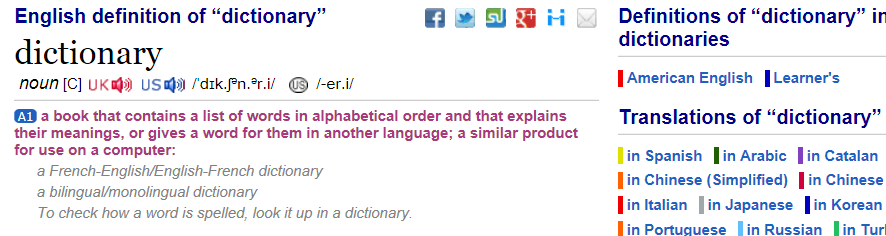
  • The Cambridge Online Dictionary
It is an online dictionary of course! What I like about it is that you can press the little speaker buttons (on the webpage) and hear the AmE and BE pronunciation of the word you are looking for. 
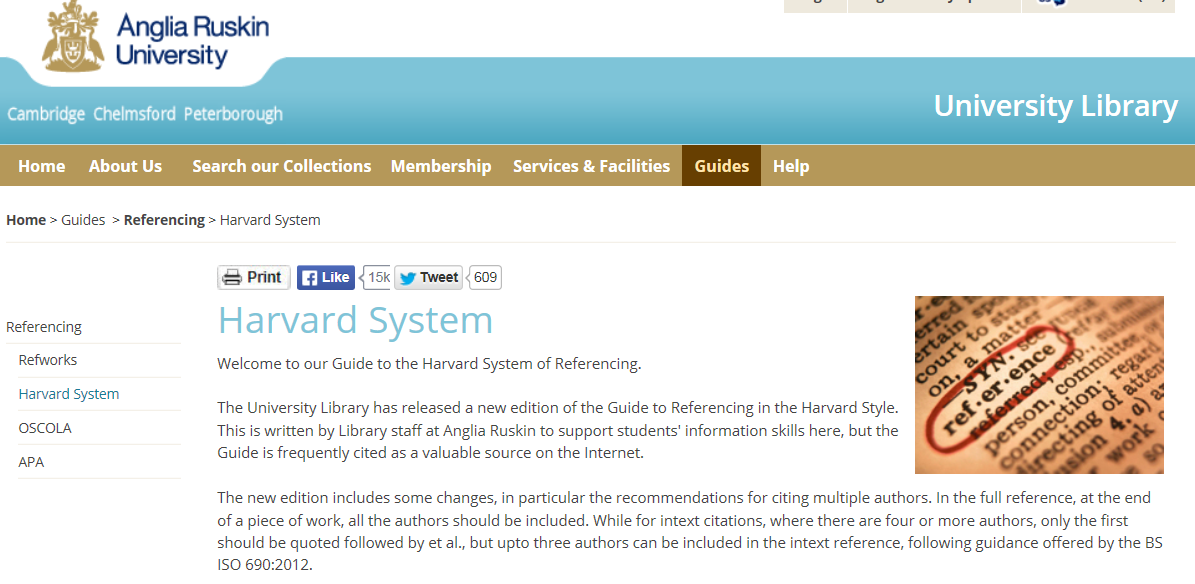
  • Anglia Ruskin University Library (Harvard referencing)
I like this site because if the reference system you are using is the Harvard referencing system, then you can find clear examples and great guidance of in-text citations and how to write the reference list as well.
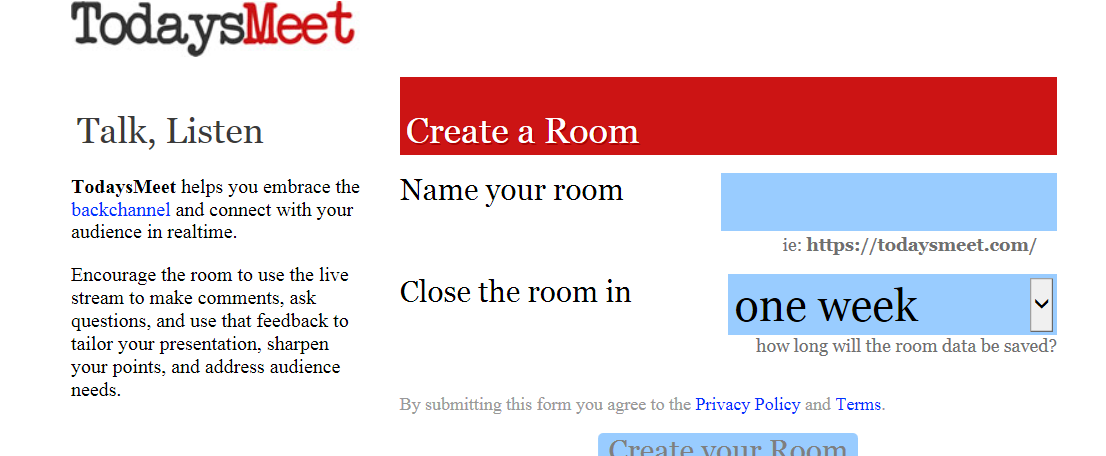
  • todaysmeet
You can use this site to hold short discussions with your learners. Use it like a discussion board (especially when blackboard’s discussion board is down during the summer). It is similar to twitter as there is a characters limit. It is great for starting threads. Just go ahead and create a room and share the link with your students!
  • Ted talks/Ted-Ed
There are many talks from subject specialists which you can watch in class with your students as part of a listening or presentations skills class. There are many videos to choose from. Two of my favourites: Jamie Oliver’s award talk on obesity and Amy Cuddy’s talk ” your body language shapes who you are”. You can also go to TED-Ed and create a lesson!
  • British Council BBC
You have probably visited this site many times. Press EAP in the search tab and you will find many interesting links. You can get many ideas from this website about how to teach EAP, discussions about EAP and lesson ideas.
  • British Council-Learn English
Here you can find the Writing for a purpose resource with lots of information on how to write assignments, exercises and examples of assignments (there are many different types of genres to choose from so it is great no matter what field your students are in). There are lots of tabs to choose from, and the information is very clear for us teachers and for our students as well ( they can look at this at home or in class)! Very well organised and easy to click through and find what you are looking for.
  • turnitinuk
This is the software you can use to check your students’ writing for plagiarism. You just need to create an account and submit the papers. After a while, you get the plagiarism results as well as the initial source of what was plagiarised. 
So, if you have heard of the Academic Word List, then this is a go to website. You can find the AWL (a list of words that researchers have concluded appear very frequently in academic texts) here. There are also tabs that focus on all the skills. You can either do some of the tasks with your students if you print them out or you can send them to this site as part of a self study task. Tell your students to press the materials tab and get down to work : ).
This is where you students can upload their presentation and record themselves speaking while changing their own PowerPoint slides. They then send the presentation to your email account and you can listen to them talk whilst also looking at their PPT. You need to press the home tab, sign up for free and then you start. Registering can be quite tricky but do try it out. My students loved using it.
  • Academic writing-Routledge website
If you have taught academic writing, you probably know Academic Writing: A Handbook for International students by Stephen Bailey. I often use material from this book especially for my lower level students. This book has a webpage and on this website you can find the answer key to the exercises of this book. There are also tabs with extra material, quizzes etc. Have a look at the plagiarism quiz tab!
  • Dvolver moviemaker
Your learners can create movies and send them to you. You may wonder what the connection to EAP is, though. Well, I use this as part of my seminar skills class. Very frequently, I suggest/teach expressions my students can use when holding discussions, negotiating etc. I then tell them to send me little movies with these expressions in them. So, apart from practicing during a speaking task in class, they also get to write them down and make their own dialogues whilst having fun!
  • One Stop English
You all probably know this website! There is an ESP tab and lots of material, some free, others you have to sign in for. Teaching tip: find the pdf file adopt Ivan. It is a great file to use when teaching seminar skills!
I hope you enjoyed this post. I know that there are many websites out there that you can use. I will be back with more suggestions in the near future. I look forward to reading any of your suggestions!: D
Till next time