Teaching …

Teaching is like …….. acting
have you ever thought of how many professions overlap? When teaching, do you ever feel like you are an actor/actress? Of course my title is not a sweep statement nor do I believe that teaching is exactly or simply like acting, but in this blog post you will find a few reasons why I believe being a teacher is like being an actor/actress minus the Oscar nomination. So, here goes….

  • No matter what is going on in your personal life, you got to put on a smile:
    • You can’t dwell on any hardships you are facing on a personal level, you have to teach, and teach well cause otherwise your students will not learn, enjoy themselves, be happy with your teaching.
  • Your classroom is your stage:
    • When you need to be the center of attention, you need to grab your learners’ attention. Your classroom is your stage. If your teaching, like acting, is boring, you have lost your audience; your learners (I am not saying that teachers should be the ones talking all the time and learners should just listen. Just saying that when teachers talk, they got to be interesting).
  • You need to sing and maybe even dance:
    • Isn’t singing and dancing part of your teaching especially when teaching young learners? Don’t you teach your students songs that will help them learn the alphabet, the vowel sounds, the colors? Aren’t you the one who shows them the moves to heads, shoulders knees and toes? That is some serious dancing and singing (you tap into the Fred Astaire you never knew you had in you, fellow teacher).
  • You use props:
    • You use everyday items and they are part of your setting (also see the stage bullet). These items help you get your message accross, make your lesson more lively. They are like special effects in movies. The only difference is that they make a ‘special impact’ on the learning process.
  • You add drama, laughter, surprise to your sessions:
    • In order to make your lesson more exciting you may resort to making jokes, being dramatic or adding a surprise element to your sessions. Aren’t all good actors/ actresses versatile? As teachers, we are not one trick ponies. We add a variety of elements to keep our learners engaged.
  • You cannot ‘perform’ well if you do not plan:
    • You need to know what you are going to teach before you go into class. You may even rehearse some of the things you will do to make sure everything goes according to plan. If you are a new teacher or teaching something new, you may even resort to learning things by heart!
  • You role play or… help them rehearse for plays:
    • In order for your learners to learn very often you get them to do role playing activities. This makes the target language often easier to learn. Then there is the end of the year event which very often is a play! You, of course, are responsible for costumes, rehearsal of plays etc.
  • You make your learners think, you broaden their horizons (self explanatory).
  • You get letters. messages, flowers, gifts….:
    •  You get lovely little cards from your students. You may even get a small gift or flowers as a way of showing that they enjoy your teaching.
  • Paralinguistic features matter:
    • You use your facial expressions, your body, your gestures to convey meaning, to get the message accross just like an actor or actress does.
Of course, you will not get an Oscar nor will you make big bucks, but then again who cares? You affect people’s lives and you equip your students with something exceptional: you help them communicate their thoughts!
Picture taken from here
Till next time….

EAP writing

          Going from being a teacher, to being a learner

Isn’t interesting how, sometimes you teach something, and then when you actually do what you are teaching, you see how hard it is? Well, that is what happened to me. I went from a teacher to a learner. I tried to go from what I teach, to actual practice, and this, my friend, was a tough cookie. But what am I talking about? OK, let’s take things from the beginning.
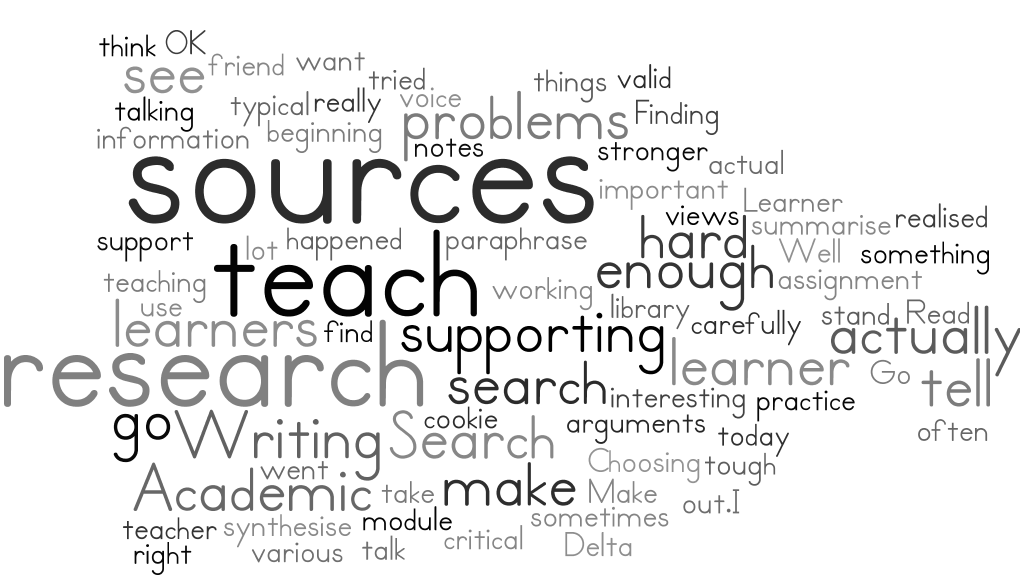
Academic Writing. I teach it. I teach how to do research, how to use the research, paraphrase, summarise, make your voice stand out.I talk about having arguments and supporting them, but today while I was working on my Delta module 3 assignment*, I realised that this is really hard! So, let’s see some typical learner problems, what I tell my learners and what I actually think.

Academic Writing: Learner (and my) problems

  • Finding/ Choosing the right sources
I often tell my learners that they will/ should find a lot of sources to support what they want to say and that it is important to make their views stronger and valid by supporting them with research. I then go on to say, “When you do not have enough sources. Go to the library. Search more. Search, search, search. Be critical. Read what your sources say carefully. Make notes. If there is not enough research, synthesise information from various sources”. 
What I really think: 
  1. There is so much research out there and understanding what and how to use something is extremely hard. Searching online or in a library is time consuming. Not being able to access freely what you want is frustrating. This may lead your critical thinking down the drain and you may end up using what you found even though you now it is not always the best. It is like using a source just to use a source.
  2.  There may not be enough research on what you want to argue because researchers focus on other things or because what you are writing about is fairly new or so on. In this case, you cannot support your views with a source, making your argument weaker than you want.
True story: Today, I wanted to write about some of the challenges NNS EAP students have when giving oral presentations and could not find sources mentioning anything about body language or intonation patterns. In fact, I could not support half of the things, I know as a teacher, are challenging for international students who have to give a presentation.
I often tell my learners that if there is not research out there that must mean something. But what does it mean in my case? Are these not implications or is it that someone has not written about them?
  • Your first draft should not be your first draft
Or should I say, “always redraft before you give me your first draft.” Often when I teach EAP, I ask to see a student’s first draft. I always tell my students, “Please make sure that you have read, re-read everything before you give me your first draft. The better your first draft is, the better feedback I will give you”.
What I really think: Spot on! My first draft was rubbish. I redrafted so many times before handing in my so called first draft. 
  • Plan
I always tell my students, ”it is important to plan, make notes of what you will include in each section. This helps the flow of your ideas. It makes your writing more coherent and concise”. Yes, it is time consuming and requires a lot of thought and coining of ideas BUT the end product is much better than just sitting on your chair and writing.
What I really think: Planning does require time and when you have been reading, reading, reading, the time constraints are really tight, it is much easier to start writing cause in your mind, you think you have your essay all mapped out. Unfortunately, the time you saved planning, is spent on redrafting, so I am adamant about the planning stage. It should be as meticulous as possible actually.
  • Word count
I tell my learners, ”there is always a word count and you need to stick to it. It is important to be able to say what you want to say with fewer words and that is why you need to write and rewrite. Paraphrase and summarise.”
What I really think: Being able to summarise, paraphrase and be in the word limit requires a lot of training. It is not easy. Word count is something I always struggle with, I like to ramble and I am a chatter box (my blog is called myeltrambles for a reason). If I struggle, what do I think my students do? I need to see how I stick to the word count, and try to transfer the strategies I employ to my learners.
  • Citing/Referencing correctly from the beginning
As the reference system I teach is the Harvard referencing system, one of the first things I show my learners is how to cite and compile a reference list. I do this during the first lessons. I do not just teach them how to paraphrase but I also focus on citations. I tell my learners, “if you leave the referencing and citations for the end, then it will be very time consuming (and boring). To make matters worse, you may even plagiarise and forget to cite a source (the word plagiarism always alerts them).Knowing when to use italics or ‘  should be something you do correctly from your first draft.”
What I really think: Get it over and done with. As a writer of an academic text, you need to find out what the referencing system is and use it from the first line. Also start making the reference list when you first use the source in your paper. it saves you the turmoil of compiling a reference list at the end ( I do not like that. It takes so much time!).
  • Tutorials/ Ask questions about your writing
First drafts are often followed up by tutorials. Students get a chance to ask questions about their first draft based on the worries / questions they have or their tutor’s comments. I always tell my students to write these questions down, have a plan and ask, ask, ask. Some do. Others don’t.
What I really think: Asking questions is necessary. Yes, I think I do know what I am writing about but I still need help. There are things I am already on the fence about, which is why I already have 5 questions about some of the things I wrote in my Delta assignment. I have already asked them. I actually sent a first draft with some questions.

Quoting my friend Vedrana, ” being in your learners’ shoes is a great way to see if you are focusing on the right things as a teacher!”

Word count: unknown : )

*Today is world Teachers’ day and this is the day I wrote about what it feels like to do what you teach.Going from a teacher to a learner. If you ask me, a good teacher needs to know what it feels like to be a learner…….


Till next time…..


One to one lessons

My one to one lesson procedure
I have been teaching one to one sessions for a very long time now and I thought it would be a good idea to share with you the steps of my one to one lessons.
Step 1
Greet the learner and start the chit chat.
I like asking my learner questions about his/her daily life, what he/she did yesterday, what he/she ate and so on. I like asking content questions. I have been a witness to lessons where the learner says ” Oh, I lost my bag yesterday” and the tutor’s response is ” Oh! OK….. so let’s talk about the 2nd conditional…” That’s a no no for me. Don’t just ask him/her how his/her day was for the sake of asking. When you ask a question, ask it… I mean ask, ask. Follow up with another question. I always have mini conversations.

Picture credits: Iconarchive


Icing on the cake: These mini conversations are a great way to check their grammar needs, what kind of vocabulary they are lacking, what they are interested in and they get to speak. They also get a chance to ask me a question or two, so my learners get to know me better. It is a win-win.
Want more? This summer I asked my EAP students what they think makes a teacher interesting (post here) and they told me that the teacher must tell them stories. They like hearing about their teacher’s life.

Step 2
The aims of the lesson
I tell my learner what we will be doing today (lesson aims). I talk about the grammar/vocabulary we will be using in today’s session. I also tell them what they will be able to do by the end of the lesson (outcome).
Step 3
The lesson
Step 4
I make lesson notes during the lesson. I write down the mistakes my learner made and talk about them. Don’t get me wrong, of course, I give immediate feedback but I like taking notes of some of the lexis or grammar my student struggled with. I then give my student the paper and we go over everyhing together. So immediate feedback + a feedback sheet with little mistakes/comments.
Step 5
I get feedback. I ask my student what he/she liked about the lesson and what he/she didn’t like. I ask for any suggestions or if my student wants to go over something in the next lesson. Getting feedback from the learner is really important especially when you are having one to one lessons cause:
1. You have to keep the learner happy with the quality of your teaching.
2. Your learner chose you as a teacher but if he/she is not happy then adios… the learner will go elsewhere.
3. This is how you, the teacher improves. So, ok, you may think you are a super duper teacher (and maybe you are) but it is essential that you hear it from your learner as well. Teaching is about being flexible. If your learner is not responding well to the way you are teaching something, his/ her feedback will help you develop.
Step 6 
I end my lesson with a bit of information about the next lesson, just to whet my student’s appetite for learning (or at least that is my intention). Then it is time to say bye bye and then go home.

 Feel free to comment in the comments section. Thanks for reading : )

Till next time……

Good times, bad times…..

Here for the good and the BAD times
This blog post seems more like a diary entry cause it has to do with how I feel at the moment. I should be studying for my EAP specialism but I can’t. What’s wrong? Well, fellow teacher, it is great when you share a moment of success with your students, isn’t it? Your beginner students learn how to read their first sentence on their own, the weak student does well in a test and smiles, your students pass their language proficiency exams and they cannot stop grinning, but what happens when your learner feels he/she has failed? Very often learners feel that passing a test equals success and not passing a language test means failure.

I do not know about you guys but I find it extremely difficult to:
1. Deliver bad test results to students.
2. Offer soothing words or advice that will alleviate/ minimise any bad feelings my learners have. Don’t get me wrong, I do tell them that it is not the end of the world and other nice words but…….

Two students with the same look on their face
Students study. That is what they do for a living, so when the end product is not what they expect, they often feel a sense of failure.
Last week one of my Chinese students on an EAP course I was teaching, did not meet the language requirements set by her department. She was crying. She came to improve her English and try to get into a UK university, but, although she tried, she didn’t get in. She looked at me and asked me,
” Why? What am I going to do now?”
I said to her, “Your English has improved. Don’t you feel that?”
” Yes, but it wasn’t enough. I tried and it wasn’t enough” she said.
” You will try again! You have improved…..”
“Yes, but what if I fail again?”
Yes, what if she fails to meet the requirements again? I, the teacher, cannot guarantee that she will acquire, learn and use everything I teach her and do well in her test. Then there are things that are totally out of my control. She may just even have a bad day on the day of the test. What can I say to my student that will make her feel better? What words can I say?
This week one of my teenage students found out she did not pass her B2 exam for the 2nd time. She was so sad. I tried to make her feel better by telling her that she did much better than last time. I told her that she was really close to passing this time. I told her about all the things she accomplished this year and how much both her speaking and writing had improved but it wasn’t enough. She stayed silent. When I said, ” You should sit for the exam again” she said,  “What if I fail again? I can’t fail again”.
What can I say to this student? What will make her feel better?
I can only hope that both my students see how well they have been doing and find the strength to try again. Tests are hard. Some people do not pass them, so it is necessary to try again.
 I do not really think that anything I say will make these students feel better. The only thing I can actually do is be there when they need me. Pick ’em up, guide them and help them with what they think is success. Passing the test.

Final thoughts
In some cultures/educational backgrounds/situations language acquistion is associated with passing a test. Unfortunately.

Till next time…….

Principles

 Principles underlying my teaching
I am currently applying for a Delta module 3 course, and one of the requirements is to write about principles underlying your teaching. There is a 750 word limit and you have to mention examples from your own teaching experience. So, I started thinking about that and it is not very easy to write a short summary of the things you think make for good teaching. So, here is what I consider the most important principles (and part of the essay :).
A teacher should always be willing to learn:
I have a BA in English, a M.Ed in Tesol and have passed modules one and two of the Delta. I have attended webinars, I like attending conferences and have presented at a few. I do this because I like to learn. I believe that teaching evolves, there is always a new idea or technique out there, and a teacher should always be willing to learn and try out the new things she has learnt.  I am a firm believer of CPD, because when I do the same things over and over again, I get bored. I also think that learning helps me approach my teaching differently and when I notice that something is not working I can read up on it and try something else.  So, learning something new may give me a new idea; make my lesson more interesting and enjoyable for my learners and me.
A teacher should have a good rapport with her learners:
I think that students learn better when they have a good relationship with their teacher. What I mean by good relationship is that they feel free to ask questions, they are not afraid of making mistakes and taking initiatives. They come to class happily. I recently asked my EAP students what they think makes a teacher boring, and they said they like their teacher to be funny, friendly and tell stories about her/his life. I totally agree with this. I do like telling my students stories about what I did on the weekend, for example, and I like to make them laugh when I can. I want my learners to feel free to take risks with the new language and not be afraid they will embarrass themselves.
A teacher should know her learners’ needs and adapt her teaching:
I really think that there is not just one way to teach something, and that a teacher should be willing to adapt and be versatile. I approach teaching vocabulary or grammar to children differently than when teaching adults. With children I often try to make it fun, with adults I try to connect it with their needs and explain how and when they will need to use something. I also think that when a lesson not working, I need to change it. . When I see that my students have not understood something, I try to find different ways to help them. If one task is not working or an explanation is not good enough, I need to find another way. I often have to stray off my lesson plan with my BE students who do not feel like having a grammar lesson after a very long meeting. They sometimes just want to have a conversational lesson. So, I do that. I change my lesson to suit their needs. My learners’ needs always go first.
Pair work-group work:
I think learners learn better when they do things in groups or pairs. I like mixing up groups and pairs as well. I do this so that all my students have the chance to learn and work with another student. I also think this is a good way for shyer students to make friends and for strong students to help weaker ones. Jigsaw reading tasks and lots of pair speaking tasks, for example, are often parts of my lesson plans whilst when I teach EAP, I often set up study groups or group presentations.
                                    
The most important principle is this one though: a teacher needs to love teaching. I love it. I have been doing it for as long as I can remember. If you do not love teaching, you can’t teach.

So, what do you think? What principles underlie your teaching? What makes for a good teacher in your view? Feel free to comment in the comments section : )
Till next time……..

Choosing your teacher

Getting rid of the boring teacher
Catchy title don’t you think? Well, this was the title of a reading text I was using with my students today, so I thought it would be a good idea to talk a bit about this title, activate my learners’ schematic knowledge. So I did, and my, oh my, was I surprised!
Let me begin by giving you a bit of context though.
Context
At the moment, I am teaching English for academic purposes in the UK. The majority of my learners are post graduate students who will be moving on to a master’s degree. Their English is not at the necessary level so they are attending this EAP course. Most of these students are Chinese and this is for most of them, their first time in the UK. Today, my focus was on reading and the aim was to get the learners to make predictions about a text by reading the title. So I did.
Getting rid of the boring teacher-the title.
I asked my students, ”Look at this title. What do you think this text will be about?”
They replied, ”this text is about firing boring teachers”.
So I then asked, ”What makes a teacher boring?” and this is what I got. Some of the answers I expected, others, not so much.
Boring is a teacher:

  • who is not funny and does not have a sense of humor.
  • who only does things from the book/ reads everything from a book.
  • who is strict (?!) not flexible.
  • who does not show any facial expressions, stands still.
  • who doesn’t have a lot of knowledge.
  • who doesn’t tell us stories about her/his life (: O Didn’t see that one coming!).
So this is what, for my learners, makes a teacher boring.  we discussed them in a bit more detail and then ….. Then I decided to become the devil’s advocate and said, ”Yes, but what you may think is boring, I may find interesting”.  That is when they said something which I really, did NOT expect.
”That is why we should have different teachers teaching the same subject. We should be allowed to choose the teacher we want”. ” Huh? Say what?”In fact, one of my students told me that at her college in China, the students could choose the teacher they wanted and that there were teachers with 60 students and others with 3!A learner can do this if it is a one to one lesson but at school? At uni?
Choosing your teacher?
So, when we think of learning styles, do we also consider teacher styles? Isn’t a learner’s learning style affected by his/her personality? Does it actually all come down to rapport? Learning something, for me, has to do with giving and taking. The teacher gives, the learner takes. The learner gives, the teacher takes. So, why not match different teachers with different learners based on what type of teacher the student wants?
I am a happy, chatty teacher, who moves around and makes jokes occasionally, but is that suitable for all my learners? Maybe not. I also run a business in my home town. I have never, till now, thought of giving the students the option of taking a class but choosing the teacher. I know of students choosing subjects cause of teachers or their friends, but choosing among teachers, teaching the same subject? I like the idea! I think it is very learner centered actually. I do not know if it is practical or realistic but it would be a good idea, don’t you think?

Final thoughts
I am really interested in your views fellow teachers so feel free to comment. Does this happen somewhere you know? Do tell : )

Till next time……..

The Newbie Online Presenter

                        Presenting at my 1st Online Conference

Picture: my own : )

Like most teachers, I too have attended many conferences. After having attended many of them, and since I have many years of teaching experience, I thought to myself, “Maybe I should present at a conference”. I did. Face to face conferences (not sure that that is a word but I am talking about the conferences where you have to be physically present) are great for teachers/presenters  because basically:

  • You read up on what you will be presenting so you become even more informed.
  • You meet and share your views with people who are interested in the same things as you.
  • It is great for your CV.
So, I loved my ‘presentation’ experience and decided to try something new. An online conference. I am already an online teacher so why not become an online presenter? I sent a proposal, it got accepted and I will be presenting at my first web conference (Belta and TESL Online Conference on Reading and Writing on the 8th and 9th of August). So today, I made myself a big cup of coffee, I found all my notes and the articles/ books I was reading in order to prepare for the conference and started working on my PowerPoint presentation. Whilst sipping my coffee though, I started thinking about the differences of a ‘face to face conference’ and an online one. So, here is what I think as a newbie online teacher/presenter. Let’s start with some similarities between presenting at a conference and presenting at a web conference.
                         Similarities
  • Reading, reading and some more reading.
My talk is about academic writing and helping students avoid plagiarism, so like all my other conference presentations, I have read  a lot about my topic. I want to be well informed and be able to give the audience a sense of 50 minutes well spent. As this is a topic that has to do plagiarism, I am also extra careful of how I will reference, cite everything and I am very cautious of not plagiarising!! Now wouldn’t that be a big flop? A presenter talking about how to avoid plagiarism, plagiarising : S
  • Rehearsing
Like all the other times, I have rehearsed what I will be saying. I am timing myself and checking to see if I have enough slides for a 50 minute presentation. I think time management is quite difficult so I need to practise as much as I can.
  • Spreading the news
I have also informed my teacher friends about this conference. I have shared posts about the conference on my Facebook page and Twitter.
                          Differences
  • Spreading the news
Yeap, the similarity is also a difference. I think that because this is an online conference, I need to make my social media presence even stronger, so I guess I have to start bombarding people with posts (hmmm ?!?!?!?!) about the when, where and how of this web conference.
  • Technology
At my previous conferences I worried about the technology. I wanted everything to work (lap top, sound, WiFi) because my presentation heavily depended on technology. Now I worry even more! This presentation will solely be delivered online, via the Internet. This means that if the technology in the accommodation I am currently staying at is acting up and being temperamental, my presentation will go down the drain*!! I just hope the WiFi Gods will help me next Saturday. I do have my roommates to rely on if my lap top decides to break down, so no worries in the lap top department. 
* extra worry: I need to think of my time management as well because if the technology goes on and off my time will be affected as well.
  • Interacting with the audience
As an online teacher, I know that interacting online is quite difficult. this makes me wonder how I will connect with the people at home. I do not like going on lecture mode. I find it boring and I will try to avoid it. How? I will ask questions and see what the other teachers have to say in the web conference room’s chat box pod. icing on the cake? The web cam. I need to use it to my advantage (don’t know how but still thinking…..).
  • My Visuals
This is an online conference which means that my visuals need to be very effective. They are the main thing the audience will be looking at. They need to be to the point, clear, no contrasting colours, the right size and in general viewer friendly. Unfortunately, I am not an expert at PPT presentations so my slides will probably be basic! But then again simple is sometimes better than fancy schmancy.
  • Recording the presentation
As this is an online conference, I think it will be easier to find software that will enable me to record the presentation. I will be able to keep it, share it if someone wants to view it and watch it a dozen times and be reflective about what I should’ve, could’ve, would’ve done if I gave the presentation again : ).
Final thoughts
I hope everything goes well. I am presenting on the 9th of August at 5.30 pm CET. I will be talking about academic writing and plagiarism. I will be looking at the steps the teacher needs to take in order to help students avoid plagiarising and I will also give ideas on tasks that can be used in class. For more information about the conference go here. Feel free to leave a comment in the comments section : ).
 Till next time………

                     Induction Week
I started working at Sheffield University on the pre sessional English for Academic Purposes course last Monday, and time has flown without me realising it. There were no lessons this week. This week was all about teacher training and getting informed about how the English Language Center runs their EAP course.  It actually got me thinking about how important training sessions are and how useful these induction weeks are. So, my take on inductions in general and this week’s induction in particular.
One Week of EAP input

Having taught English for academic purposes before and having attended 3 different EAP induction trainings, I strongly believe that a week long induction is necessary. Inductions that are shorter are not enough because the information can be so overwhelming that it is impossible for things to sink in in less than a week!
What goes on during the induction?
Well, you learn about lots of things during induction week. You learn about teaching techniques, you become familiar with what you will be teaching, you look at the materials thoroughly, you get Q & A sessions, you attend various workshops with an EAP focus, you learn about the campus, different technologies, assessment criteria and lots more.
And anything else?
There is also the social aspect. You meet the people you are going to be closely working with. You meet your director of studies before the teaching begins (before you start bombarding the poor lad with myriads of questions about how to do this or that! Notice how I am already using lad?!?!). Meeting the people you are going to be working with in a more relaxed setting is great because no one is stressed. Your conversations are  not just about who taught what and when, students and so on. There is a lot of teacher talk going on, but it is the good kind (teachers talking to other teachers about…..other stuff : P).
What I particularly liked about this EAP induction.
The English Language Center of Sheffield University divided the teachers in two groups. there was a group for teachers who had taught EAP before, and a group for those new to the EAPsphere.
So?
Well, instead of being introduced to EAP related issues or reviewing things I already knew, I got a chance to be a bit more reflective and shared my experience with other tutors who had  EAP experience.  It was actually a bit like a swap shop/ a think tank.
Anything else I like about induction week?
As a teacher who lives abroad, I also got a chance to acclimatise myself a bit better before getting into a classroom.
Icing on the cake?
One of the teacher trainers was Jennifer Spencer, one of the authors of EAP Essentials.
 
So, this was a good week. I learnt a lot and enjoyed it even more. Am I stressed? Yeap. A bit. But it is productive stress. The good one.


Till next time………..

Teaching grammar

                 Teaching grammar like math

Picture taken from Media4Math website. Link here


I have always loved teaching grammar, I am in my element when it comes to grammar. On the other hand, as a student, I had an aptitude for math and although I did not choose to specialise in it, I have found a way to approach and present grammar structures/rules as if they were a math problem. It is my belief that, especially when you first learn a language, it is a good idea to know some general rules behind a structure or simply what goes with what.Now, fellow teacher, if you are rolling your eyes with the whole rules notion, please bear with me, will you? This post is not about whether grammar is or is not governed by rules nor is it about whether we should teach rules or not. It is just about a mathematical approach to presenting and teaching grammar. So, let’s take one step at a time.

                                                   The grammar lesson

Provide context
Never, eva start your grammar lesson by giving them a grammar rule.  Provide context for whatever structure you are teaching. Say you want to teach comparative, show them a spot the difference picture. If you want to teach the conditionals, play a song with if clauses in it etc. etc.
Discovery methods
So, now you have provided the context, get your learners to use the information they have to form the rules. Scaffold and help when necessary but do not tell them the grammar, don’t give them the rules (yet). Help them discover the rules.
Time for math
Now you have provided context and your learners have used discovery methods to figure out how the structure is formed. Great! This is when I bring in some math into the equation. I find that for many structures it is often the case of this+this=that and now before I move on I need to clarify a few points:
  • Of course, where there is a rule there is always an exception!
  • My mathematical approach cannot apply to every single grammatical phenomenon.
  • As a learner, I always liked learning things through tables, so it is only natural to teach the way I learnt because it is easier for me, as a teacher to explain things.
  • This post is not a post about how these phenomena are formed. I have used simple explanations of these particular grammatical structures. Of course, there are loads of stuff that are missing from my board examples : ) I am sticking to basics (grammar for let’s say, intermediate level students).
         +/=/} symbols+tables= grammar(?)

You may now ask, “When do you use the mathematical approach?”  Very often. ” Ummmm, ok! For what?”

  • Conditionals (the traditional 1st, 2nd, 3rd)


  • Wishes/if only

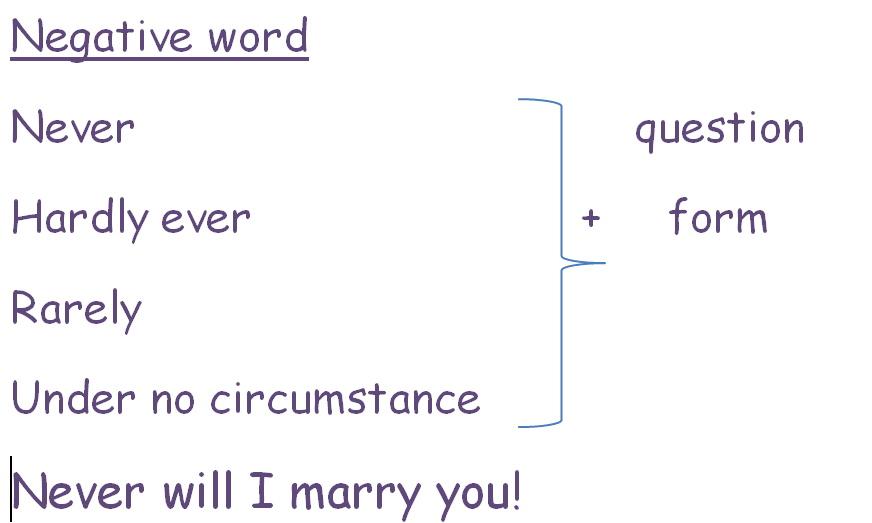
  • Inversion (some types)

  • Adjective Order

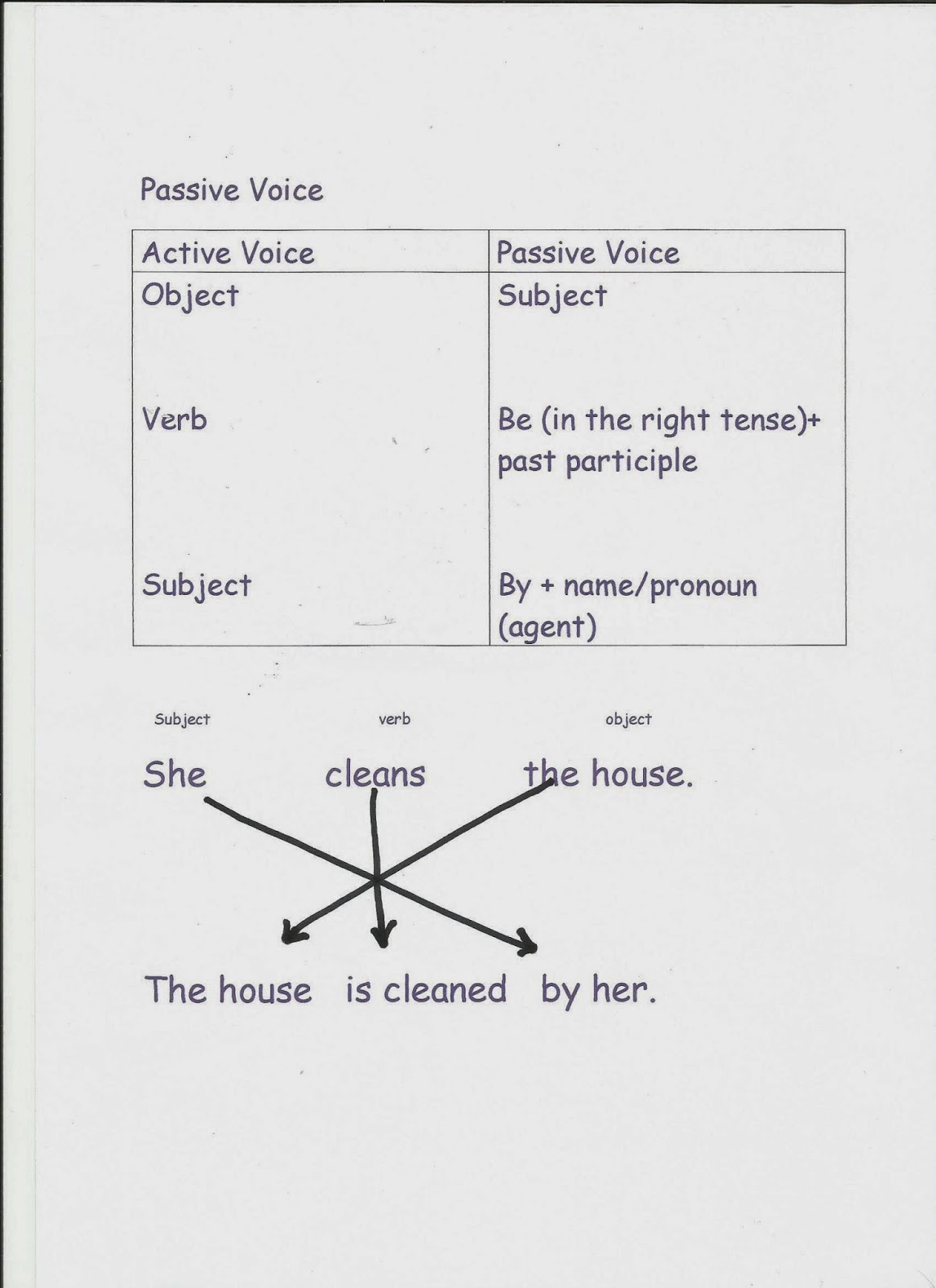
  • Passive Voice

This is what my board and my notes look like when I am presenting ‘rules’. Of course presenting the ‘rules’ does not mean that they will actually learn the language. It may though give them an understanding of some grammatical phenomena. Does this presentation work with all learners? Nope. Some like it, others don’t. So, then I start drawing or use another way to present grammar.

So,
[(context + discovery methods) = introduction of a new point + my math presentation = grammar] + practice and production = new language
or something like that….. Remember, at the end of the day, I teach English not math : ) Coming up…. teaching syntax like math! Feel free to leave a comment in the comments section.
This post has been shortlisted for this month’s Teaching English via British Council blog award. If you like it, go here and press ‘like’ on my post. Thanks for reading : D

You can download everything, here.
Adjective Order.docx
http://viewer.docstoc.com/

var docstoc_docid=’171658147′; var docstoc_title=’Adjective Order.docx’; var docstoc_urltitle=’Adjective Order.docx’; Till next time…………

Online teaching -the niche

The niche

I attended a live class by Jack Askew yesterday as part of WizIQs Teachers Teaching Online MOOC (if you want to learn about online teaching, I strongly suggest you enroll NOW. It is excellent!). The title of his presentation was ‘ Being a Successful Online Teacher: Find your Niche, Build your Brand, and Constantly Grow’ (you can watch the recording of his talk if you enrol!). It was a very informative session, he gave a lot of tips and it was an hour well spent. One thing he said, and something many people agree on, is that if you want to be a successful (freelance) online teacher, you need to be known for one thing you are really good at. You need to create a niche. A specialisation may I add. But do you or should you? Don’t get me wrong, I totally agree that nowadays, you cannot do everything well, you need to specialise, but as a teacher, why can’t my niche be teaching? Won’t I be a successful online teacher if I do not specialise?And, if I specialise, I may be a successful online teacher, but will I be a happy one? These are just a few thoughts……….

All in favor of the ‘niche’ say, “I”
” I”  but “Why?”

  • Well, practise makes perfect, so the more you specialise in something, the better you will become (well, at least that is what common sense says). You become an expert!
  • You target a market. You find people people who are interested in your ‘brand’, your specialisation. You have loads of experience teaching Business English, you are into EAP, you like teaching with songs. Find your niche, make a brand and promote it.
  • You create good resources, your own material and you do not have to be constantly looking for and creating material. You do not have to teach an Ielts class, make the material for this class, and then prepare new stuff for your Business English class. You create your own , solid bank of material and enrich it.

BUT…… and yes, there is always a BUT

  • If I specialise in one field, won’t I get bored after a while? If I am bored, won’t my learners be bored? I like variety and new challenges.
  • Don’t I close my door to ideas, teaching trends and mixing and matching? Taking a Business English idea on leadership and turning it into a session for my young learners about what makes a good leader, is what I do now. As an online teacher with a specialisation, will I be able to do that?
  • Can I not be good at two or three things?
I don’t know about you guys but I like to stick my fingers in many pies! I enjoy teaching Business English (online, yes , who would have thought?), I like teaching EAP, and I like teaching young learners. I guess for me, finding my niche is gonna be so damn hard… unless I could have a niche for teaching, but then how would I survive the online teaching market? Hmmm then again, if you look at this ramble, two out of three of my likes are ESP so maybe that’s my niche : ) Dunno about you guys, but I am on the fence about this one. I understand why I need a niche to be a successful online teacher, but I am not sure if I wanna have one. I am doomed : P
Final thoughts
Very confused……sitting on a fence. Feel free to share your thoughts in the comments section. I really want to hear from people who DO have a niche.

Till next time……..
                             which will be very soon cause, well I have a lot of free time.

Picture taken from: http://images.search.yahoo.com/images