Uncategorized
Some really cool conferences ahead
Some really cool conferences ahead : D
Preparing for a conference presentation on Teaching Business English online. What have I been up to?
-
Loads of reading.
-
Drafting and redrafting.
Although I have been teaching students, for some time now, how to deliver a PPT presentation, I have come to realize that including all the information without squashing everything or having loads of blank pages is HARD (how do you do it lovely pre sessional EAP students?). Then, there is the whole deciding what should go on the slide and what not? Should I have pictures or not? What about animations?
- Rehearsing.
I really don’t want to mess up, so I have been practising what I will say over and over again. I sometimes forget some of the things I wanted to say, but I think that by the day of the presentations I will be ready (fingers crossed :0).I also want to avoid going into lecture mode, so I am trying to find techniques to keep the audience engaged and make the presentation as interactive as possible. I have made some note cards just in case though….
- Handouts for the audience.
I will have two different handouts. One will have links to all the sites I will mention during my talk and the other will have the PPT slides for my audience to make notes on. I think the latter is really helpful cause the people watching you get to keep your presentation and take notes on the things they really found interesting. I also believe this is appreciated by people who can’t see well! It is awful when you are unable to see the slides!
- Letting my teacher friends know I am presenting.
They will encourage me and give me a sense of security. I am a newbie, remember…..??
Finally, there is all the girlie stuff I have to consider, but I would need to write a whole new blog post regarding the do’s and don’ts of looks at conferences :).
My final thoughts
I will list the conferences I will be presenting at in chronological order. I am really excited about all three and I cannot wait to meet all the wonderful people I have been in touch with regarding the conferences. I really appreciate the opportunity the people hosting these events are giving me: )
15-16th March Tesol Greece 35th Annual Convention (Athens, Greece)
22 March 2014 Belta Day (Brussels, Belgium)
6-7 June Eltforum.sk (Bratislava, Slovakia)
Links to these events:
http://www.tesolgreece.org/index.php/en/events/forthcoming-events/convention
http://www.beltabelgium.com/belta-day-2014/
http://www.eltforum.sk/index.php?page=index&lang=en
I will definitely blog about these events in individual blog posts later on. : )
Till next time…..
Teacher in LaLa land
Teacher in Lala land
How I think my learners will improve their writing skills and how they think they will improve is a completely different story. I ask CCQs and ICQS, but I don’t really ask them much about how they think they can improve their English.
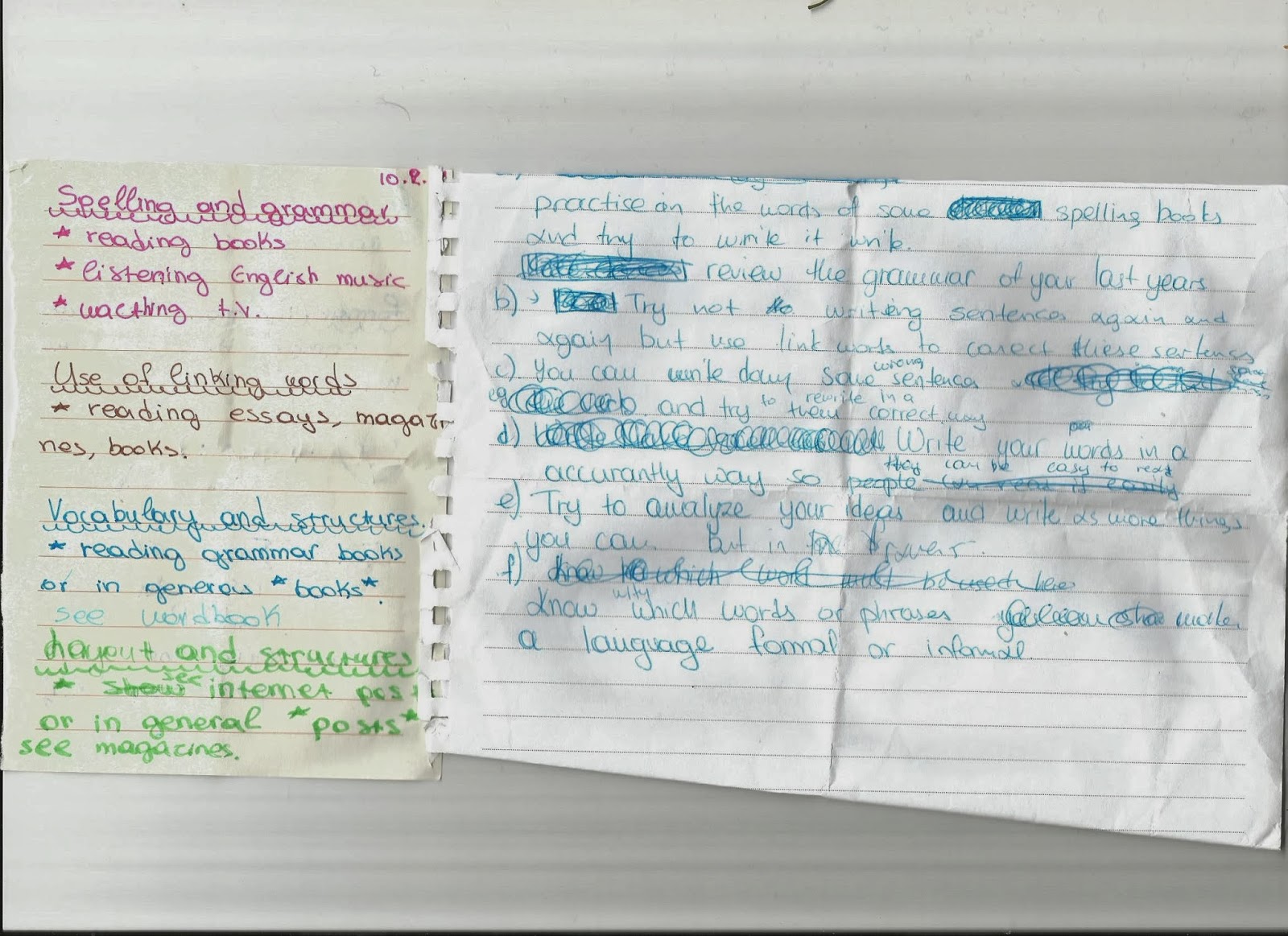
I had a CAE writing class the other day, the focus was on writing an essay. The students were asked to suggest ways they can improve their writing skills and in particular:
- vocabulary
- structures
- grammar & spelling
- punctuation
- layout
- formal/informal language
- developing paragraphs
- linking words and linking sentences together
Now, before I move on to tell you what their answers were, I would like to tell you that my learners are C1 level learners, in their teens, and they have been taking English classes for quite some time now. They have written tons of essays and we have spent hours discussing what makes a good essay and what to avoid when writing one. We have also spent time doing exercises that help improve their writing skills in the areas I mentioned earlier BUT I have seldom asked them ” How do you think you can improve?” Don’t know about you guys but I usually tell them how they can improve!
So, I gave them about five minutes to make notes and tell me what they think they can do to help them improve in writing.
Here is what I got.
Spelling and grammar:
- read books
- listen to English music
- watch TV
- go through word lists and copy the spelling
- review your grammar books
Use of linking words:
- read essays, magazines, books
- try not to write the same sentences again and again but use linking words and try to connect them
- practice writing on a daily basis (yay!!!)
Vocabulary and structures:
- read grammar books (huh?!) or in general reading books
- correct sentences that are wrong
- write your words in an accurate way so they can be easy to read
Layout:
- search the internet for magazine posts/posts in general (I think she meant essay examples)
Formal/Informal language:
- compare formal and informal essays
- know which words phrases are formal and which informal
Now, this is the point where I pour myself a glass of wine and reflect.
What I have not been doing
- I have been telling them you need to do this and that but I have not been connecting it to the real needs and explaining why and how the exercises we do in class or at home will help them. I have not got feedback from them on the effectiveness of the tasks we do.
What I need to do
- I need to give them more opportunities for natural or native like exposure to the language and give them more books, magazines and internet posts to read and make notes. Use what they read to learn new words and use the new words.
- I should do more error correction in class with them. I think I ought to use their own material in this case to connect it with their language needs.
- I really need to help them with features of writing that have to do with layout.
Things that made me happy
- They know how to improve register and are conscious about formal and informal language.
- They suggested reading as an answer to almost every problem connected to writing. So now I can say, ” Well, we are doing this cause you suggested it as a way to improve, hehe” (I would drop reading grammar books! Who does that any more?).
- I realized that I need to ask these types of questions more often.
Where do I go from here?
This week I will tell my learners that we will try to improve vocabulary on a daily basis. Every day they will read an article from a newspaper. They will look for any new words, write these words on word cards and bring them in to class. We will practice making sentences/paragraphs with the new words. They will also keep a journal of how this is helping them improve in vocabulary and spelling. I will also make tasks and exercises based on the new words they bring into class.
Till next time….
ELT Chat summary-Teaching English in the corporate world
#ELTchat summary (12/02/2014)
A similar topic had been discussed before, so it is a good idea to read that summary too http://t.co/UJly7MdvLj as it taps into what was discussed during this chat as well.
Challenges of teaching in-company classes
Challenges of teaching in-company classes:
-
Managers don’t want to attend classes with their underlings(@OUPELTGlobal).Bosses and secretaries having sessions together, especially when the secretary’s English may be better than the boss’s, may not be such a great idea.
-
Random attendance,late comers (@rapple18) or no shows due to busy or not so busy schedules.
-
Motivation and mixed classes (@CotterHUE).
-
Poor assessment and people who are forced to attend these classes (@HadaLitim).
-
Working during classes (@ Marisa_C).
-
Homework or actually lack of homework.
Ideas on teaching in-company classes & some solutions to the challenges
@teacherphili asked if there was a “particular methodology or approach applied to these corporate classes or if depends on the situation?” “It depends on learner expectations of education experience, but I tend to use more output-feedback” (@teflgeek).
-
Role playing(@Marisa_C/@joannacre/@teflgeek).
-
Tasks applicable to work, work related. Business students do not want to waste time!(@CotterHUE).
-
PPT/ Prezi, which help students practise their presentation skills*.
-
Newspaper articles, which learners can read during their coffee breaks : ).
-
Pecha Kucha can help them improve fluency skills (Marisa_C).
-
A reflection of a daily work done in the context of a job (@jankenb2)
-
Reports, emails, telephone conversations.
Till next time…..
Presentations software: http://www.powtoon.com/
The 11 blog challenge
The 11 Blog Challenge
How this works:
1. I need to acknowledge the nominating blogger.
2. I share 11 random facts about myself.
3. I must answer the questions the blogger who nominated me asked.
4. I will list 11 other bloggers
5. I post eleven questions for the bloggers I nominated. I must let the bloggers know that they have been nominated (that actually took some time) and I cannot nominate the person who nominated me.
I got all this information from the Datenglish blog (Deborah Debovich):
http://datenglish.blogspot.com.ar/2014/01/the-11-blog-challenge-by-ageliki-asteri.html
So, here I go!
3. I hate bridges!
4. Dream holiday? I really want to go to New York City… hopefully I will one day : ). My most romantic city in the world (out of the ones I have visited that is) Strasburg. So pretty. Seriously.
5. I do not really cook, but I really like going to fancy restaurants and trying out food from all around the world.
6. I have never had tasty fish and chips in the UK. Too greasy. I will pass.
7. I once boiled a spider and without knowing it drank tea out of the pot (with the dead spider’s remains). After that I was anxious to find out if, in the UK, spiders were poisonous. I guess not cause I live to tell the story : P
8. I find teaching people from around the world both challenging and stimulating. I have learnt so many fascinating things from my Chinese students whilst in the UK. My online teaching job has given me the chance to learn a lot about the French and German. It is mind blowing how you can use a computer and teach someone, somewhere else in the world.
9. My favourite colour is pink… oh and I am colour blind so.. yeah.. go figure.
10. I love crumpets. They are so tasty!
11. My facvourite song and motto Should I stay or should I go-The clash.
http://www.youtube.com/watch?v=GqH21LEmfbQ
Now let’s see Ageliki’s questions
1. Can you tell one weakness of yours?
I am not spontaneous enough.
2. What do you most enjoy in life?
Travelling and having fun with my friends and family.
I don’t like it. If I have the opportunity, I say what I think.
4. What flowers do you like and why?
Pink roses. They smell nice.
5. What book have you read recently?
Eap essentials. I do not have time to read novels and stuff. Most of my reading is work related. I am reading a lot about BE and online teaching at the moment cause I am presenting at the TESOL Greece conference http://tesolgreeceblog.org/2014/02/13/an-interview-with-joanna-malefaki/ and Belta day http://www.beltabelgium.com/belta-day-2014-meet-the-speakers-joanna-malefaki/
6. Why do you teach and what part of teaching do you enjoy the most?
I studied the language at university so it was only natural for me to teach it to others. I love it! I like everything! I have been teaching for many years and as my friend, Lia, said, “got my fingers in many yummy pies” so cannot say one specific part.
7. What do you do to help the unmotivated student?
I try to make the lesson memorable. I also try to find the reason why he/she may be unmotivated.
8. What are two things in teaching that have problematized you in particular?
Students who are not motivated.
9. What do you do to develop as a teacher?
I am doing the Delta. I will also start a course for teachers of Business English. I am currently looking into a second MA.
10. What have you found interesting about blogging?
I love it! It is like talking, writing a diary about teaching. I hope someone apart from me reads what I write and finds it interesting too!
11. What is your view on social media and professional promotion?
It is fascinating how the internet allows you to meet people from all around the world. LinkedIn and twitter, especially #eltchat on twitter, have given me the opportunity to meet lots of interesting people from around the world.
My questions to the bloggers I have nominated:
1. Describe a good teaching experience you have had.
2. Describe a difficult teaching experience you have had.
3. Do you have a teaching mentor? If yes, can you tell me how this person has affected your teaching?
4. Where do you see yourself in ten years from now?
5. How do you deal with students who dominate the sessions?
6. How do you deal with shy/introvert students?
7. How much time do you spend on you work and how much on your personal life?
8. If you won 1 million euros, how would you spend it?
9. What’s your favourite food?
10. What do you hate doing around the house?
11. Describe your ideal day.
Look forward to hearing from you guys.
Till next time……..
Bloggers I have nominated:
Sally Fryer
Deirdre McKenna
Chara Machairianaki
Christina Malefaki
Ola Bakri
Evangelia Kallianos
Marina Daskalaki
Maria Mihelaki
Eri Mihelaki
Angela Fradelaki
Georgia Psarra
TBL with my business English students
TBL part 2: My business English class
My friend told me the other day that I have my fingers in many yummy pies. I do. I teach general English mostly to kids, I do business English with adult learners from other parts of Europe and I also teach EAP courses during the summer in the UK so it is quite a mix, and I love it!
In my last post, I talked about a TBL lesson I tried with my Ielts prep. class (posted on January 16th) and this time I will talk about using the same lesson with my Business English students. the material I used in both classes was the same and it was based on this video
The first question you may ask is “Why would I use a video based on a true story of a 5 year old saving his dad’s life with a business English student?”. Well, three reasons:
- It helps them with “small talk”.
- It facilitates practicing a long turn-using past tenses and other genre features of a narrative.
- It is fun (are you allowed to have fun during a BE session? YES!!).
According to research “small talk” and using English for social purposes has proven to be very important for BE students (Basturkmen, 2006) and should not be neglected. Story telling does give the students an opportunity to talk for a longer time. How often is it that you just have you as a teacher asking a question and the learner answering it? In real life, your BE students may have to talk about something that happened to them in the past, so in my view, story telling can be part of a BE syllabus. Finally, it is fun. So, they are business people and you teach them how to negotiate, deliver a presentation, send an email/memo, but your session with them may be a break from their hard day, so why not try something entertaining from time to time?
Feedback I got from my own learners
Most of my learners enjoyed it. Especially when they realized their story and the true story were completely different! It was fun, interesting.
There was one that did not like it though, cause she doesn’t like using her imagination and telling stories (ok, fair point) but she did note that it did help her practice using past tenses (yay).
Such lessons can be quite demanding for the not so creative students so it is something that should be taken into consideration. They are great for the freer conversational session which can be part of business English syllabuses where the focus is on everyday English.
Final thoughts
I will definitely use this lesson again but instead of telling them to tell me a story about an emergency, any emergency, I would make it more related to their work. An emergency at work and how you dealt with it. So basically keep the TBL steps just change the follow up production tasks.
Till next time…..
References
Basturkmen, H (2006) Ideas and options in English for specific purposes. New Jersey: LEA
TBL with my Ielts students
As part of my Delta course I had to experiment with instructional frameworks and try new approaches. I chose Task Based Learning and designed a lesson based on information I found in the Willis ELT website ( http://www.willis-elt.co.uk/ ).
My class
My students were attending English classes as part of their preparation for the Ielts academic English exam. The lessons we had done so far were particularly exam oriented and focus was mostly on writing and speaking. There was no time for fun and all the lessons focused on gaining skills/strategies that would allow my learners to succeed in this exam. The lessons were quite dry so I thought this would be a great opportunity for something fun.
The lesson
The lesson was based on a video of a true story about a five year old who used his knowledge of the ABC to help save his father’s life (http://www.nbcnewyork.com/news/local/New-Jersey-Kindergartener-Saves-Father-Life-Spelling-Letters-Dad-Seizure-Car-206971791.html). The tasks followed the TBL framework so I started with a warmer that made use of words from the story and asked my learners to quickly guess what they thought the story was about. I then asked questions and generated discussion that would get them to think more carefully about emergencies and what young children can do in such cases. Students then concocted a story and afterwards reported to the whole class. After the reporting stage, my learners watched the video and found out what had actually happened. We then talked about genre features specific to story telling and focused particularly on past tenses and extreme adjectives. The new language was presented and students used the structures whilst answering questions like ” What kind of emergency have you ever faced? How did you deal with it?” As homework, my students were asked to watch the video again and tell me the story again.
Samples from the lesson
What is the story? What connections can you make?
|
The setting
New Jersey
The characters
A father
A five year old son
A grandmother
The paramedics
Some phrases from the story
“use your active listening skills”
FURNITURE
School shoes
Paralysed
Route 22
|
-
They had a chance to talk about something that allowed them to use their imagination.
-
They got to watch an authentic video and see how close they were to the real story.
-
They noticed linguistic features which they made use of in later stages of the session.
My thoughts
This was a memorable session and highly motivating one. There was a lot of noise during the session and the grammar facilitated the realization of the intended outcome. unfortunately though, I was unable to predict all the grammar and structures my learners may have needed to complete the task.
The thing my learner said and put a smile on my face
So, my students did take the IELTS exam in December and when they called me the first thing my learner said was, ” I used lots of extreme adjectives when I did the speaking task”. Out of all the sessions we had the most memorable one, the least exam oriented one, was the one that she remembered and mentioned after having taken the exam. This makes me rethink about lots of the material I use in class!
I will follow up with a twist… I used this lesson with my BE students too! Till next time!
The news report
The news report
So I am not going to talk about something new, I am just going to write about what I did during a session and maybe someone will read something interesting and do the same in one of their sessions.
Down to business:
Choose a news report that has some drama: I chose an article about a Chinese university student who tried to bribe his university professor and dropped a firearm while doing so (you may know the story).
It is easier to attract the reader when the story has to do with money and guns!
- Prime well:
I used a PPT slide with pictures from the story but did not include the gun. My learners made assumptions and then I added the gun and their guesses became quite adventurous.
- Advance organisers:
My DELTA tutor suggested using these. You get your learners to say what they already know about a story, what they need to find out etc. Students start tapping into their prior knowledge which helps them connect what they know with what they want to find out/expect to find in a text.
- Chunks:
News reports can be demanding and the vocabulary can sometimes be even daunting so why not cut it into chunks? This also allows the learners to predict what will follow.
- Pre teaching vocabulary:
I cut the news report into chunks and then got my learners to guess the meaning of unknown words from the news report. Depending on the aim of the lesson (whether it is vocabulary or a reading session) you zero in on vocabulary teaching.
- Q & A:
News reports can be used as stimuli for speaking tasks so choose something that will generate discussion. I chose something that had some moral issues and could engage learners in interesting conversations.
- Pair work:
Pair work is essential here. One student can rely on the other for help. Challenging topics and unknown vocabulary can become less frustrating when tackled with in pairs.
- Jigsaw reading:
Give one learner half the news report, the other, the other half. They read their text, take notes. Then you take away their paper and they have to rebuild the story together. Paraphrasing the story may also be helpful for learners who are reading news reports.
Of course turning a news report into a whole session takes time but it will be very rewarding for the learners.
The dominant one
So, how do you deal with the dominant student?
Well, firstly, the easiest way is to actually nominate another student. Ask individual students questions and avoid addressing the whole class.
Paperclips: The idea is you give each student some paper clips and tell them that they have to use the paper clips during an activity. Each time the student speaks, he hands in a paper clip. That way your dominating student will only speak a few times and the rest of the ss will also have to contribute to the conversation/task.If you do not like paper clips, then you can use pieces of paper, postit notes or whatever you wish.
Paper boards: This is quite fun! In order to know everyone is on task, give them a sheet of paper. ask a question and tell them to write the answer on their paper board. When everyone has finished, ask them all to show you their board. That way everyone answers your question. The limitation here is that you cannot use this paper board when you are practicing a long turn and it is not very practical during speaking tasks.
Group/work/pair work also make this problem less evedent and you could always ask your dominant student to be the teacher for a few minutes and ask questions instead of answer them!
It is hard when this happens in an adult class so I still find this quite challenging…
The consequence chain story
The consequence of the chain story… the consequence chain story+part 2
After trying the chain story (14/2 post), I thought I should jazz things up so I gave the consequence chain story a shot.
Background info:
My lesson was on the 2nd conditional and I wanted my students to use this structure in a freer activity as part of the practice stage of my lesson. My learners had to use the second conditional in their consequence chain story contributions.
Procedure:
I got students to write a sentence on a piece of paper, They then handed it to the person next to them. That student read the sentence and continued the story. Then he folded the 1st student’s contribution and handed it to the 3rd student who could only read the previous student’s sentence (student C can see what student B wrote, but not what student A did).
How is this difference to a chain story?
Well, it is not that different in essence, but the theme has to be about something that lead to something else.
E.g
Student A: If I wasn’t in class, I’d be at home.
Student B: If you were at home, you would be in big trouble with your teacher.
Student C: If your teacher knew you were playing truant from school,….. and so on.
This was a fun task my students giggled and added some funny sentences. Yes, they used the target language and the task went smoothly except for one thing. Timing. Were I to do this task over again, I would give them a time limitation like 30 seconds to a minute. I would maybe even bring in an hour glass or a ticking clock to add some drama. I think this would make the task more challenging and everybody would be writing. There would not be piles of papers next to one student and nothing next to another. I would make sure you I had two different consequence chain stories coming from both ends of the class so I don’t have your students waiting around for too long.
Ideas for the end of the lesson:
- You can gather all the papers and either offer a feedback session in the next lesson.
- You could handout all the student’s paper and ask the learners to correct them as homework.
Not exciting enough?
- Give two or more students a consequence chain story and tell them to create a role play based on the story and present it to the rest of the class in the next lesson.
Twist number 2- A few months later…
I wrote this blog post some time ago, but I revisited it today. I was teaching all three conditionals to my young learners (pre-intermediate group). I actually used the consequence chain to present the language instead of in the production stage. My learners provided me with the examples of the target language. They really got into it and there was a lot of laughter in the class. I had taught the conditionals to this group in the past, but this time it felt like they really got it cause it was fun and memorable. We spent almost 20 minutes writing consequence chains on the board and you can see what my learners came up with in the photo I have provided. Try it out with your young learners. It’s a winner!
I am interested in any contributions you may want to make : )
Till next time….