My melt down

Blogging is cathartic, it liberates you. Big phrases eh? Well, blogging for me is like writing in my own professional diary!! So, here is my melt down. Here is my story. It ain’t pretty.

Have you ever had a lesson that was your “worst lesson ever” ?OK, so keep that in mind. Now, think of how that lesson could have been worse. Do you have the image in your head? OK, so I am trying to create an atmosphere. Get your mug of coffee and read on.

I had one of those lessons the other day. One of those lessons where you feel like it can’t get worse than this!! The  bad-est lesson eva! I think the word badest needs to exist cause you get bad and then the suffix -est accentuates it!

So, I, the super duper teacher, sat on my super duper chair, in front of my super duper pc to give a super duper online grammar lesson. I do consider myself kinda a grammar queen. I thrive when it comes to teaching grammar or do I?

My learner hates grammar. He is a B1 level adult learner and we have online lessons once a week. My learner has said this (I hate grammar) many, many times, but this learner ended up requesting a grammar lesson, and we had one. It was an overview of the tenses. Unfortunately, this grammar overview did not end in one teaching hour. We had to finish it off in the next lesson. My learner was fine with that. Second grammar lesson day came. Everything was going great until the learner got tired of the lesson and half way through decided he was not going to move to the production stage. The question I asked was, ” What did you eat yesterday?” No answer. In fact, my learner said, ” I want to think about this”

Me: ” OK”

Learner: ……. thinking….. thinking……

4 mins later

Learner: ” No, I cannot answer this question. I have not revised the tenses.”

Me: “Oh! That’s OK. Don’t worry about mistakes. I just want to see how you talk about things that happened yesterday, in the past.”

Learner: “No. I haven’t revised”.

Me: ” OK. Let’s talk about something else then. What will you do on the weekend?”

Learner: ” I cannot answer the question because I have not revised the grammar”.

Me…. starting to sweat in my super duper chair. I needed to do something otherwise we would have a staring contest….. online.What did I do? I completely changed the lesson. I dropped the questions cause I felt like a dentist pulling out my learners tooth and moved on to an article based lesson. We read an article and answered a few questions that were based on the article.

The lesson came to an end and we both went our separate ways. I went and made a big cup off coffee and grabbed a box of cookies. I was going to eat my sorrow and think.

Thoughts

Maybe I shouldn’t have turned a one hour lesson into a two hour grammar lesson with this particular learner. I should have treated the lesson like a Band-Aid and pulled it off quickly, but I am not a rush- rush teacher. I spend time on tasks and timing as in, sticking to the lesson plan/syllabus,  is not as important as understanding.

When my learner said, ” I don’t want to talk because I haven’t revised” I should have gotten the message. My learner actually is not very talkative and gets frustrated when I correct mistakes anyhow. Big mistake Joanna!! Seriously, what were you thinking?!?!?!?!

Maybe I should have done more controlled tense practice activities like gap filling. Well, my excuse here is that I panicked. I heard no to a simple question ( simple in my mind) and then stopped thinking clearly.

I think changing the focus of the lesson, allowing the learner to revise, and moving on to something completely different was the best solution in this case. This was an online lesson, so I could not  move around and ‘see’ my learner. Difficult teaching moments can be a bit more difficult when online. If I was in a class and saw that my learner was frustrated, I would stand up and say, ” OK! Let’s go outside and take a breather”.

I so dread the next lesson with this learner because he said he will revise and then he wants to do some more grammar. I think I will try to find a few alternatives though, just in case!!!

In retrospect, I think I still do not know how to properly react when a learner says, “I don’t want to do this”. Especially when this is something we have done as an ice breaker/warmer/chitchat, but never as a production stage of a grammar lesson.

Reflecting in front of the beach (Chania, Crete)

Reflecting in front of the beach (Chania, Crete)


I need to reflect…….

A few weeks later I wrote a blog post about what I ended up doing with this learner in the following lesson. If you want to read that post, press here

Till next time…..

Fun activities for the 2nd conditional

Let me begin this blog post by saying that conditionals are not the easiest phenomenon to teach, especially since there are lots of combinations which are used in natural speech, but are not really covered in text books. After having shared with you my fun activities for the first conditional, I thought it was about time to move on to what is traditionally known as the 2nd conditional and suggest a few fun activities which practice the 2nd conditional. First, let’s have a look at the form (keep in mind that there are many other forms not mentioned here). 

Form:

If + simple past , would + base verb

E.g. If we went by train, we would get there earlier.

(Also possible:  would+ base verb +if+ simple past)

Meaning:

Something reasonably possible but ‘ more tentative’. Past tense does not refer to past. Here, it is likely that the train would take you to your destination faster. 

                                                      Alexander, G. L. (1998, p.208-9)

                     Activities

Stranded in a cave
Tell your students that they are stuck in a cave. Put them in groups of four. Give them different pictures or word cards with random items on them e.g. a chocolate bar, a chewing gum, a rope, a dog, a magazine, a plastic bag and so on. Each student has their own set of cards and each member of the group has different cards. Ask them to tell you how they would use these items in the cave. Would they also use them to get out of the cave? How? Each group should decide on the two or three most necessary items. They should use the 2nd conditional when saying how they will use this.
For example,
Item on picture card:
Chewing gum
Student response:
If I had a chewing gum, I would chew it in order to feel less stressed.daisy

2nd conditional songs + Karaoke
You can do listening activities with the following two songs and then do Karaoke with your students!
If you could see me now  The Script (official video)
If you had my love Jennifer Lopez (official video)
Karaoke version
Also, why not get your students to change the lyrics and sing their own versions?
Conditionals noughts and crosses
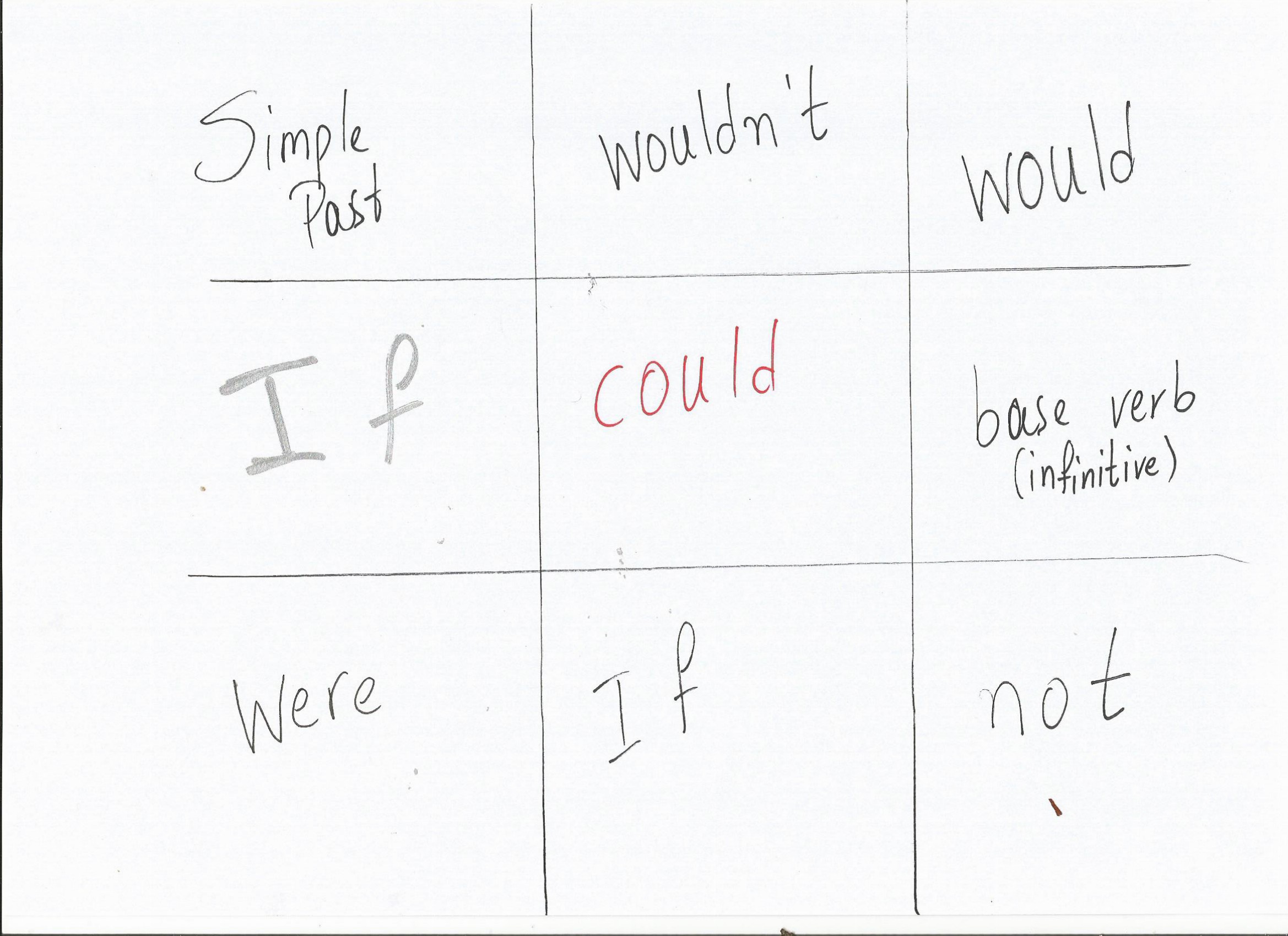
We have all played noughts and crosses, so why not put words that are used in the 2nd conditional in the box? In order for you students to get an X or O in the table, they need to make a sentence using the word in the box and of course this sentence needs to be in the 2nd conditional.Scan0081
Consequence chain story
A consequence chain is like writing a chain story but the learners must use the 2nd conditional and write about consequences (for more about this go here). How do you set this up? Well, get your students to sit in rows. One student from each end of the room must write a sentence in the second conditional. Then, hand it to the student next to him/her. That student uses the previous student’s main clause to form an if clause, and then adds his/her own main clause and so on.

 Student A: If you arrived here early, you would meet Peter. Next student: If you met Peter, you would probably end up going on a date.
cece3-2014-04-0217-21-07

My students’ consequence chain (level: A1)


Finish my sentence-Ball game
If you have learners who like moving around, you should play this game. One student stands in the front of the class and says half a conditional. The learner then throws the ball to a student and that student needs to finish off the sentence. You can even turn this into a team game where each student’s correct answer adds points to the team. This is great for the summer, you can play outside!

Let’s do some math
Give your students math tasks and ask them to write down what they see.

For example,
If I had 3 cows and they produced 5 kilos of milk every day, how much milk would each cow produce?

If scenarios

Get your learners to talk or write about what they would do in each of these scenarios. You can jazz things up by getting them to draw pictures while doing so, like a little picture composition.
If I won 1 million euros, I would……..

If I had one day left to live, I would……

If I could fly anywhere in the world, I would…..

If I could choose any famous person to date, I would…….

Dating game

You choose three students and give them three I.D cards ( you can make these cards up or you can use information about famous people). You also choose a bachelor or bachelorette. The bachelorette/bachelor cannot see the three candidates. He/she asks questions like, ” What would you do if you were on a deserted island?” and the candidates need to answer using the 2nd conditional as well(if you press the title of this idea you can watch another teacher describing this game in more detail). 43105-valentine

Card game
You need an hour glass or some sort of timer and some cards with either an if clause or a main clause. Once you hand your students their cards, they need to write the rest of the conditional clause on a sheet of paper. When the timer goes off, the student that has the most correct sentences is the winner.

Where I looked for some ideas

References
Alexander, L.G. (1998). Longman English Grammar Practice for Intermediate Students. New York.: Longman.
 
Hope you liked this post.
Till next time…..

100 Blog Posts later

1 is for the first time I blogged (February 2013).

0 is for the minutes I spent second guessing my posts ( my posts are me-no regrets).

0 is like a circle- it shows connecting. I am connecting with you, wherever you are.

Be real, be truthful, be myself (my motto these days). Accept and move on (this year’s motto).

Love writing, love blogging.

O M G the things I write in here (sometimes I wonder……I bet you do too!).

Going to keep going for as long as I can (that’s a warning   :p).

Please bear with me and be patient with my typos, my rambles, my wordiness, my silliness.

Oh! I have no idea what to write here    😀

Smiley faces and comments is what I like seeing in the comments section (comments-me like ’em).

Two hundred blog posts is the next goal.

So happy to be blogging and sharing my 100th post (Yay).

Yeap, yeap!! I reached 100 blog posts (if you count the guest posts it’s more) and I really don’t know how time flew by. I started without really knowing what I was getting into. I started in Blogger now I am in WordPress. I have written about my teaching, my life. I have been silly and serious.I am still here and I already know what my next post is going to be about! And because my previous post was “I know who I am, but who are you?” I added a bit of sound to my post! So, now you know what I sound like as well    😀

http://vocaroo.com/player.swf?playMediaID=s1jm7Huh93Ni&autoplay=0
Voice Recorder >>

daisy

Till next time…….

I know who I am, but who are you? : D

I attended Sandy Millin’s talk a few hours ago. It was about blogging and professional development. Among other things, she made suggestions about what to blog about, and one of her tips was to ask questions on your blog. This gave me an idea. In this post, I ain’t going to say much. I am going to ask a few questions, I have asked myself many times. Who are you? Yes, you, the person reading this post. I mean, I see numbers when I look at my blog’s stats. I know there are some courageous people in the world who actually read my posts, but in this post (my 99th post. Yay!), I would really appreciate it, if you took a minute to say hello, tell me where you are from/about yourself, and what you like reading in the ELT blogs you read.

Today’s post is for you, the reader. 

I am doing this cause I want to get to know the people who actually read my posts. Reading your comments really puts a smile on my face!

Oh! If you blog, add your blog in the comments section!!!!If you like reading blogs, mention them in the comments  section.


2015-05-17 20.07.07

I am really curious about this one………Also, kinda risky cause no one might comment :p.

Never say never

This is going to be short and sweet and of course non ELT-related. Even if someone tells you that you can’t do something, but you feel you can, do it. This is what my painting looks like. I have no idea what the colours are any more. I do not know how well they match. I used what I learnt about colours, my teacher helped me and I made something, even though I thought I couldn’t! Yes, there are loads of imperfections, and of course it could be ten times better but.. who cares? I did it 😀 Here is my first painting, and as I am colour blind, this is ‘my mountain’ and I kinda climbed it! Yay!

2015-05-19 13.16.41

Till next time…..

#Youngerteacherself Katherine Bilsborough’s Guest post

Thank you to Joanna Malefaki for inviting me to contribute to her ‘A letter to my younger teacher self’ blog project. I love writing. I work as a writer so am privileged to be doing my dream job. But this project gave me an opportunity to do some serious ‘thinking’ too (and some not so serious), which is always a valid pastime if you ask me. This letter is to my younger teacher self, when my children were toddlers, we were living in Madrid and the Basque Country and were rushing around like blue-arsed flies, trying to teach enough classes to make enough money to make ends meet.

Katherine old

 Hi Kath,

How are you doing? What do you mean you haven’t got time to read a letter? Make time! Life isn’t all work, work, work … and this is from Me, the most important person in your life! Besides, it’s about work … ah, that got your attention. I’m here to help. Advice from an older you/me. Read on, take heed … and life might be a tad easier. If I remember rightly, you’re obsessed with numbers right now so I might keep your attention if I organise this letter into 10 neat points. Are you still reading? … Good, thatta girl!

You might want to invest some time practising your board drawings in your spare time. If you haven’t got much time, just concentrate on your ‘bananas’ and ‘sausages’ … and maybe use a flashcard when you want to show a rocket.

banana

Ditch that paranoia! Your teenage students are not whispering about you and they aren’t laughing at you either. In fact you are one of the least important people in their lives right now … however important you might think you are.

Speak up when something isn’t right! Your silence will be taken as complacency and the people    around you are probably feeling the same. Change won’t happen until someone speaks out.

Get a Spanish teacher otherwise it will take you approximately 25 years to master the subjunctive. Seriously, get a Spanish teacher! No, seriously …

Keep a diary of your own children’s bilingual and trilingual developments. I know you think you’ll remember everything but you aren’t as super human as you think you are … and memories are selective.

You are spelling ‘pronunciation’ wrong! Yes, that’s right … there is no ‘o’ after that ‘n’. How can you be so daft? Don’t worry too much though. Someone will take great delight in telling you in about 20 years’ time and it’s always nice to brighten someone’s day.

And while we’re on the subject of spelling and pronunciation …

It isn’t ‘gaze bow’, it’s ‘ga zee bo’. And (you might find this bit hard to believe) you’ll actually say this word one day … in a very public place!

Coming back to the classroom …

Don’t worry so much about your students using their mother tongue in class. It is happening in every English classroom all over the country. If anyone tells you differently, don’t believe them! They lie!

Speak to experienced teachers about ‘the O word’. The main objective of an observation isn’t to catch you out … and the more O’s you have, the better teacher you will become.

And just to finish …

Don’t worry about spending approximately three hours preparing materials for each one-hour lesson. In the future there will be course books and resource books and a whole load of ready-made supplementary materials.

And besides, all this experience in materials writing might even come in handy one day!

Have a great life!

Me, XX

p.s. You’re doing an excellent job!

Katherine

Biography

Katherine is an ELT author. She writes for OUP, Macmillan, Richmond, Burlington and others. She also writes English courses for the BBC and the British Council. In her spare time she writes other stuff. She doesn’t write her own blog at the moment but she’s made an art of hijacking other bloggers’ blogs.

Thanks for writing Katherine

#Youngerteacherself Helen Waldron’s Guest post

A letter to my younger teacher self.

Dear Younger Helen,

Age writing to youth inevitably involves giving advice. So here goes.

Hold your head up high. You are doing better in a complex world than you give yourself credit for. After all, your generation never writes the rulebook.

Forget the acne, puppy fat, cheap clothes etc. too. You’re young and therefore automatically beautiful.

Hold your head up in your job too. There’s a lot that needs changing in EFL, but it’s rarely the teachers. Now as then, EFL is a profession full of highly dedicated individuals being dragged through the mud and exploited at every turn. This is partly because of the fragmentation of the profession, and unfortunately not much has changed here. Many of us are still working freelance in foreign countries, still struggling to find out our rights and exercise them. You know how hard it is to frame the right questions in a foreign language and to be heard and taken seriously. The good news is that there will be something called the internet, which will mean untold free resources, less professional isolation, and the chance to hear and read English again. Remember when you despaired of your own ability to speak and write, let alone teach, your mother tongue? The internet will be the lonely EFL teachers’ friend.

Don’t worry, I’m not going to advise you to form a union for teachers’ rights because you’re still going to be teaching English in Germany 30 years later. What twenty-something wants to know that?

Well done for working at one of the more famous language schools for a year and then leaving. Once you learn some German, the management can’t thrust long, incoherent documents at you to sign, and you’ve done your apprenticeship, so it’s a win-win situation. Tell other teachers to do the same. Go. Do your own thing. One lesson without the middleman may see you earning the same money as a morning of language school classes. You will meet teachers in their 70s who insist that they still teach because they love it. Fair enough, maybe it is their hobby, but if the real reason is that they are poor, despite decades of working like a dog and living like a student, well, maybe they should be more honest. They need to hold their heads up too. Maybe they should be forming a union for the next generation.

Regrets, Young Helen, I’ve had a few, but then again, too few to mention.

  1. Do you have to be so bad at maths that you will shy away from negotiations that would further your career?
  2. Do you have to retreat into “ladylikeness” when all around you are letting rip (and getting heard)? It’s the culture, stoopid. People say what they mean in Germany, and if women aren’t supposed to have opinions – oh well, I suppose you’ll learn with time.

Congratulations on your perseverance and not walking out in disgust when Unknown HR decides to replace you with a language school (and later a computer program). Your students will stick up for you and Unknown HRs have a habit of changing jobs every two weeks anyway.

I’m happy you always try to understand your students and work out how best to adapt the lesson to their needs. After that first language school year, you will always be lucky enough to be able to teach in your own style, with the confidence to pick and choose your own resources.

You’ll be lucky enough to have children too, so have a break! There is a downside to perseverance, you know. You’ve no idea how hard it will be, holding down a contract-free job in white, male, corporate Germany. Your students will be sweet, but they won’t understand that you have been up all night with the baby before standing in front of a class at 7.30am. And going to work again at 5p.m. seems even more like a ten day week without sleep. You’ll end up paying the childminder more than you earn. It will make you ill and young mothers can do without the ignominy of trying to deny pregnancy and motherhood when Unknown HR is looking for reasons to reduce the number of freelance teachers in the company. (This is not a criticism: Unknown HR will arguably save the parent company up to €3.50 a year, which will be converted into some miraculously aspirational statistic and lead to Unknown HR’S next promotion).  Without a job to return to you will be fearful for the future, but you owe it to yourself to hold your head up as a mother too.

Try to learn something new once a year. Try to be creative despite working in a conservative environment. Be open to new ideas, but don’t forget your common sense. Don’t be ashamed if you can’t afford the courses you would like to be taking because you have to i) pay for them yourself and ii) take time off work (and thus not get paid). This is not your fault and you can learn a lot by reflecting on your own experience and on the experience of those around you.

And that’s about it.

Just do your best.

The Older Helen

 helen

Biography

Helen Waldron www.helenwaldron.com is an English Language Coach working in-company in the Hamburg area of Germany. She writes a blog (www.speakeasyandwritewell.wordpress.com) about two fictional English trainers.

Thanks for writing such a lovely post Helen.

Joanna

When the going gets tough, it’s TTG


Nice title, eh? I guess you are wondering what TTG means. It’s Time To Go. So, that’s my title. When the going gets tough, it’s time to go. Today I will tell you a story about a girl who wanted to be a big boss, to conquer the world of  business. But we don’t always get what we want, do we?

In 2007, after more than 10 years of teaching, I thought it was time to take the next step. Go up the career ladder and open up my own private language school. I was very excited, so was my sister. We were going to be partners. We were going to make something that was ours. We looked for a building to rent. We found one close to my house. We then furnished it and opened the school in September of 2007. During our first year we had 27 students. That was great. We had small sized classes, we did lots of extra curricular activities with students like parties for Christmas, birthday parties etc. I spent lots of Sundays teaching exam classes. They were free lessons aiming at helping my learners. It was a successful year. We were happy, our students were happy. Things were going to be super the next year.

They weren’t. While there was a small increase in the number of new students, I also had losses. Students finished their training or moved away. I pretty much had the same number of students. This is when some of my student/ customers started having money issues. recession and the financial crisis in Greece was knocking on the door. People started owing money/tuition. I did not send them home though, they were my kids. I kept them in their classes and continued to issue receipts for money I was not earning. The law  says that you must issue a receipt for the student at the end of every month, even if the student has not paid. You also pay tax for this student. This policy is based on the assumption that you will eventually get your money. I wasn’t.

To make matters worse, my expenses were piling up. My school was open 9 months a year and shut during the summer. I still had to pay rent for the months the school was shut.

2009-2013 were pretty much the same story. I now had about 40 students but the competition was killing me. There were new language schools in my area, charging peanuts for classes. I had to do the same. Of course, Greece was going through the financial crisis and people stopped taking language classes. This is when I started to lose my drive, so did my sister.

I was trying, trying and not seeing any results. Don’t get me wrong, I was happy with my lessons and my kids were great, but I couldn’t make ends meet and that was very disappointing. I did not have any more energy. I had had enough. I tried for 7 years and was not going to try anymore. In September 2014, my sister and I decided we were going to shut down the business. And we did.

I actually found myself ‘mourning’ the business. I had put my heart and soul into something that failed. I felt like a failure.

In retrospect, I think I approached the whole language school with a lot of enthusiasm but no marketing or business skills.

My mistakes……..

I opened a business in an area that already had many language schools. I was far away from actual schools. I was paying a high rent and a lot of tax. When I started the business, I did not have a financial plan. I did not do any market research. I did not actually do any research. I was naïve.

I found it very difficult to ‘sell’ my services. I was not at all aggressive. I was probably a pushover business woman.

I treated my students as my kids, not customers. This is nice and fuzzy, but it does not pay for the bills. Love alone, does not cover the expenses.

What about my teaching? Had I done enough? I thought I was doing a good job, but was I? Was this why the business was not successful?  I will never know.

I am aware of the fact that I am casting blame on everything else and not really myself, but the latter is hard. I am stubborn in that way.

Today

It is about 8 months later, and now the language school is a memory of the past. I tried it, it didn’t work, I moved on. On the plus side, I have more free time, and financially I am much better!!! I am free of something that was a dream and at the end, became a burden. Oh well, life is all about trial and error, isn’t it? Been there, done that.

Acknowledgements

Vedrana asked me what it was like to run a business and suggested I write a post, so here it is.

TTG is Eri’s phrase. I like it. I use it 🙂

2015-05-10 15.17.41

Till next time…..


Delta LSA Writing

This is my Delta LSA on writing. This was my external assignment. I got a pass. I am sharing it with you so you can get an idea of what a writing LSA could look like. Please do not copy anything from my assignment. Plagiarism is not taken lightly and Cambridge has zero tolerance of it.

There are a few problems with the formatting/font due to the fact that this post is a copy paste of a word document.

  1. Introduction

My teaching experience has shown me that helping learners to become good writers can be quite challenging. At an intermediate level, when their grammar and lexis become richer, producing texts that are well written is quite hard. In fact, at this level they also become familiar with different genres, register and tone, making writing texts more difficult for my students.

Writing emails may be an everyday task for some of my learners and semi-formal emails is a common genre in their course books. In this assignment, I zero in on helping my learners improve their writing of semi-formal emails (booking a hotel via mail) which can be transferred to their real needs as they may need to contact a hotel and reserve a room. It is also a genre that has distinct features like formulaic expressions, the layout is different, structures used can be more demanding (e.g indirect questions).   In fact, semi-formal emails can be quite tricky as they share features of formal and informal emails so distinguishing the differences is integral (see section 2 on learner problems).

 “Fundamentally, writing is learned rather than taught, and the teacher’s best methods are flexibility and support” (Hyland 2002, p.78) which is why it is imperative that I train my learners to activate and use writing strategies (see section 1.3) necessary for effective writing whilst encouraging their efforts. All the above are reasons why I chose to write the paper.

  1. Literary review

1.1. Two productive skills: Writing versus speaking

Speaking and writing share common features but there are many differences. In order to understand writing, methodologists often compare writing to speaking.

Speech·         more hesitations, interruptions and self- corrections·         no spelling and punctuation conventions·         relies on gesture and paralanguage

·         concrete, fragmented, informal and context-dependent

·         characterized by turn-taking

Writing·         more subordination and passives·         longer sentences·         more explicit coding of logical relations

·         less modal modification

·         structurally elaborate, complex, abstract and formal

·         characterised by monologue

Street 1995, cited in Hyland, 2002-exact copy of table

Such a dichotomy neglects distinct differences of spoken and written genres. Biber (1999, cited in Hyland, 2002 p. 50) found that features like the present tense, deletions which are characteristics of spoken speech are also found in written genres like narratives and personal letters. On the other hand, elaborated references like relative clauses, which frequently occur in written text, are also prominent in interviews and public speeches (spoken genres) ibid. Therefore, Hyland (2002, p.51) concludes that, ”these descriptions require more delicate, more socially informed, and more  genre-sensitive frameworks than simple comparisons between exposition and conversation allow”.

1.2. How we write

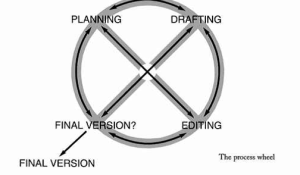
No matter what someone is writing whether it is an email reserving a room or a shopping list, it is done in the following way; people plan, draft, edit and then provide a final draft. Sometimes someone may re-draft or re-edit and the time spent may vary from almost no time to even days (process wheel-Harmer 2007, p.6).
harmer

Image taken from Harmer, J. 2004, p.6

1.3. Writing Micro and Macro Skills

Brown (2004, cited in Damayanti n.d) composed a list of writing micro and macro skills which are the following:

Micro skills

Produce

  • graphemes and orthographic patterns of English.
  • writing speed according to purpose.
  • acceptable string of words following word order rules.

Use

  • acceptable grammar.
  • cohesive devices.

Express

  • meanings in different grammatical forms.

Macro skills

Use

  • the appropriate conventions and rhetorical forms of writing.
  • a pool of strategies like assessing audiences’ interpretation, paraphrases and synonyms, editing etc.

Convey

  • links and connections between events and express ideas such as main idea and supporting information
  • culturally specific references in the written texts

Distinguish

  • between implied and literal meaning

Accomplish

  • the meanings of functions of the texts based on form and purposes                                                       Brown (2004, cited in Damayanti n.d)

1.4. What affects our writing

According to Harmer (2007, p. 16-26) the way people write is affected by

  • genre features
  • text construction
  • cohesion (lexical and grammatical)
  • coherence
  • register

1.5. The email

  • Follow the style/conventions of letters, faxes.
  • Use grammar, vocabulary, punctuation, capitalization as in any other type of communication.
  • Everything in capital letters equals shouting.
  • Keep messages short and to the point as many people receive many emails.
  • Edit emails just like any piece of writing.                                                               (Ashley, 2005)

1.6. The semi-formal email

We send semi-formal emails to people we do not know well, colleagues, tourist information offices, hotel managers. Formal emails are sent to people of authority which we do not know well for example, the mayor, the president, a human resources manager when applying for a job. Informal emails are sent to our friends, people we know well and have a friendly relationship with. The language in semi-formal emails is closer to that of formal emails as the writer may use a friendly tone but still needs to be polite, friendly but quite formal regarding language.

Language:

Semi-formal greeting/Salutation:

Dear John,

Dear hotel manager,

Semi-formal sign off:

Yours sincerely,

Yours faithfully,

Kind regards,

Thanks,

Introduction

  • Reason for writing:  Departure date will be on (date, including the day of the week) at (time).
  • Arrival date will be on (date, including the day of the week) at approximately (time).
  • I am writing to book a room/I am writing to reserve a room (room type) in your hotel for (number) nights for (number) guests                                                               From: sites.google.com/site/hotelbookingsonline/Home/sample-hotel-reservation-letter

Main body

  • Information included in different paragraphs:
  • Room type information
  • List of any special requirements/needs
  • Booking/requesting/enquiring about special facilities                                     From: sites.google.com/site/hotelbookingsonline/Home/sample-hotel-reservation-letter

                                                                           Conclusion

 Thank reader for prompt attention/assistance.

Thank you for your prompt attention to the above. I look forward to receiving a letter confirming my reservation.                                                                                            From: sites.google.com/site/hotelbookingsonline/Home/sample-hotel-reservation-letter

  • Requesting information ( mixture of direct/indirect questions Could you also inform me ….?I would also like to know if… 
    • I would also like to know whether
    • Do you know ….?
    • Could you also tell me….?
  • Thanking for information: Thanking you in advance for this information                            (Taken from: www.sites.google.com Поликарпова Римма Николаевна writing hints and tasks 10-11)
  • I would like to thank you in advance for this information
  • Avoid using contractions/emotional language-emoticons

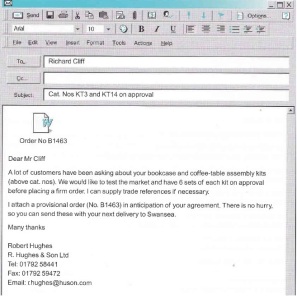
Layout example of a semi-formal email
sample

                                                                                         (Ashley, 2005)

  1. Learner Problems and suggested solutions

Formal (semi-formal) versus informal language

In semi-formal emails, students have difficulty using the appropriate formal language. As semi-formal emails are closer to being formal than informal it is necessary to train learners on the differences between formal and informal language. Learners who have languages which have formal grammar structures when writing formally (e.g in Greece we use  εσεις-esis- which is the formal pronoun you and shows respect) may have difficulty understanding that a pronoun for example, does not suggest formality whilst special structures do.

Suggested solutions:

A teacher could:

  • give learners very informal sentences and ask them to write a more formal sentence and then pass it over to the next student going from “ I need some information…” to I would like some information” etc. When the last student gives up or the sentence written is more informal than what the previous student wrote, the learner who provided the final formal sentence gets a point (English club, 2012).

Evaluation: this is a semi controlled task which practices writing in the form of a game so it can be fun. Chain sentence exercises require good planning on behalf of the teacher as some students may end up with piles of papers. Game like activities can be appreciated by all learners especially kinesthetic ones. The purpose someone is learning English may affect the learners’ attitude towards the task as more exam oriented classes may mistakenly view this as a waste of time as they are preparing for exams and not learning English for fun.

Problems with word order-syntax

Weigle (2002, cited in Watcharapunyawong & Siriluck 2013) claims that,

 L2 writing can be more difficult if syntactic properties of the two languages are very different, which makes L2 students rely on their first language when writing in a second language (ibid).

Greek learners in particular have difficulty with word order as in Greek word order is freer than in English (Papaethymiou-Lytra, cited in Swan and Smith 2002). From my own experience, my Chinese learners have difficulty with word order too as there are not many tenses and there is not a particular word order in Chinese.

Suggested solutions

In order to help learner with the syntax of semi-formal written English a teacher could:

  •  show learners sentences and ask the learners to identify the parts of speech and by using discovery methods ask them to form the rules of syntactic patterns of for example, indirect questions which are prominent in semi-formal emails. They could also fill out syntactic grids and have a visual representation of the syntactic patterns.

Evaluation: activities that engage learners in discovery method learning are an effective way to help learners realize the rules that govern the language. Such activities are appreciated by learners who like to learn rules and have an arithmetic perception as in my view, syntax is often like math. It is more appropriate for adult learners already acquainted to the syntactic patterns.  This type of task could be used as a lead in activity to freer productive activities.

  • Another alternative suitable for younger learners is filling out open ended sentences which give the students the beginning of a sentence and they have to fill in the ending. Students cold listen to a song  and then fill in the missing information. After that they are asked to mimic the sentences with their own examples focusing on the target lagage.

Evaluation: younger learners may not be familiar with syntactic patterns and may lack the maturity to understand such tasks like syntactic grids. That is why drilling tasks, which are a controlled way of learning, may be more effective.

Problems with spelling

Greek spelling is phonetic with almost one to one phonetic correspondence, but this is not the same in English. This can affect the writing semi-formal emails as spelling is integral! In order to help learners with their spelling a teacher could:

  • Practice spelling of difficult words like request/information/query with spelling bee games if the learners are young or by having a running dictation activity.

Evaluation: this is a fun and creative way of teaching spelling and young students enjoy it. Unfortunately it cannot be done on a day to day basis as it can be quite noisy and may be discouraging for weaker students as they may not be able to win.

  • Another way I practice spelling with my learners is through dictation. I usually get them to check their own spelling or exchange with a classmate as I think this helps them notice their errors rather than me using red ink over their papers. I also get them to write sentences in chunks so they can also practice the way words collocate with each other.

Evaluation: This is something my learners are used to and has proven to be an effective way of learning new words. It is a dry activity though and not very productive. Also it is questionable if the learners remember the words after a while.

Problems with punctuation

Students have difficulty with punctuation especially when there is not an L1 equivalent (there is no semi colon in the Greek language) or when different punctuation marks are used for different reasons e.g the position of the comma.  In this case a teacher could:

  • ask students to look at a text and notice where the punctuation marks go, asking them to punctuate something and a combination of the two (Harmer 2004, p. 52).

Evaluation: Noticing activities raise awareness which is essential when learning how to use punctuation marks and using discovery methods to explain their usage is a better way to establish acquisition. They can be lead in activities to productive activities like writing their own email and using the appropriate punctuation.

Problems with coherence

Students may have problems with lexical coherence or grammatical coherence. In the case of lexical coherence a teacher could:

  • Train learners on lexical cohesion at a paragraph level. She could jumble up sentences of an email and ask the students to put them in the correct order. Then the learners could circle the words that connect the text lexically.

Evaluation: jumbling up sentences makes the exercise like a puzzle and gives the teacher the opportunity to make this type of task like a game. This is a very controlled task which does not allow much productivity on behalf of the learners but it does facilitate raising awareness and noticing. It is appropriate for all types of learners who are learning English for various purposes.

As far as grammatical coherence is concerned at a paragraph level, a teacher could:

  • Use (open) cloze activities like those in the FCE exams. She can delete the words from a formal email and ask her learners to fill in the gaps with the missing words.

Evaluation:

Gap filling activities have been used for many years now and are a great way to tap into learners’ prior knowledge, activate schematic knowledge and make use of the students’ grammatical knowledge. Their difficulty level can change from quite easy, if they only have to put the verb in the right tense, to more challenging, if pronouns, reference words are missing. Such activities are more suitable for exam preparatory classes.

                                        Problems with cohesion

Many students have difficulty connecting their ideas and giving a flow to their text especially when they do not really engage in writing in their L1. In this case a teacher could:

  • Rearrange/cut up a text and get learners to put it in the right order.

Evaluation: game like/puzzle activities are enjoyed by most students no matter their age. Putting a text back together may be a fun activity which forces students to look at the way the ideas are connected. They look at main ideas and supporting ideas and how they all connect at a text level. This is a controlled activity that could be used in presentation stages of the semi-formal email.

  • A teacher could also get the students to read a text and underline the main ideas and supporting information.

Evaluation: this is an awareness raising activity which gives the students a visual representation of what goes where and the connection of ideas. It is necessary especially when students have difficulty putting a paragraph together. Such an activity is appropriate for all types of learners.

  1. Conclusion

Helping my learners with their writing skill is a very demanding task which requires a lot of effort. Once learners start to learn how to write though the texts they produce can make satisfy the teacher and make the learners feel that they have achieved something very important. They can express themselves through a text!

References

Ashley, A (2002) Oxford handbook of commercial correspondence (pdf file) Available at: < http://www.cc.kyoto-su.ac.jp/information/tesl-ej/ej35/r1.pdf> [Accessed at 09.11.2013]

Damayanti, Y (n.d) Micro and Macro skills found in the writing exercises of the Bridge English Competence for SMP Grade. Academia edu. Available at: http://www.academia.edu/1139509/MICRO_AND_MACRO_SKILLS_OF_WRITING_FOUND_IN_THE_WRITING_EXERCISES_OF_THE_BRIDGE_ENGLISH_COMPETENCE_FOR_SMP_GRADE_VIII_PUBLISHED_BY_YUDHISTIRA  [Accessed: 18.11.2013]

English Club 17 n.d. How To Teach Formal And Informal Language [Online]. Available at: http://edition.englishclub.com/tefl-articles/how-to-teach-formal-informal-language/ [Accessed: 18.11.2013]

Harmer, J (2007) How to Teach Writing: Malaysia. Pearson Longman.

Hotel Bookings Online n.d. [Online] Available at: < https://sites.google.com/site/hotelbookingsonline/Home/sample-hotel-reservation-letter>  [Accessed: 19.11.2013]

Hyland,K. (2002) Teaching and Researching Writing: Essex. Longman.

Sites-google.com n.d Useful phrases-How to write formal emails [Online] Available at: < https://sites.google.com/site/vktgenglish/polikarpova-rimma-nikolaevna/writing-hints-and-tasks-10-11-forms/useful-words–how-to-write-formal-letters> [Accessed: 10.11.2013]

Swan, M. and Smith, B. (2002) Learner English 2nd edition. Cambridge: Cambridge University Press.

Watcharapunyawong, S & Usaha, S. (2013) Thai EFL Students’ Writing Errors in Different Text Types: The Interference of the First Language English Language Teaching; Vol. 6, No. 1.

#firsttimeteaching

Theodora Papapanagiotou started a blog challenge called  #firsttimeteaching. When I saw it I thought that was a great idea for a challenge. I was gonna do it. Then I realized I did not remember the first time I walked into a classroom!! Quite worrying, eh? Anyhow, I am going to move from the firsttime I taught in a classroom, to the first time I logged onto my online classroom. Yeap!! I remember that one. The first time I taught online!!

Let me start by saying that I am not the most tech savvy gal in the world, I am actually far from that. My computer skills at that point were more about how to download something, watch a YouTube video and probably blog. I did not know how to make Pdf files, how to make folders that would save Mp3 recordings etc. etc. That was too much for my pretty little brain. So,  boy oh boy was I pushing the envelope (or should I say pushing the email since people don’t send letters anymore?). Teaching online was going to be a tough cookie for me… and it kinda was.

I started working for my company. I had received a lot of training and even had test lessons. Everything trainingwise had gone well. On the day of my first ‘official’   lesson, I turned on the pc, logged onto the internet, then my email, and I sent my student an email with information and links to our ‘virtual classroom’: the platform we were going to use for the lesson. I then called my learner. It was the first time I was using the phone and Adobe to have a lesson. I had never taught using a webcam before either. Both felt strange, especially since I had my webcam on, but my learner was only using a phone. That meant that I couldn’t actually see the student. I could only hear a voice. The lesson started as all lessons do. The only different thing was that I had to ask TRCs. That is what I call technology related checks like, ” Can you see me? Can you hear me? Do you see the slides” etc.

Not using paper and writing/correcting stuff was odd. I did go around that though, and when I wrote on the virtual whiteboard, I told the learner to take screen shots.

I also found myself having difficulty with turn taking, cause I did not know when the learner was going to talk. I could not see the learner! Not being face to face was actually quite stressful in the beginning.

Everything did go smoothly. I think the hardest part of the lesson was the things I had to do after the lesson!! The administrative stuff!!Downloading and uploading files/recordings. The first few online lessons took me hours to prepare and complete. Now, it is a piece of cake! I have gone a far way since my #firsttimeteaching online!

EAP resources

Till next time………