Speaking time

Let them Speak

In today’s post I am going to share with you something I did with my learners to get them to speak a bit, to take a long turn, a short monologue if you prefer. My students are intermediate level learners who feel a bit intimidated/challenged when they speak. Today though, was a completely different story, my learners had a lot of fun and actually spoke like they never had before! I was really pleased with today’s session. They went from talking about something ordinary to something extraordinary. So, what did I do? 
Normal everyday pics- Stage One
I gave my students two A4 cardboard sheets with four pictures stuck on them. The pictures were of people doing everyday activities. There were lots of details in the pictures. I then gave my students some instructions.
Instructions:

  • Choose 2 of the pictures you feel you can talk the most about. Tell me what you see and whatever else you think connects to the picture.
  • I will give you 5 minutes to plan and make notes BUT when you start talking about your pictures I don’t want you to be looking at your notes.
  • I will not help you with any words. Use the vocabulary you know and paraphrase whatever you don’t know.
  • There is no time limit. Speak for as long as you can.
I also wrote a few questions on a sheet of paper and put it in front of them. I said, ” You can use these questions to get ideas if you want.”

                           Wh  Questions:
                                      What/who do you see in the picture?
                                          What are they doing in the picture?
                                              When was this picture taken?
                                                  Where was this picture taking
                                                      How do the people feel? How does this picture make you feel?

Five minutes later…
I told them that they should close their notebooks and just talk about the pictures. If they got ‘stuck’ , they could then open their notebooks to get ideas. That’s what they did. After each student spoke we had a short chat about things that had been said incorrectly and they also asked me about words they did not know. They took notes (these notes have been linked to the next session).
Stage two- A painting with people
After they spoke about the everyday pictures  I showed them this painting.
Picture taken from Pablo Picasso org. Link found here
I told them to do the same thing again. The instructions and questions were the same but I gave them an extra task. I told them that this was a painting and that they had to give it a title. This is when they started turning their heads, turning the pic upside down, and trying to figure out what they see. This time my students were a bit impatient saying things like, ” tell us miss what is this?”  ” I can see this and that but.. hmm… what is the other thing” They were extremely engaged.
Five minutes later….
Of course they spoke to me about what they saw in the painting and they were very amused with what they were describing. I then told them what the painting was called. It’s the Three musicians by Picasso. They loved it! They then tried to figure out where the musicians were, what they were playing and so on. There were a lot of Uh hu moments today.

Final thoughts
Using pictures to get your learners to speak is a great start, especially when they are not mature enough to answer questions related to ‘hot topics’ or when they are quite weak. Prompting them is also important and this is why I used a few questions. I did not give them any vocabulary help because I thought that it is necessary that they rely on their own language to speak, and because paraphrasing skills are important and these tasks give them the chance to do so. I started with everyday pictures to make them feel comfortable and then moved to cubism (abstract art) to challenge them and to make them use their imagination. On the plus side, you can do this with ANY learner, no matter what the context is!
The outcome
My students had a lot of fun, spoke a lot and said, ” When are we going to do this again?”
What I learnt today? Maybe the most rewarding lessons come from the simplest ideas + bring abstract art into the classroom : )
Till next time…..
Drawing during grammar

Time line with a twist

Every once in a while, I am sure you draw a time line on the board to help your learners understand a tense. Why not jazz things up a bit and instead of drawing a time line, draw a picture time line? Also, why not get your learners to do the same? This post is about picture lines, posters and making grammar fun and creative.
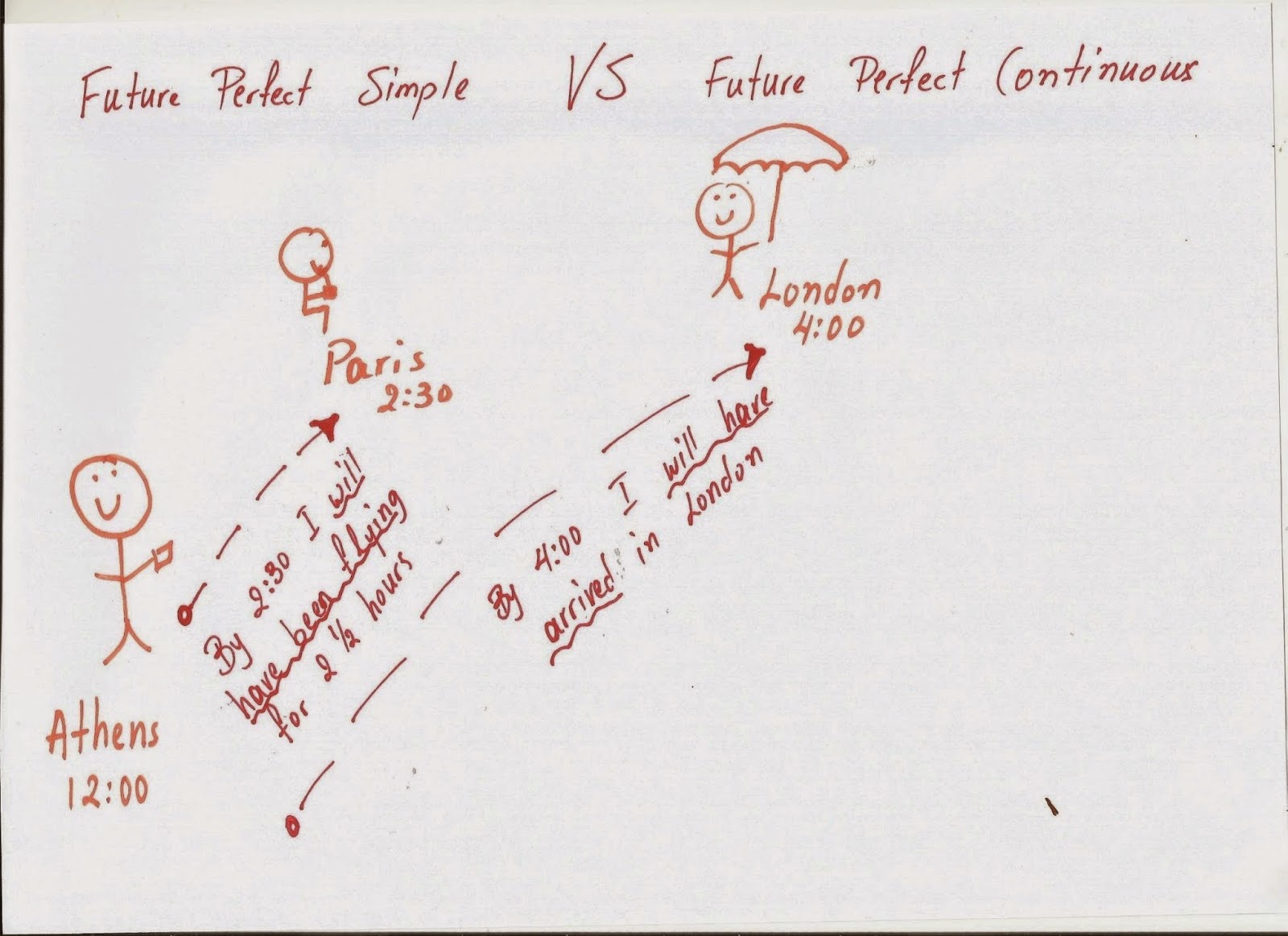
The other day, I was teaching the future perfect simple and the future perfect continuous and used the example I always use. I also drew the pictures I always draw when I explain the difference between the future perfect simple and the future perfect continuous tense so here goes.
Uses depicted in this picture time line:
  • Future perfect simple: action that will be completed by a specific time in the future.
  • Future perfect continuous: action that will be going on up to particular time in the future. We emphasize duration.
Example of a picture time line. A flight from Athens to London
I draw this on the board and ask my students a couple of questions based on my lovely sketch.

Examples of questions you can ask about the picture time line:
Where is Jack flying from?
Students: Athens.
Where is Jack going?
Students: London.
By 2:30 will the action (the trip) have finished?
Students: No.
By 4:00 will the action have finished?
Students: Yes.
Why draw when making a time line?
  • Your students can visualise the grammar.
  • In this case they can also see the distinction between the two tenses.
  • It’s fun cause if you are great at drawing, your students admire your drawing/sketching skills. If your drawings are terrible (like mine), your students crack up and there is a nice Happy atmosphere in the class.
  • They will probably remember the ‘rule’ cause of your drawing (mine do)!
Personalise the Future Perfect Tenses
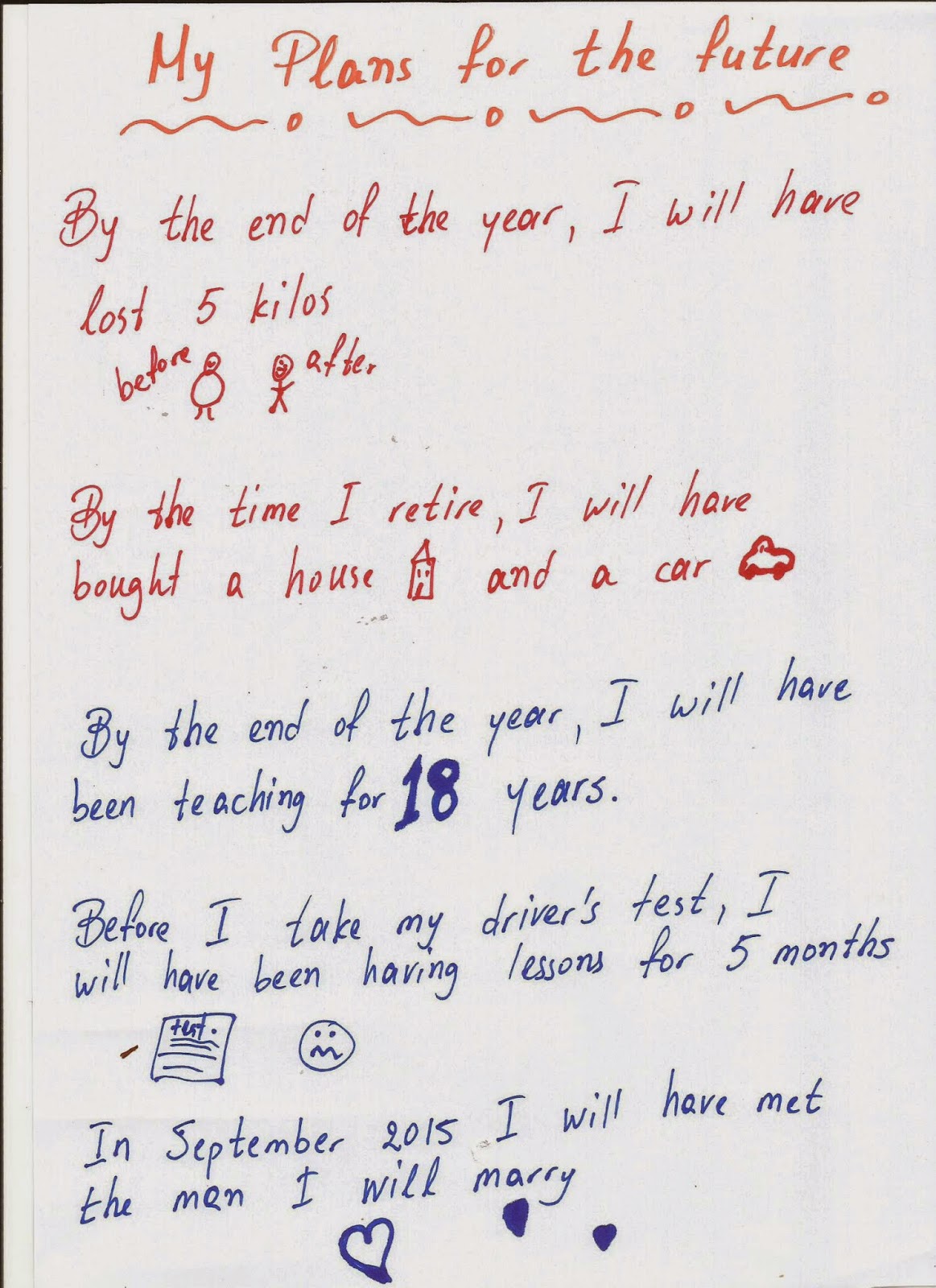
So you have presented the difference with a drawing, why not make the production stage of these tenses fun and creative for your students? Give them a big sheet of paper and ask them to make a list of their future plans. Tell them they need to make little drawings and use the future perfect simple and the future perfect continuous when talking about their future plans.
You should also make your own My Plans for the Future Poster.

My future plans poster

Add a twist-back to the picture time line

Once your students have made their “My Future Plans” poster, check it, and then get them to make their own picture time lines as well. After they have made their own picture time lines, they can share them with the class. Maybe  even be the teacher and show the rest of the class their examples.
Let me know how this goes!!  Have fun drawing. Have fun with your grammar : )
Till next time…..

Done with the D

The emotional roller coaster aka the Delta
One day later
I am done. Finished. Hasta la vista Delta. 
In this post I am going to tell you the stages or some of the stages every Delta trainee goes through after submitting/finishing the final module. Of course, not everyone is the same, and the intensity of emotions does differ, but their is a kind of aftershock that prompted this post. So, let’s see the stages.
You have just submitted the final assignment or taken the exams, and you get up from your chair.
Denial: You think, “Huh? Is that it? Is it over?” You start wondering if you actually finished. You wonder if you wrote your name correctly on the papers or if you forgot to add something. You doubt yourself. You think that something else is waiting for you around the corner. This can’t be the end. No way.
Emptiness: After you have handed in your final paper and you go through the stage of disbelief/denial you feel a bit empty. It is Saturday night and there is no Delta. You can actually go out. Huh? How on earth did this happen? You have free time and you really don’t know what to do with it (yeah right, as if). There is a void that needs to be filled.
One month goes by, then the second, and then results are just around the corner. That’s when uncertainty kicks in. You wonder, ” Hmmm, what if… What if my paper is not good enough. What if I actually did forget to write my name… what if I fail?”
Uncertainty and anxiety walk hand in hand, so yeap, you get anxious. You want to get the results. You start checking your mail 24/7 waiting… and waiting….and waiting.
Elation. Results are in and you have passed. Yeap you are done. You are on an adrenaline high. 
Back to the day after
Now what? For me, teaching is about learning. I like to learn and study. I may not be the best teacher-studentin the world, but I defo like to learn stuff. Any stuff. Since I already have an MA and now the Delta, I feel numb. What can I commit myself to?  I will find something for sure : )
One final thought
Doing the Delta is a great idea cause you learn stuff, you improve,  but it is intense, especially if you are working full time. While I have exaggerated a bit in this post, there are a lot of emotions you go through as a delta trainee and a lot as a candidate waiting for results. 
If you want more rambles on the Delta press here and here
How do you feel? Feel free to write your comments in the comments section below. If I have forgotten any ‘stages’, please let me know.
 Oh yeah… now it’s party time. 
                                                 Done with the D.


Till next time…..

Presentation skills

Using assessment criteria to teach presentation skills

If you teach presentation skills for Academic or even Business English Purposes, you may find this post interesting. Today, I will talk to you about a little project I did and talked about at the Cultures of EAP online conference held last week. This is actually me, reporting about my talk and digging a bit deeper into issues I mentioned and some I neglected to mention during my talk. So, anyhow, let’s take things from the beginning.
A bit of context: An idea is born
I was doing module 3 of the Delta and decided to specialise in EAP presentation skills. My aim was to create a presentation skills course, but….where would I start from? My first step was to start thinking of the elements of a good presentation. If I wanted to make a syllabus, I needed to know the characteristics of a good and effective presentation. As I had taught presessional English many times, I had been trained on how to teach EAP presentations skills, I had assessed my students’ performance in them and I had access to loads of material, I thought I would start there.I also had three very important sheets: Presentation Skills Assessment criteria from three UK universities (Newcastle, Bristol and Sheffield) and voilà.

Time to create my syllabus
Why and how can I use assessment criteria?
I am not a presentation skills guru. I know some things about presentations, but I felt a bit insecure to design a whole course and define the objectives and aims based only on my experience. I decided to combine all the assessment criteria sheets into one and then decide what should be part of a presentation skills course.
What are the elements of a good presentation?
Based on what I found, when students present their  research or give an academic presentation ( this of course, extends to all kinds of presentations), they should focus on the following criteria and relevant sub skills/strategies/features:
Task fulfilment & Content/Structure:
Here the focus is on the introduction/overview, main body and conclusion of a presentation. Stages of a presentation are integral as well. This criterion also addresses issues related to backward and forward referencing. Key question: Is the subject matter clear?
Language (Lexis and Grammar):
Closer look: when giving a presentation, the learners’ language needs to be clear. A variety of structures should be used. Discourse markers are also important. On the whole, a very good control of the language is what is essential here.
Pronunciation/Voice: 

Here the focus is on the pronunciation of the words and connected speech. Voice and rhythm. Is the speaker monotonous? Does the presenter know which words/ how to attract attention? What about intonation?

Technique/Communicative effectiveness/Presentation skills: 
Closer look: This has to do with eye contact and using gestures/facial expressions when delivering a presentation.Visuals and timing also affect the delivery of a presentation.

So should we be using criteria to asses or inform? Or Both?
In my case, presentation skills assessment criteria were used as a way to informally asses my students through formative assessment. It also was a great teaching and learning tool. Giving your learners assessment criteria at the beginning of a course works wonders as well:
  • It allows the learners to familiarise themselves with the aspects of a good presentation.
  • Students can self assess their performance.
  • They can pinpoint the areas where they are having difficulty with.
What are the implications of using assessment criteria to create a course?
If you design a course that focuses on using assessment criteria as a guide to syllabus, there may be a few implications you may need to consider. The course I designed focuses on criteria which are assessed in EAP presentations. This, of course, may not be connected to the students’ real life needs later on. Assessment may lead to anxiety as your learners may always feel that they are being assessed which may make the lessons less fun. ‘’Receptive skills can be tested objectively but productive skills usually require subjective testing’’ (Jordan, 2012, p. 86) So, you, the tutor, may have undergone standardisation on how to assess, but subjectivity is always an issue in these cases. Also, the assessment criteria focus on general academic skills, so if your group is a specialised group of students and you are teaching English for specific academic purposes, you may need to focus on some criteria more than others. For example, a student majoring in mathematics  will probably not have the text size of a student majoring in history and so on.
I gave a talk about using assessment criteria in order to design the syllabus of a presentation skills course at the Cultures of EAP Web Conference. You can watch the presentation here Of course, I know I am not really talking about something new in this post, but it is definitely worthwhile knowing the elements of a good presentation prior to teaching one. Assessment criteria enable you to do that!
Till next time….


References:
 Jordan, R. R. (2012) English for academic purposes: a guide and resource book for teachers. Cambridge: Cambridge University Press.

Fun tasks for Valentine’s Day

Valentine’s Day ❤

Looking for something to do with your students on Valentine’s day? Search no longer,fellow teacher.!In this blog post you will find ideas for different things you can do on that day.
Online quizzes, vocabulary games for young and older learners
There are lots of websites that offer online quizzes for young learners. You may want your students to play an online game and match pictures and words or an online crossword (this is more suitable for older learners).
Love songs (the songs with * have fairly simple lyrics)
There are so many love songs to choose from. The lyrics will definitely be available somewhere as well. You can do gap filling tasks with these songs. I have added the link to the YouTube video in case the title does not ring a bell.
Frank Sinatra LOVE
*The Contours Do you love me?
The Cardigans Lovefool 

Gloria Gaynor I love you baby
Whitney Houston I will always love you

A Project about Valentine’s Day
Why not get your students to do research on Saint Valentine, the origing of this celebration, how it is celebrated around the world and so on? This should be organised a few days earlier. Your students can present their projects on Valentine’s day.

Picture taken from here

Jigsaw reading about Valentine’s Day around the world.
Why not read about Valentine’s day and strange traditions from all around the world. Student A reads about 5 countries and Student B the other 5. Once they have read their texts and taken notes, take them away and ask your students to tell each other about the strange Valentine’s Day traditions.
Remember this old TV show? Watch an episode or one round of the game. Stop when the timer shows who the man or woman is going to choose (this is minute 5 on the link I have shared with you) and ask your learners to summarise the 3 contestants’ answers and then guess who will get chosen. I would suggest using this with older learners or adults. This is a blast from the past!! The sound quality is not that great either, so I also suggest using it with stronger students.
Make a card
You can make Valentine’s day cards with your students. You can either print colouring pages and get them to add this to cardboard and make a card or print actual card templates. You can also try this cool Valentine’s Day 3D pop up card. If I have young learners who are shy and they don’t want to make a card for the one they love, I say that you can make this card and give it to mummy/ daddy or grandparents. Of course the poem that goes in the card is:

                Roses are Red
                         Violets are blue
                                     Sugar is sweet
                                                  and so are you.

Valentine’s day debate
Split your students into two groups. One group in favour of celebrating Valentine’s Day and the against it. Each team should have a spokesperson. Give them about 5 minutes to prepare.  Once both teams are ready, they can debate over whether we should or should not celebrate this day.
Colouring page screen shot taken from here

Valentine’s day cupcake topping ideas
How about watching a video about cupcake toppings? Ask your students to take notes of the way they can add a flower or a rose topping on a cupcake. You can add subtitles if you have weaker students. There is also a transcript option.

             /

Valentine’s Stepping stones Odds and Evens
You can revise numbers, teach your students the difference between odds and evens by using this great odds and evens stepping stone coloring page.
I have made a lesson plan about first dates and the growth of a relationship. The language focus is on Make and Do collocations. You can find that here


Couldn’t resist embedding the song : )

If you want more ideas, have a look at this website:
www.activityvillage.co.uk

Feel free to add any other ideas in the comments section below.

Till next time……..

EAP

EAP Presentation skills: Learner perceptions, problems and an itsy bitsy case study

In this post I am going to talk a bit about EAP (English for academic purposes) and presentation skills in relation to learner problems and students’ perceptions. I will do this by sharing with you a small case study. Before moving on, let me just let you know that in EAP very often students are asked to give a presentation about something they are doing research on. Presentation skills are also assessed as part of many/almost every pre-sessional EAP course.

My experience

I have been fortunate enough to have had the opportunity to teach pre-sessional EAP at 3 great universities (in the UK). Moving around the UK whilst teaching EAP, has allowed me to see how different universities teach presentation skills and how presentation skills are assessed. It has also given me the opportunity to witness presentation skills learner problems. Whether the learner is Chinese, Iranian or Greek, international students do tend to face the same or similar problems.

What do learners know about presentations anyway?

A bit of context: I had a group of four EAP students, all Greek and all post-graduate level learners, studying at a university here in Greece. During our first session, I asked them, ” How do you prepare for a presentation?” Their answer surprised me. They had never had any input whatsoever on how to give a presentation in English, although they were expected to, and had, given one or more presentations in English while attending university.
When I first meet my Chinese students during their EAP courses, I ask them about their presentation skills experience, 99% of the times I get the same response.

What do you consider important when giving a presentation in English?
I asked my (Greek) learners the million dollar question (what do you consider important for a good presentation?) and this is what they thought:

1st Planning
            2nd Language (General vocabulary)
                    3rd  Signposting language
                             4th  Pronunciation

                                       5th  Appearance of visuals


Valid points, don’t you think? All the above are important when giving a presentation. But there are more…..
So, I then observed my learners in order to see what kind of difficulties they had when presenting research in English. I observed them without having given them any guidance on how to deliver a presentation in English. They used material they had actually used at older conferences, material they had presented before. I looked at structure/content of a presentation, language, pronunciation and voice, communicative effectiveness and presentation skills. This is what I found.

Learner Problems
Structure/Content of presentation:

  • Missing slides ( overview/introduction, main body, conclusion format was not followed)
Pronucniation/ Voice:
  • Speech often monotonous, robotic
  • Intonation similar to their L1
  • Mispronunciation of key words
Content/Task Fulfillment:

Whilst all learners knew what they were talking about, there was an over reliance on their research papers. They did not elaborate on their ideas.
Language:
  • Grammar/lexical range was basic (not enough complex structures)
Communicative Effectiveness/ Techniques:
  • Students were not giving a dynamic presentation. They stayed glued to their computer (some did not even stand up as a chair was available)
  • No eye contact with audience
  • a lot of reading from slides
  • Visuals were too wordy with a lot of unnecessary animation
Finally, during their first presentation, my learners plagiarised a lot, but they didn’t know they were plagiarising!
Conclusions
Both my Chinese and Greek learners have similar weaknesses when presenting in English.   Presentation skills in EAP require the bringing together of many sub skills. In order to help the learners, it is essential to know what the individual learner problems are and address them in class. Knowing general learner problems is a good starting point though.

Want to hear about assessment criteria, learner problems and syllabus design?
On Thursday the 15th of January I will be giving a short talk on my experience teaching presentation skills to a group of Greek learners. I will look at assessment criteria (used by 3 universities) and learner problems, and how they inform syllabus design.
The conference is free, online and hosted by Sheffield University and Oxford University Press.
If you are interested in hearing the talk, press here for more information.

Till next time……


What makes a good teacher?
One of my last lessons of the year was with two boys who are about 12, and I asked them that same question. It was actually part of a reading task but I thought I should start with a bit of a chit chat about teachers and hear their views. So, I posed the million dollar question.” What makes a good teacher?’ They told me their opinion which is what I am going to share with you. Interestingly enough, I had asked a similar question to a group of Chinese students, my EAP group, during the summer and I will share their views as well. Do you think that my learners agree or not?

My Young learners:
A good teacher:

  • makes you laugh
  • answers your questions
  • doesn’t shout
  • makes the lesson interesting
  • helps us relax when we are tired (didn’t see this one coming!)
  • gives good grades (this one is kinda saddening cause it shows me that from such a young age, my learners focus and chase grades)
Now, according to my EAP (adult) learners:
Boring is a teacher:
  • who is not funny and does not have a sense of humor.
  • who only does things from the book/ reads everything from a book.
  • who is strict (?!) not flexible.
  • who does not show any facial expressions, stands still.
  • who doesn’t have a lot of knowledge.
  • who doesn’t tell us stories about her/his life.

So, looking at their answers, a few conclusions can be drawn. Humor is always important. So, find ways to make your learners laugh and have fun during your lessons. Lessons should be interesting, which is why it is important to connect with your learners and find out their likes and dislikes. It is important to be informed and well prepared. When you go into class, you need to know what you are talking about and be able to answer questions. Not being flexible, and shouting are no, nos.

So, as 2014 is towards its end, time to reflect and think about how you teach and how your learners would like to teach. I know I am.


See you in 2015!!

Delta

DIY*- Delta module 1
Continual professional development is very important for me as a teacher. That is why, after 15 years of teaching experience, a BA in English, a M.Ed in Tesol, I decided it was time to do the Delta and I did. But my way. As the Delta is quite pricey and after some of my friends suggested it, I thought, “why not try studying on my own for module 1?”  I did. I passed. This is my story.

What is module 1 of the Cambridge Delta?
Module 1 is Understanding Language, Methodology and Resources for Teaching. It is a written exam and there are two papers ( for more information go here and here).

Person specifications
Well, I had been teaching for fifteen years and I already had an MA. So, I did feel a bit comfy in my ‘teacher’ skin.

                                                   DIY-module 1

How did I prepare? 
Well,

  1. I found a center that would be willing to take me on as an external candidate. In my case it was Celt Athens
  2. I googled Delta module one suggested reading list and I found loads of websites with suggestions on what to read in order to pass module one.
  3. I looked at my bookshelf and found books I already had from my BA or MA and made a Delta module 1 shelf.
  4. I searched online to see if any of the suggested reading material were available and saved them in a folder on my desktop. The My Books folder (Scribd and Google books do have some of the books from the reading list).
  5. I found all the examiner reports and past papers available. This took some time but Google was my best bud those days. I saved everything in a different folder. The exams folder.
  6. I found blogs with tips on how to pass module one and put them on my favourites list.
and then I started studying……..
The books I read from cover to cover:
About Language by S. Thornburry
How to teach English by J. Harmer
The Practice of English Language teaching by J. Harmer
Teaching English Pronunciation by J. Kenworthy
Testing for the language Teacher by A. Hughes
Second Language Acquisition by R. Ellis
and I made notes. Loads of notes. this is actually how I learn. I underline or highlight stuff and then I make notes in my notebooks. I like using different colours, and  I try to make things look pretty. Do not ask me why. It just makes studying and note taking much more fun for me. 
Exam papers
As I said earlier, I found all the exam papers available online and I printed them. I know this is not very eco-friendly, but I like to be able to circle and underline rubrics so that’s why I printed everything. I then started doing the tests by myself and tried to mark myself based on the examiners reports. I looked very carefully at the examiners reports and made notes of the suggestions the examiners made. If I was unhappy with my performance, I would do the test again. Most improtantly, I timed myself!

When I found theories I had never neard of before or knew nothing about in the past papers, then I would do a new Google search and try to find information to add to my notes.

My weakness
Phonetics. I did not like phonetic transcriptions. I found it very difficult and I struggled a lot with this during my module one exam prep. I would phonetically transcribe words and then go to the Canbridge online dictionary to check the phonetic transcription. Connected speech was harder which is why I went back to my uni modules and found everything I had done on connected speech and tried to figure out how to write a whole script. This was the most challenging Delta topic for me!
                              /ˈwiːk.nəs/
Study hours
I work full time, so mornings and afternoons. I usually finish work at 9 pm. I did the same while I was preparing for module one. That meant that I squeezed in a few study hours during the week but most of the studying went on during the weekends. I started preparing in Septemebr and took exams in the first week of December.
Is this for you?
Do you need…….
✓ to study with others?
✓deadlines?
✓feedback?
✓pep talks?
                  
Then, nope, this solution is not for you. If you decide to prepare by yourself for the Delta module 1, you need to be self-disciplined and quite organised. You are on your own. No one is around to help you. May I also mention that I only got a pass. I did not get a merit or a distinction and maybe the fact that I prepared by myself did affect my grade, meaning that maybe  I would have got something higher, had I done a course. I still learnt a lot though, about myself and teaching. So, what do you think? Is it worth a shot?
*DIY: Do It Yourself

Till next time……

Holiday season fun activities

Rudolph the red nosed reindeer

Picture from:http://www.123learncurriculum.com/
Holiday season everyone, and may I just point out the obvious…. I love all the Christmas-y stuff, so here is a blog post about Rudolph!! You will find Rudolph themed activities and ideas on how to use them in class. I hope you enjoy this post and happy holidays everyone : )
Project writing activity: Get your students to do some research on Rudolph and then write a project. They can either give a poster presentation or a PowerPoint presentation. I would suggest you do this with older students. Helpful links: The story behind Rudolph: Wikipedia or from Altogether Christmas

Colouring:   Online colouring Yeap, your students can color Rudolph online. I tried this page out and used the water brush. This website also gives the option of starting over and saving. It is a really fun website so check it out.
Colouring sheets: If you prefer more traditional coloring pages, then click here for an example.
You can practice colours with your learners or even animal body parts during this colouring activity. Once they have coloured their Rudolphs, they can make cards for their loved ones or little Rudolph streamers and decorate the class.

Picture from http://www.coloring-page.net/pages/rudolf.html
Games:

Pin the nose on Rudolph: How do you play? Your students have to pin Rudolph’s red nose onto his face. If you want to make it more fun, you can blindfold your students and tell them to turn round in circles for a few seconds. Once they are twirling for 6 seconds they can then pin Rudolph’s red nose. 

Online game: Where is Rudolph? If you press the link, you will see a picture of a snowy house and a Christmas atmosphere. Rudolph is missing. Your learners need to guess where he is (spoiler: click close to the chimney. That is where he is hiding!!). You can use this as a guessing game and learners can practice using prepositions whilst you are the one doing the clicking on the computer screen.


Rudolph the movie: You can watch the movie Rudolph the red nosed reindeer in class and get your students to summarise it or write a review of the movie (this would be great for an exams class)!!

Screen shot from the movie

Listening:

You can find the YouTube video here but be careful, the lyrics are on the video, so use the sound only as part of the listening task. You can then use the video to check the answers. If you do not want to use YouTube,  I am sure you will be able to find the Rudolph song somewhere on a Xmas carols CD.

Gap filling task A1/A2 level students

You know Dasher and Dancer and Prancer and Vixen,
you know Comet and Cupid and Donner and Blitzen,
But do you recall?
The most ———- reindeer of all?
Rudolph the Red-Nosed Reindeer
Has a very ——— nose
And if you ever saw it
You would even say it glows.
All of the other reindeer’s
Used to laugh and call him ………
They never let poor Rudolph
Join in any reindeer games
Then one foggy Christmas Eve,
Santa came to say,
Rudolph with your nose so bright,
Won’t you guide my sleigh tonight?
Then all the reindeer’s ——– him,
As they shouted out with glee,
Rudolph the red-nose Reindeer
You’ll go down in ———-!
Rudolph the Red-Nosed Reindeer
Had a very ———- nose
And if you ever saw it,
You would even say it glows,
And all of the other reindeer’s
Used to laugh and call him ——–,
They never let poor Rudolph
Join in any reindeer games,
Then one ——- Christmas Eve,
Santa came to say,
Rudolph with your nose so bright,
Wont you guide my sleigh tonight?
Then how the reindeer’s ——— him,
As they shouted out with glee,
Rudolph the Red-Nosed Reindeer,
You’ll go down in ———–!

B1 + level students: Get them to guess the lyrics of the song. delete a whole chunk of it and ask them to write down the missing lyrics. Then listen to the original song and see if anyone was close to it.
You know Dasher and Dancer and Prancer and Vixen,
you know Comet and Cupid and Donner and Blitzen,
But do you recall?
The most famous reindeer of all?
Rudolph the Red-Nosed Reindeer
Has a very shiny nose
And if you ever saw it
You would even say it glows.
All of the other reindeer’s
Used to laugh and call him names
They never let poor Rudolph
Join in any reindeer games
Then one foggy Christmas Eve,
Santa …………………
You’ll go down in history!
Rudolph the Red-Nosed Reindeer
Had a very shiny nose
And if you ever saw it,
You would even say it glows,
And all of the other reindeer’s
Used to laugh and call him names,
They never let poor Rudolph
Join in any reindeer games,
Then one foggy Christmas Eve,
Santa ………………

Answers (from metrolyrics.com)

You know Dasher and Dancer and Prancer and Vixen,
you know Comet and Cupid and Donner and Blitzen,
But do you recall?
The most famous reindeer of all?
Rudolph the Red-Nosed Reindeer
Has a very shiny nose
And if you ever saw it
You would even say it glows.
All of the other reindeer’s
Used to laugh and call him names
They never let poor Rudolph
Join in any reindeer games
Then one foggy Christmas Eve,
Santa came to say,
Rudolph with your nose so bright,
Won’t you guide my sleigh tonight?
Then all the reindeer’s loved him,
As they shouted out with glee,
Rudolph the red-nose Reindeer
You’ll go down in history!
Rudolph the Red-Nosed Reindeer
Had a very shiny nose
And if you ever saw it,
You would even say it glows,
And all of the other reindeer’s
Used to laugh and call him names,
They never let poor Rudolph
Join in any reindeer games,
Then one foggy Christmas Eve,
Santa came to say,
Rudolph with your nose so bright,
Wont you guide my sleigh tonight?
Then how the reindeer’s loved him,
As they shouted out with glee,
Rudolph the Red-Nosed Reindeer,
You’ll go down in history!

If these ideas are not enough, you may want to visit this site for more on Rudolph themed activities (suitable for young learners).

I hope you enjoyed this post. Let me know in the comments section below how the activities went!

Till next time……..

Thoughts

D for Delta
When I first heard about the Delta, I was in the UK teaching Pre sessional English (EAP). A lot of my colleagues had a Celta or a Delta. Me? Nada. No, actually scratch that. I had a BA in English, 15 years of teaching experience in various contexts, and an MA in Tesol. Not bad, eh? Well, that’s what I thought, but then everyone would ask me, ” So, have you ever been observed? What about the practical side of teaching? How do you know you can teach?” ” Huh? I dunno. I just know I can teach. I have been doing it for like fifteen years… duh!”
(Note to reader:brief context. In Greece you can study at university and  get a BA in English language and Philology.This is a four year course, during which you either major in literature and minor in linguistics or vice versa.  You then take state exams, or at least that is what used to happen before the recession, and when you pass the exams, at some point, you start teaching at a state school).
After my first summer in the UK, I started thinking about the Delta. I read about it on the Cambridge website and then decided I was gonna do it.  I was going to do the Delta at my own pace though, slow and steady (emphasis on slow). Oh! By the way, if you are looking for tips on materials and what books to read, stop reading. This is my personal take on the Delta, how I did it, and how it has affected me.
My Delta Course
I did one module at a time. In the order mentioned below.
Module 1- DIY 
I started with module 1. I studied for module one by myself. I asked Marisa Constantinides from CELT Athens if she would accept me as an external candidate, she said , ” Yes”.  So, I was able to sit for the exams! I passed.
Module 2
I did a blended course at Celt Athens. I had online lessons on the weekends and face to face observations at CELT in Athens over the months I was doing the course. This was the best option for me cause the lessons were on the weekends, so I did not have to cut back on my teaching hours, and they were online, so I did not have to move somewhere to do the course. Of course, I had to go to Athens for the observations, but that was a chance to go to the capital as well, so win -win. I passed.
Module 3
Module 3 came after a big break (I think about ten months). I did a distance course at Bell. My specialisation is on EAP and the results are pending (fingers crossed people!).
So, that’s my story. Now, let’s move on to the story, behind the story. How the Delta changed me.
Little things
The girlie stuff:
  • I was fifteen kilos lighter when I started the Delta. Thing is, when you are thinking about starting the Delta, you ask about the workload and the modules, where people did the course and so on. No one really tells you the ‘other’ stuff. My daily habits changed. I stopped reading fashion magazines and started reading methodology books. Instead of riding my bike, I would think to myself, “I can’t ride my bike now. I have to study” and I ate a lot of food for the brain- carbs and chocs. Forget about healthy smoothies and fruit. Gimme coffee and a cupcake!! So, Delta + sitting in a chair + fatty foods = 15 kilos. This of course takes a toll on your wardrobe as well : (
  • Personal life? Huh? No, actually, let me put things into perspective. If you take time off and do just the Delta, I think you are fine. If you work full time, then something has to go. The thing that goes is mingling time. I have spent many Saturday nights working on my Delta instead of drinking a mojito or a pink…. cider!
Other side effects
  • I was whining a lot. I was also talking about the Delta 24/7 and when I wasn’t, I was thinking about it.
The bigger picture

So now you may ask me, ” Why do the course?”
  • You learn a lot about your teaching style and yourself. Planning sessions on your own, teaching them, being observed and then getting feedback, makes you look at your teaching very closely. You put more thought into your lesson plans, you try to find links between your tasks, everything has to happen for a reason! ” Why am I doing this? How will this help my learners? Will this work? What about that?” Also,the fact that other people watch you teaching and give you ideas on how you can improve or give you thumbs up on things you are doing well is SO important.
  • You try out new things. I, for example,  had heard and read a lot about TBL, but had never made a lesson based on it, I did during the Delta though.  I had been teaching the conditionals for ages, but only when I wrote an assignment about the 2nd conditional, did I realise that there was so much more about this grammar form!
  • It is practical, what you learn, you can use.
  • You reflect and then reflect some more.
  • So the workload is heavy, but the reading you do is so interesting, especially if you are a ‘nerdy’ teacher. You will really enjoy reading the books!! 
  • You meet people. I have made so many new friends cause of the Delta, friends who share the same interests as me and who were my study buddies. Now they are my buddies.
  • Marisa, my Delta tutor, got me into blogging and twitter. I actually wrote my first blog post for the Celt Delta blog. Now, I love blogging (I guess you figured that, eh?) and I really enjoy taking part in twitter chats as well. Also, because of the Delta, my professional learning network has grown and I have ‘met’ people from around the world and am sharing ideas with them. Because my PLN grew, I heard about conferences, started presenting at them and now I will be writing my first newsletter article as well (yay!).
  • The Delta opens doors and is a great teaching qualification (truth be told, it looks good on the CV). I teach EAP in the UK, and the Delta is one of the qualifications the unis ask for. You can also use the Delta to teach all around the world!
  • Your writing skill improves greatly and because of word count, you learn to tame the wordy teacher inside you! I really struggled with word count, but now I know tricks to reduce the words used in my writing (current post excluded!).
In hindsight my biggest regret is doing the Delta while working full time at the same time (I had a morning job and an afternoon one!). My advice to people thinking of doing the course would be make sure you have time. If you want to get good grades, then this is a MUST. The Delta course is such an interesting course and it is a shame if you do not have the time to enjoy it. Should you do the course? Definitely!!! Just keep in mind, no pain, no gain or as the ancient Greeks said,  

              τα αγαθά κόποις κτώνται


If you want to share your own experiences, please do so in the comments section below.

Till next time…….