The stranded in a cave task

Stranded in a cave
The other day I showed my intermediate level students a picture of a cave and asked them what this was and what they’d do  if in a cave. Then I added some drama and told them, ” Well guys, bad luck! You are now stranded in this cave and you have to get out or survive by using whatever is on the card!”
Activity: Students have cards with pictures on them and have to say how they would use this item to get out of the cave or survive. Some of the pictures have weird items on them e.g chewing gum or a plastic bag so as to make the students use their imagination and also make the task more fun. There is also a card with a question mark on it which means that the student has to choose his own object.Students are also asked to take notes of how their classmates would use these items so as  to use these notes during part two of the exercise.
Aim of the task: This is a speaking task (group work). Students can practice the use of the 2nd conditional (If I had a torch, I’d use it to guide me outside). Other structures are also used as this is a group task which invloves expressing opinion/problem solving/asking questions. This task also involves purposeful listening and note taking.
So, how did the task go?
Well, it created a great atmosphere and there was a lot of laughter. The element of surprise was there especially when a student had to mention how he would use the question mark card.Students did use the second conditional form but this was not the only strucutre they used. Some kept notes of how their classmates would use the items and others didn’t (one of the weaknesses of this part of the lesson).
Best part: My class was a group of adults! Who says adults dislike gamelike tasks?
How could I make this even more fun?
Add music-dramatic music like in the movies : ). Bring realia into the classroom. Something tangible although don’t know how the lesson would go with a dog in the classroom…….
Any comments?
I wish…

The other day I had an adult class and the grammar structure they were going to learn were wishes. I thought to myself ,”Ok, today they will form the rules for me” I did not have enough time to search for a video to show them and make a super duper lesson but I thought that it would be a good idea to write my own text and include wishes. My learners were all women and in relationships, which gave me the idea to write about a woman who made a lot of wishes regarding her current husband, her looks, her life in general. It was like a Brigdet Jones situation. The text although not a nobel prize winning novel made my learners laugh and they actually got the differences between the different types of wishes which were the focus of the lesson. After we read and laughed, they told me which structures we should use in order to make a wish. We then moved on to make our own wishes about our lives and the whole task was fun as the students ended up writing about their lives too. Was this the most innovative lesson on earth? No. Did I manage to get the message accross? Yes.
The grammar lesson was close to home and the theme was something my students could relate to. They giggled while reading which made them associate the target language with something fun and they produced sentences about their lives. I think that when presenting grammar in a text, the text needs to be engaging- fun. Bottom line: the more smiles you put on your learners’ faces- the greater the possibility they will actually learn something.

Learner Autonomy

For the past few years I have been reading alot about learner autonomy but how easy is it to actually achieve? Well, in the UK, learner autonomy is a BIG deal, in Greece it is getting there , I guess. So here I am reading methodology gurus go on about how your learners need to take their learning into their own hands and  that you should not spoon feed your learners all the time so I thought “Eh, Let’s try this out a bit” So I did. Well, sort of did : ).
Dictionaries. Do you actually use them in class? I do. I tell my sts to open their dictionaries. Well it is more like “Hey guys, you gotta use your dictionaries cause I will not be around all the time to help you out and I am NOT a walking dictionary!” So, my learners do use their mobile phones and look up words in their online dictionaries (I hope they are looking up words and not facebook statuses) and I am happy cause well, my learners are autonomous and I am a great teacher!
A couple of weeks ago I had my first delta diagnostic observation lesson. So I thought to myself “What do I do well? I get my learners to look up there own words” So, I will try this out and see what happens here.
The Lesson
It was a speaking/grammar lesson. The focus was on the function of agreement/ disagreement. I had found all my materials, made my lesson plan. I had figured everything out. I was really proud that I was going to include the “learner autonomy state of the art task”-the use of a dictionary.
I walked in. Started my lesson. I was having fun, my learners were having fun. It was a pleasant class and most of the lesson was going as planned. So,we were on task 5. I had given them two restaurant reviews taken from tripadvisor. Since my learners were intermediate level sts, I had adapted the language a bit and made it easier for them to understand. I explained the procedure and then said the magic words ” You should use your dictionary to check any unknown words”. Great classroom management skills, great instructions, I know…. I showed them the dictionaries, which I had placed on their desks prior to the lesson and went on to monitor this task. My learners read the restaurant reviews and then one of them raised her hand and asked ” What does…. mean?” I said, “Well, why don’t you use your dictionary?” and smiled. She looked at me, then at the dictionary and then asked her clasmate in Greek. They mumbled something, agreed on it and no dictionary was used or talked about after that. The sts went on to talk about which restaurant they would have liked to go to and then the class ended. My learner autonomy-dictionary task turned out to be a flop!Urgh!
What I should have done:
1. Discussed and explained why they should start using dictionaries. Maybe even get them to have a little debate about it. Get them to think about it more critically.
2. Searched for a word in class with them. Displayed the use of dictioanry. Give them a visual representation.
3. Given them a purpose to use it and make them record/organise any new words they wanted to look up.
4. Have some sort of follow up activity with this new langaueg item. What else? Any other ideas?

I am sorry dictionary. I had the best intentions but poor execution. I will do better in my next class, I promise, and learner autonomy will shine 🙂

See you next week!

More on learner autonomy-dictionaries:
http://oupeltglobalblog.com/2013/01/29/learner-autonomy/
http://www.tefl.net/teaching/teaching-tip_20.htm

The chain story

Chain story-part 1

Jeremy Harmer talked about a chain story in his webinar “Does correction actually work? It depends on who you ask”. So I though hmmm let’s try this in my class some day. That day came, yesterday.
My learners: three girls upper intermediate level sitting for language certificate exams at the end of May.They are teenagers and quite weak. They are very eager to learn and are quite studious. They have classes three to four times a week and the classes are mostly exam oriented.
 It was 8.30 pm, so they were quite tired. We were going to do a reading task about animal rights but my learners were just not into it!  We had been talking about animal rights and I had written on the board a couple of words they were having trouble with.
animal rights activists            animal testing         cosmetic companies
disease           claim            develop         support        reliable way        ban
I elicited their understanding of the words and then saw boredom in their eyes. They must have been thinking ” She will make us write sentences again!” But nope! I didn’t. Instead I thought “ok, how am I going to practise some of the words and wake them up again?” and then I sinned……I did something I should not have. I did not follow my holy grail, my lesson plan!
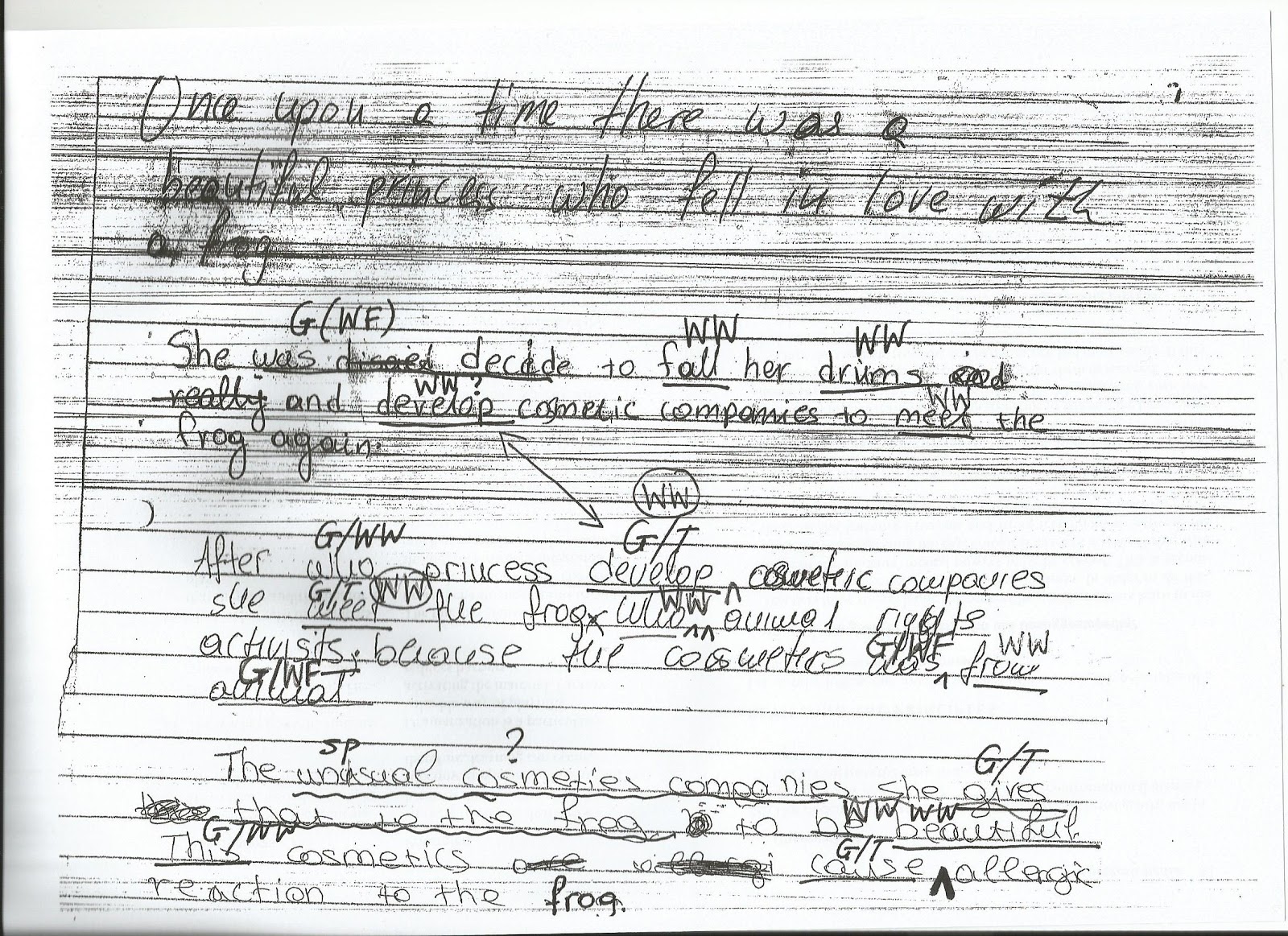
I used one of the error correction tasks Jeremy Harmer had mentioned in his webinar. I wrote on a piece of paper the phrase  “Once upon a time a beautiful princess met a frog” (well, I had to include an animal!).
I explained the procedure.Student B had to read what the person before her had written (student A) and continue the story based on what she read. Student B then had to fold up student A’s text and show the next student (student C) only what she had written. An added challenge was that I told them to use some of the words from the board (the ones in bold) in the princess story.
My students started reading and writing and then folding the piece of paper. They were laughing and smiling while doing so. What I noticed was that they did not ask me for any help with words but they actually asked eachother, quietly. They wanted to keep the story a secret and this raised anticipation in the class.
After about ten minutes of writing a story about a princess and a frog that had animal rights, it was time to read the story and I did. It generated a lot of laughter but also contained many erros which my students actually noticed. This is what I will be doing in today’s class. I will copy the story and make notes on some of the mistakes by using an error correction chart. I am very curious to see what will happen so part B of this activity will be described later on today.
PART 2
So, the girls came to class again and we continued from where we left in the last session. The girls actually wanted to write another chain story (woohooo they liked the chain story activity!) but I told them that we were going to correct the Princess story and that is what we did. I started by presenting the Error Correction Code
WW=wrong word
G=Grammar    WF=wrong form/T-tense
Sp=spelling
^ missing word
? I do not understand

I handed out a photocopied version of the story with the errors highlighted via my sacred code. The girls started reading and correcting what they could, there were giggles and from time to time I stepped in and offered help when. It was more like a classroom feedback error correction session than an individual activity After giving them about 8 minutes to check the chain story, I wrote the story on the board and the students gave me the correct answers. There were occassions where they were not sure what to write so I guided them. A couple of times I gave them the correct answer as for example, the meaning of the word found or the simple past founded. They also did not realise that they had to form the passive voice in one of the sentences so we went over the whole sentence together.The whole activity lasted for about 20 minutes.
My students’ opinion of the activity

  • They liked the fact that the story was funny and they had fun.
  • They enjoyed doing group work.
  • They prefer trying to figure out their mistakes on their own (we hadn’t used the error correction in the class much)
  • Something they all agreed on was that this activity was different and had nothing to do with the course book exercises.

They did not make any negative comments which made me feel content although truth be told, students sometimes do not want to offend or hurt the feelings of their teachers so maybe that is what they wanted to avoid. I want to believe though that the fact they they wanted to do this again is a good sign!

What do I think? These are some of my first thoughts……..

  • I should have included the chain story in my lesson plan and provided some sort of context for it. This would have prepared the ground and maybe my students would have produced a longer story with a better quality of language/ideas or grounds for more errors to check and discuss.
  • I did not provide any extra feedback/input after we finished the chain story error correction session. This is something I can do tomorrow though. I should find activities tasks that will help them with the mistakes they made for example,  tasks that make use of past tenses when narrating a story.
  • As this was a spur of the moment activity it had to be broken down into two parts. Maybe doing it in one session would have been a better idea (hmm I am going to have to think more about that).
  • My students need to have more fun in the class. I have been sucked into the whole exam preparation whirlpool and dropped anything that was fun. Its has been just EXAMS EXAMS EXAMS!
  • What did my learners actually learn? That is the BIG question.

PART 3 A few days later…..
My friend suggested I do a post-lesson, lesson plan. How would I have included this task in my lesson?Why? So I guess away with the postits on my coursebooks (my usual scribble on papers aka Jo’s lesson plans) and let’s do some serious lesson planning. Ok, not serious, semi serious… ok brief lesson planning. So, I gave it a bit of thought and come up with a couple of ideas (nothing formal here though. You will not see a delta style lesson plan).
Aim of lesson: This lesson aims to revisit the conventions regarding narrating a story. Focus will be on the written form of the story.
Stage 1
My learners listen to someone telling a story and there are some gap filling activitites where my sts would have to fill in questions like:
1. What tenses are mostly used?(provide example)
2..Who are the characters?When did this happen? Why? Where? (questions that would set the scence)
3. Fill in the missing word (the purpose here would be for my sts to notice that story telling becomes better when you can visualise it hence the use of adverbs adjectives)
Stage 2:
I would give my learners a transcipt of what they listened to and let them go over the answers in pairs. I would show the key to my gap filling activity on an overhead projector if available or through another medium.
I would also invite sts to make any other comments on what makes a good story and hold a brainstorming-classroom discussion.
Stage 3:
Some follow up activities on the elements discussed in stage 2 so as to revisit pre existing knowledge, remind them of things they already know. Build on and enhance any previous knowledge.
Stage 4:
The chain story task. This would be a semi controlled task as the first sentence will have been given by me.
Stage 5:
The error correction of the chain story task. I think Deirdre’s idea would also be interesting (see comments) to check if the sts could identify the mistakes for themselves.
Any other ideas 🙂 ?

So, this is the first activity I have tried out and semi-reflected on. I will be trying out something new next week but I would really appreciate any comments you have to make on more ways this could have been a better lesson.
Link to Harmer’s webinar
 http://www.pearsonelt.com/pearsonelt/professionaldevelopment/theharmerlectures/index.page
Alternative chain story activity http://darkwing.uoregon.edu/~leslieob/chains.html
http://lessonplanspage.com/lachainwritingidea412-htm/

This blog

What is this blog all about?

I have been teaching English for 16 years and have spent a lot of time going through articles and books written by great methodologists on how or what to teach. Choosing the right activity/task is quite hard and sometimes what you thought was a “great idea!” may have ended up being “eh, ok”.
I will test some of the ideas I thought were interesting and reflect on them here.
 I will also talk about my thoughts on anything eltish that pops into my head : P. You are more than welcome to comment and make any suggestions. Follow my blog if you find what I have to say interesting. So, may the ELT blogging begin!