Iatefl 2015 Chris Smith’s talk

ERROR CORRECTION FOR SPEAKING: AN EVIDENCE-BASED APPROACH

Christopher Smith

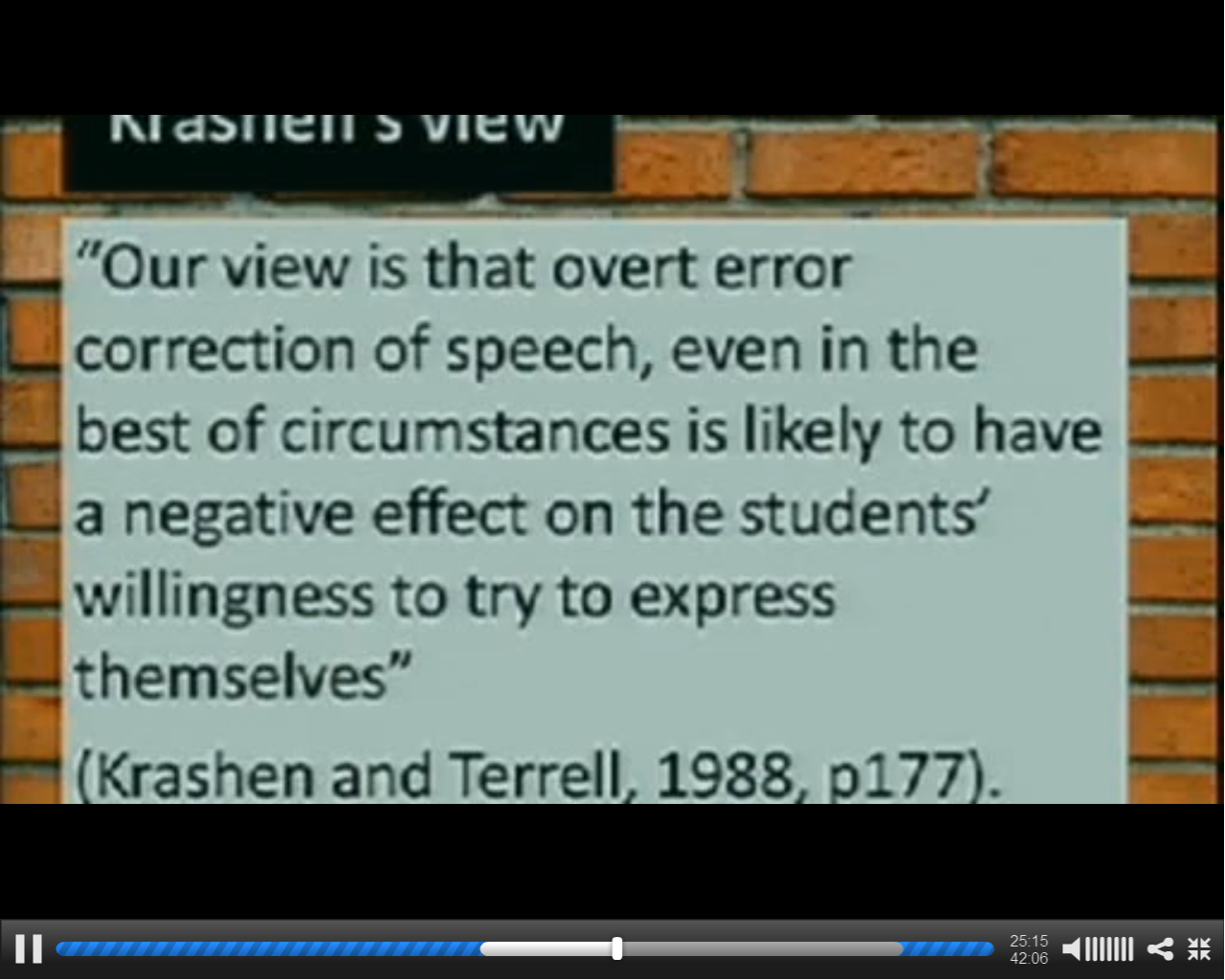
Chris Smith started his talk with a bit of information about the history of error correction. He mentioned how different approaches viewed error correction. He gave the example of Audiolingualism, where the teacher used to correct everything and Humanistic approaches where the notion is to correct nothing . Chris did point out that these statements -correct everything/nothing- are a simplistic /caricature view of how the approaches dealt with error correction. He then moved on to talk about Krashen and Terrel’s approach towards error correction. According to them, error correction did not work due to the affective filter (students got scared and embarrassed and this hindered their learning). This kind of attitude affected communicative language learning greatly.

Screen shot of Chris Smith's slides: Krashen and Terrel quote

Screen shot of Chris Smith’s slides: Krashen and Terrel quote

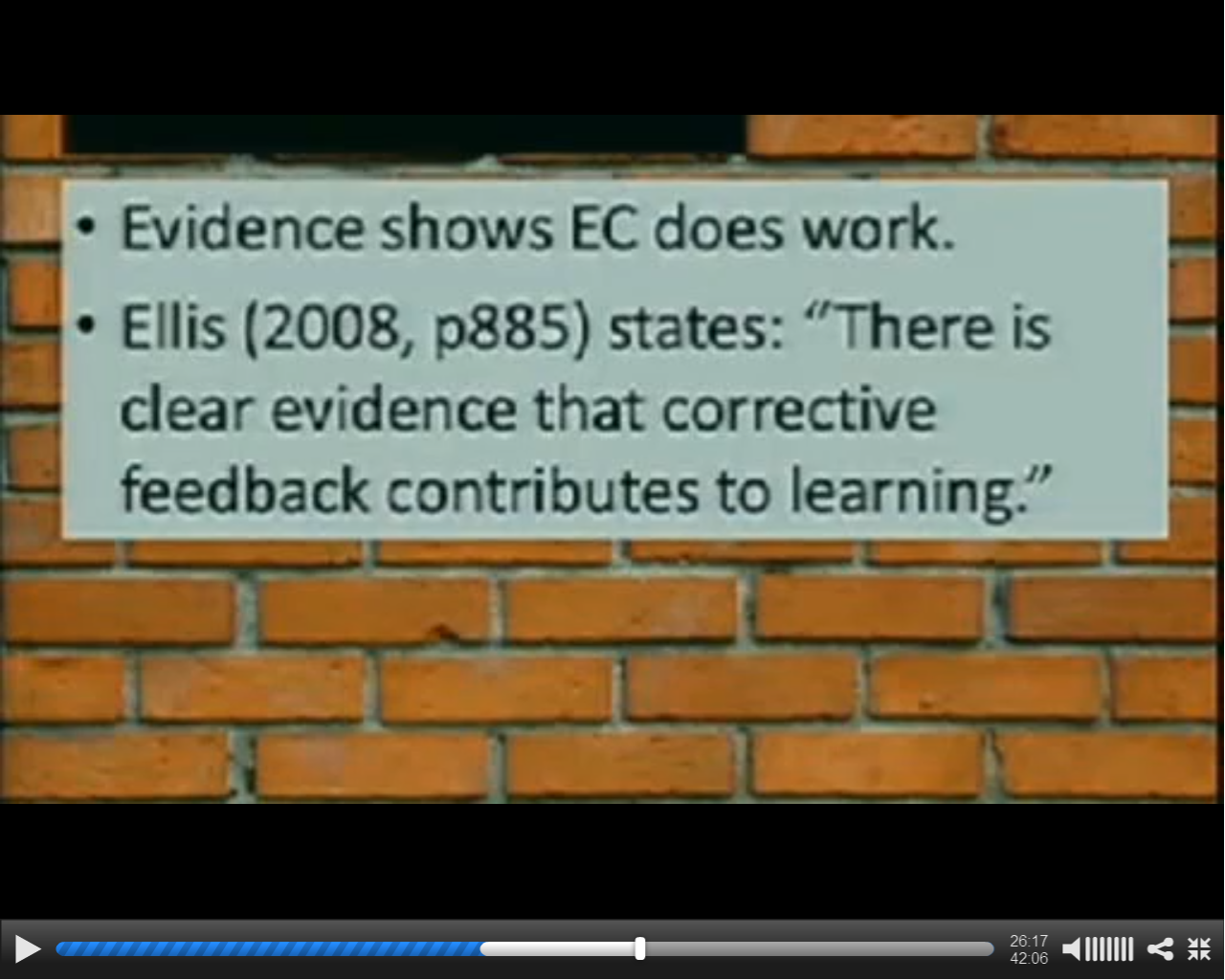
BUT research shows that error correction does work. Students who receive error correction improve.

Screen shot of Chris Smith's slides: Ellis' quote

Screen shot of Chris Smith’s slides: Ellis’ quote

Chris Smith then moved on to the main part of his talk which was his research. He  carried out research regarding error correction on speaking.

Chris Smith’s research

Learner Profile

200 EAP students (pre-master’s students). 2/3 of the learners were Chinese and the rest from the Middle East, Iraq. Kazakhstan. Most learners were in their mid-twenties. Language level: upper-intermediate.

Chris’ research started with general statements/research questions about error correction.

1). I believe error correction helps me improve.

Very strong agreement.

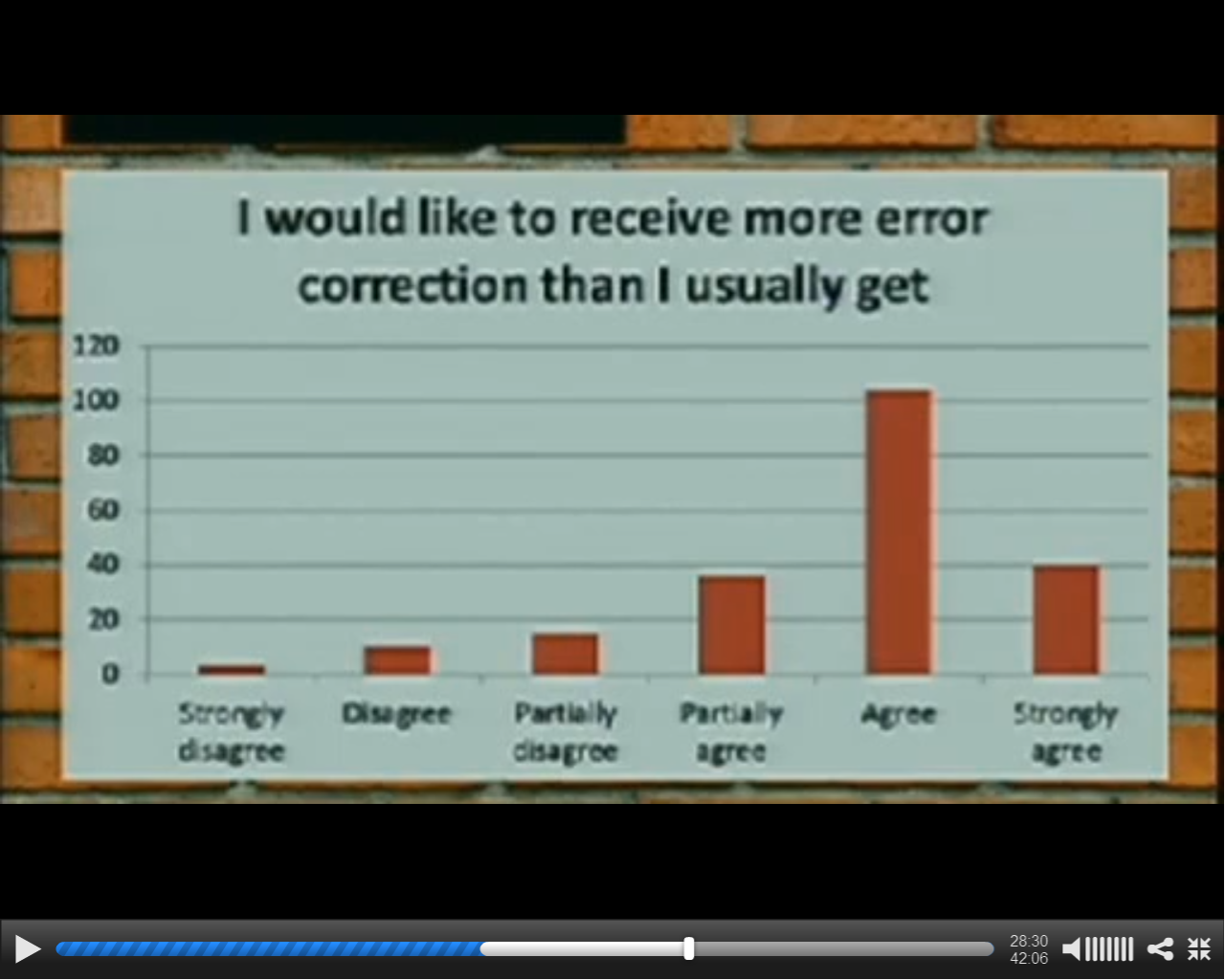
2). I want more error correction than what I get.

Agree (students, in general, want more error correction than what they receive).

But some people say you have to be careful with the amount of error correction you give. You might scare/upset your learners. This lead to Chris’ third statement/research question.

3). Being corrected by a teacher about speaking is embarrassing.

Strong disagreement.

Techniques for Error Correction

What kind of error correction technique do students prefer?

Student to student dialogues: Suggested techniques

  • Interrupting students and giving error correction.
  • Emailing students with error correction.
  • Writing errors on the board and then doing group error correction.
  • Giving bits of paper with individual feedback.

The most popular technique was giving individual feedback on bits of paper.

Recommendations on how to do that:

  • Use Postit notes so they can stick the bit of paper somewhere and because it is neat.
  • Cover the whole class. All the students must receive individual error correction on a Postit note.

What kind of error correction technique do students prefer?

Student to teacher dialogue: Suggested Techniques

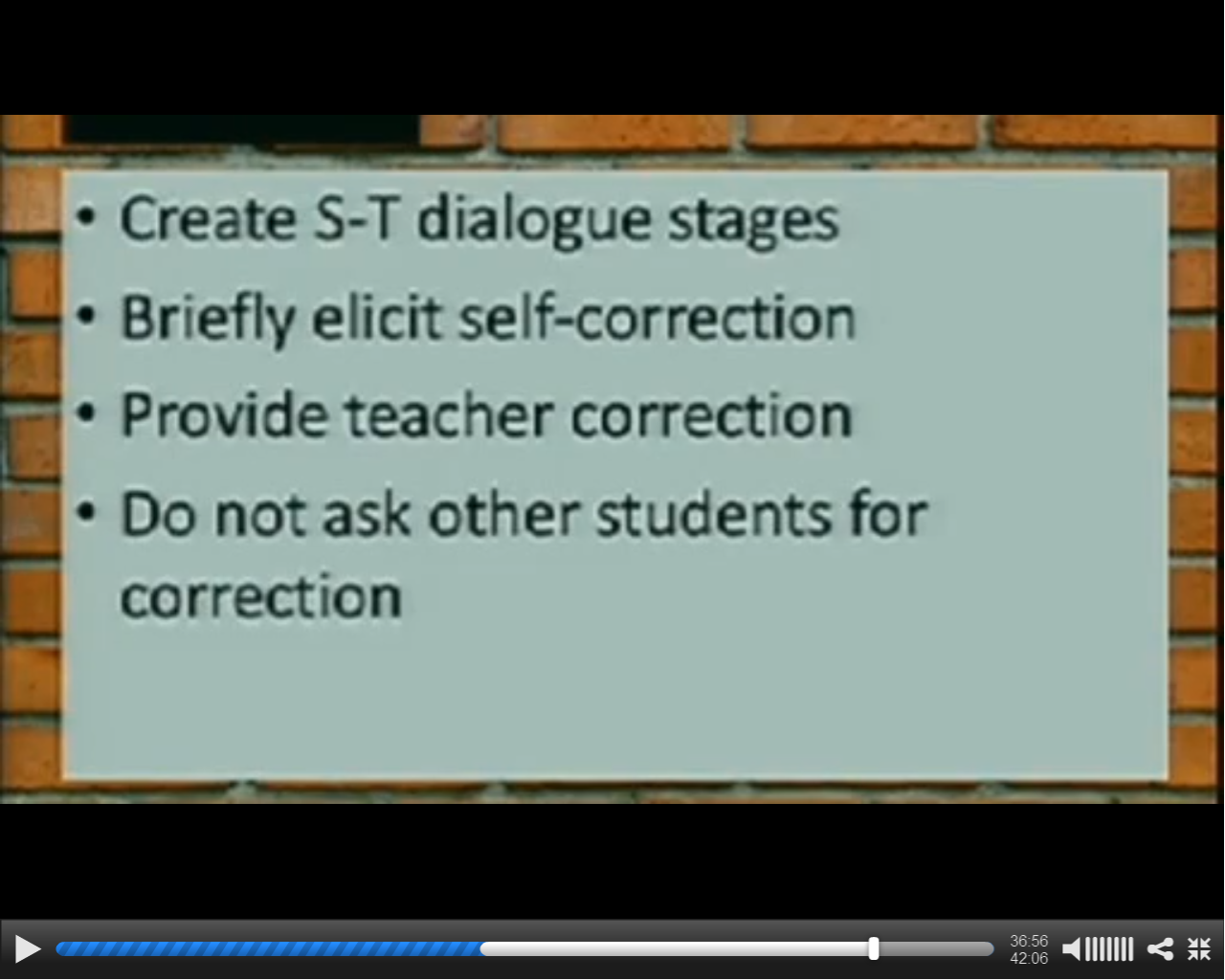
  • Teacher elicits self-correction.
  • Open the error correction discussion to the whole class.
  • Repeat with the correct feedback.
  • Stop, correct and explain.

The most popular technique was to stop, correct and explain. Students prefer direct correction. Eliciting answers came third and the least popular technique was opening error correction to the whole class. According to Chris’ findings for these students, it is OK for the teacher to correct, but if the teacher tells another student to correct a mistake, this may mean that the mistake was a simple one, a mistake that another student can correct. This may make a learner feel more embarrassed.

Recommendations

Screen shot of Chris Smith's slides

Screen shot of Chris Smith’s slides

Final thoughts

The teacher needs to think of the time s/he will do error correction, plan it and use the most suitable techniques. Error correction does work and students want more of it!!

Screen shot of Chris Simth's slide. More error correction.

Screen shot of Chris Simth’s slide. More error correction.

Chris Smith works at the English Language Center of Sheffield University. You can watch his talk here More Iatefl 2015 posts Donald Freeman’s talk Joy Egbert’s talk   Till next time……….

Confessions of a blogger

I have been teaching for many, many years and only recently have I started blogging. It actually seems natural for me as a teacher to write about my teaching experience and the issues that come up during sessions. I do spend 24/7 talking about work, so why not blog about it? Why not be an educational blogger?

Why I started blogging

I must say that when I was a child I had a fascination with libraries and books. Instead of playing with dolls, I often played “librarian”. I also liked writing, and made my own book when I was 9. I wrote a story and drew pictures. I was very proud of my accomplishment. I was a writer. So, I always had the book/writing bug in me. Blogging came into my life many years later. I actually started blogging as part of my Delta training. My Delta tutor suggested I write a blog post about what it was like to be a Delta trainee and I did. I really enjoyed it.

Blogging for me

There are many teachers who blog. I am one of them. But what is the motivation behind blogging? Don’t I already spend many hours teaching? If I am already talking about my work, why spend more time writing about it? Well, for many reasons.

First of all, I get to write about what I love; teaching. Talking shop with my friends is what I do on an everyday basis. Blogging allows me to do the same thing but with people from around the world. That is actually an extra bonus. In fact, I connect with people through blogging. I have ‘met’ people from all around the world because of blogging. My professional learning network has grown a lot because I blog. Interacting with teachers from all around the world gives you the chance to learn from their experience.

It’s also like writing a diary that’s public and educational. In your diary you write about your everyday life and so on. In your blog you share your thoughts. I am quite informal when I blog. My friends actually tell me that it is as if I am out for coffee with them and chatting about work. I like that. It is the only way I can keep going. I am myself when I blog.

Blogging also gives me the chance to reflect on my classroom practice and see what worked and what didn’t work. The fact that I have to sit down and write about a lesson makes it more tangible for me and allows me to take a closer look at my teaching habits. By writing about my teaching I can put my finger on what went wrong or what went well. This allows me to improve as a teacher. It is like looking into a mirror but instead of a mirror, it’s my own blog entry. A visual representation of my teaching.

Because I blog on a regular basis, I like to try new things, to look for activities and share them with other teachers.  Comments on my blog posts reinforce this. I learn from other teachers’ experience and there are always occasions when teachers add a link to a blog post which may inform my own teaching. I learn a lot because I blog.

It is also like having an e-portfolio, a way to save your own teaching ideas and try them out once again. So for example, you have a lesson on conditionals next week, if you blog about lesson ideas and have written a post about fun activities for conditionals, you can go back to this blog post and get ideas! Recording your great teaching moments, the interesting activities are like a think tank for yourself!

Is it a hobby?

Well, that’s a good question. If it is a hobby, I definitely take it very seriously and when I blog, I am in the zone. Ideas often float in my head. It actually often keeps me up at night. I must admit. You know how we stress at night about things that happened in class. As a blogger and I teacher, I often wake up at night with an idea and I think, “Hey, I need to write this down” And I do. I now have a notebook on my nightstand so if I have an idea, I take notes, and then go back to my notes in the morning. The best posts about my teaching are those ones. The ones that are a product of a lot of ideas bubbling in my head during the day….. and the night.

Final thoughts

Blogging does take up a lot of time. I don’t regret it though. I think all teachers should blog. It is the best reflective practice you could ask for. Teaching is all about learning. Educational blogging is about learning through your teaching. Am I good at it? Don’t really know. One thing I am sure of though is that I enjoy it. It’s fun. Try it already, will ya?

cropped-06976-10568955_10152692437432425_8792508551216274600_n.jpg

This article first appeared in Iatefl Hungary’s The mELTing Pot. Many thanks to Beatrix Price and everyone at Iatefl Hungary for giving me the chance to write about one of the things I ❤  doing.

myt article

Till next time…..

The girlie side of ELT post 6

Books

So, today’s post is going to be about my reading habits. As an ELT professional, I have spent a fair amount of time reading books on methodology, grammar, linguistics etc.. The book I have read the most times is Rod Ellis’s “Second Language Acquisition” (four times) I read that one, not so much cause I loved it (although it does have an abundance of interesting information, and everyone should read it) but because it was quite hard to understand. A big book packed with info.

The 2nd  book I have read many times is “Developments in English for specific purposes” by Dudley Evans & St. John. I really liked this one cause, well, I did get it, and because it was very closely linked to the things I teach (Business English and English for academic purposes).

books

Now, having mentioned the books I have read the most times, let me move on to the real topic of today’s post. After spending so many hours (and years) reading work -related books, I find that in my free time, I really like reading books that do not problematize me at all. Books that are so lighthearted, it’s like having a mojito on a sun bed on some nice beach in Crete. I am guilty of choosing what many people may call ‘girlie books/literature’ in my free time, and I am not ashamed to say it :p.

 Let me also confess that I think I have book disorder.related book I read, I must read it from cover to cover. Even if it is the most boring book in the world, I must finish it. This means that I may spend months reading a very boring book and a night reading something that I enjoy.

Beach Kolumpari

That’s me. The book kinda worm.

So, that’s all folks.

xx

#Iatefl15 Joy Egbert’s Plenary Talk

Engagement and practice in classroom learning, language and technology

Joy Egbert

Joy started her talk with an example of how people think they can learn a foreign language. She shared her story. Joy is American, so when she got invited to present at Iatefl, she thought it appropriate to learn British (British as a foreign language as she said). So, she decided to watch episodes of Doctor Who in an attempt to pick up a few words. She didn’t learn much though.

Why?

The people in the TV show were talking too fast and she didn’t always catch what they were saying. There was no support, no feedback, no social interactions. There was no engagement.

Engagement matters. If you want to learn something, you need to be engaged. Engagement in technology is also important. Joy talked about her experience learning Spanish on a website called Plato. She didn’t manage to learn a lot because it was all about drilling and not very interesting for her.

So, the next question that Joy Egbert mentioned needs to be asked is, how can we engage the learners? We need to understand how languages are learnt. According to Spolsky (1989) knowledge and skills in the future are a result of knowledge in the present. This is connected to abilities, motivation and opportunity (see pic for actual slide). The teacher is the provider of opportunities. The more opportunities we provide, the more chances of learning.

Screenshot of Joy Egbert's slides

Screenshot of Joy Egbert’s slides

Joy Egbert then talked about how important it is to also understand why students are unengaged. This may be because they are unmotivated by the ‘opportunities’ to learn. For example, drills, lists of words, incomprehensible tasks are not engaging. What the teacher wants to see in the classroom is students participating, being focused and engaged.

Principles of engagement

1). Authenticity (authentic to the learner)

2). Connection to life

3). Provide social interaction or deep individual focus

4). Offer practice and Feedback

5). Challenge/ Skills balance

In terms of technology, Joy Egbert pointed out that technology cannot do something by itself. It provides resources, support and opportunities among other things. This leads to the next part of the talk which had to do with ‘issues’ with technology. Issues have to do with no use of technology at all, no pedagogy regarding technology and no principles of usage.

Engaging lessons

Lessons will be engaging for our learners if we know our learners. We need to know who our learners are, their interests, their jobs, what they like and don’t like. If we do not know who our learner is, it is difficult to plan.

1st Principle- Authenticity

Choose material that will be interesting for your learners. Different material for different learners. In terms of reading texts, choose for example, different reading texts based on the learner. If one learner likes animals, choose a text about animals. If the other one like fashion, choose something about fashion. Once you have chosen the right reading material for example, move on to different activities that will appeal to each learner. Different types of technology for each learner. If your learner likes writing, use word documents. If your learner likes videos, go for an exercise based on a YouTube video.

Website recommendation: Fakebook

2nd Principle: Connection

Why is connection important? Well, students need to know how what they are learning is connected to their life and studies. The teacher needs to say, “This connects to your life this way…. “ Be explicit. Your learners will not always see the connection. You should tell them.

Website recommendation: Big huge lab website

3rd Principle:  Social Interaction

Make sure your students interact when doing activities. If you are using technology, a simple task on a website for example, something that has a drill, get one learner to look at the screen, the other to face the other way. One learner reads, the other types and so on. Get the learners to work with each other. Another thing to consider in terms of interaction is to give students a reason to interact. If one learner is presenting something, the others should be taking notes because later on they will be doing something with the notes.

4th Principle: Feedback

Feedback needs to be on time and relevant. In terms of technology, choose different types of feedback based on the type of learner. One learner may like text feedback, the other may prefer voice feedback.

5th Principle Challenge/Skills balance

Make sure the challenge is not too great and that the skills are appropriate. Take into consideration what the students can do. It is very important to work on your students’ weaknesses as well as strengths.

You won’t be able to engage all your students all the time. If you mange to engage let’s say 80% , that’s great!!

Technology

Once again, Joy Egbert pointed out that technology cannot do anything on its own. Teachers need to look at technology and work on it,/ with it. There is a lot of technology which has to do with different interests. Teachers need to evaluate the technology.

Screenshot of Joy Egbert's slides: Evaluating Technology

Screenshot of Joy Egbert’s slides: Evaluating Technology

Website recommendation: Popplet

If as a teacher you think technology is too hard or you do not have time, choose something simple like email writing for example. Why emails? Well, they

  • Are free
  • Are safe
  • Include loads of attachments etc

Closing remarks

When thinking of technology, teachers need to think of, not what is better but who it is good for. Technology needs to be used effectively. It needs to meet goals. If it doesn’t help, then the teacher shouldn’t use it.

Joy Egbert

Joy Egbert

#Iatefl2015 Donald Freeman’s Plenary Talk

Frozen in thought? How we think and what we do in ELT.

Donald Freeman ‘s plenary

Donald Freeman began his talk with the phrase  “being frozen in thought” which he explained as being stuck in the way we think. He moved on to talk about a notion that exists. The notion of thinking and reasoning in teaching. This is how we use ideas to explain and justify/ give reasons for the way we think.

Reasoning

Reason about something is an internal process while give reason for something has to do with addressing the public.

How Annie the teacher is connected to myths of teaching

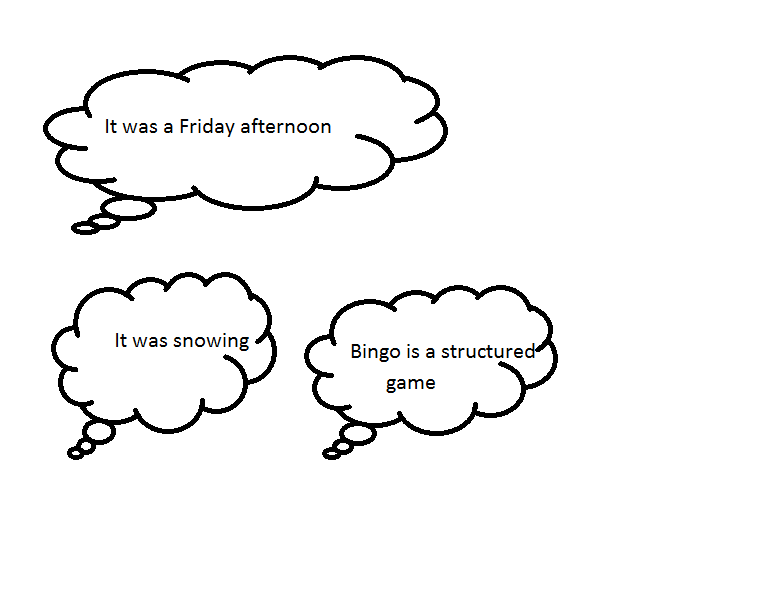
Annie is a teacher of Spanish. Donald visited her to give guidance and make suggestions regarding her teaching. It was a Friday afternoon before a vacation and the teacher started with group work which didn’t go that well. She then moved on to pictures. Again not much success. Then she reached for Bingo and finally the students were engaged. After the observation, Annie said, “Bingo is the only thing that works”.

Why did Bingo work? (Donald Freeman’s thought bubbles)

Donald Freeman's thought bubbles after hearing "Bingo is the only thing that works"

Donald Freeman’s thought bubbles after hearing “Bingo is the only thing that works”

What does this show? Teacher thinking is connected to how we induct teachers. It has to do with the ways of organizing minds and our public actions.

This brings us to the main part of the talk. Myths. Teaching Myths. “It’s important to mention that these myths are not right or wrong” said Freeman. We just need to question them.

But first, let’s see what Donald Freeman said about why myths exist.

  • They organize our work
  • Help establish meaning of what we do as teachers
  • They create communities that accept the same myths. They bring a shared understanding

1st Myth: Direct causality

Teaching makes learning happen. Think of it like a game of pool during which the teacher shoots balls.  One ball propels the other. The teacher hits different balls, hitting different aspects/ learners. So, according to this myth, learning takes place. We actually organize our schools as if that works, but classrooms don’t actually work this way.

 But the teacher creates opportunities. The teacher moves are connected to the learner moves. Teaching is more a relation of influence and less a relation of cause and effect.

2nd Myth: Sole responsibility

“ When things work/don’t work” we, the teachers,  have responsibility. How? Well, among other things, the teacher:

  • Makes critical decisions
  • Plans
  • Prepares material/ content

So, the teacher has responsibility. In this myth, teaching is like a game of chess. The teacher makes a move, then the learner makes a move. The moves the students make reshape the moves that the teacher makes (decision making). There is an interaction between moves.

But responsibility is distributed not really shared. One move/ decision / action shapes the next move. This creates an opportunity to teach for the teacher, to learn for the learner. When the moves line up, it is seamless. If the moves don’t line up, then we see the sole responsibility surfaces.

Myths 1 and 2 have to do with all teachers/ educators. Myth 3 is connected to English language teaching.

3rd Myth: Proficiency is the goal of English language teaching

The right thing about this is that we create opportunities for the learner to learn. What’s frozen in this case, is the relationship between the classroom and how we think it travels outside the classroom.

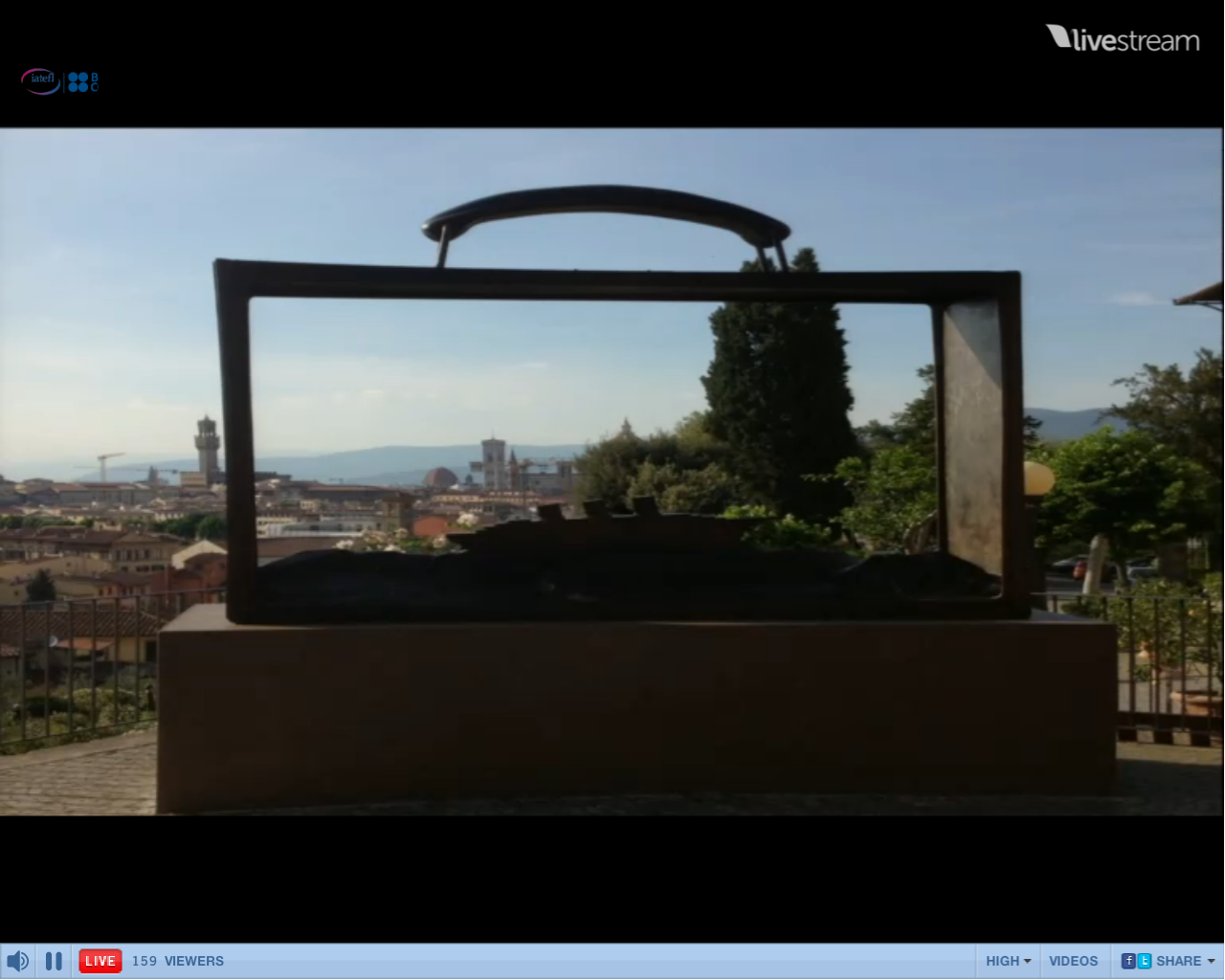
Proficiency in the classroom is grounded in an assumption of nativeness. Nativeness is associated with language proficiency and non-nativeness with striving for nativeness. The problem with these terms is that both are misleading. Nativeness is geopolitical not linguistic, and proficiency is conceptually a problematic idea. In fact, proficiency tries to describe how people get good at a language, and this will follow them outside the classroom. But how do we define getting good at a language? Language is like water. Language is connected to time, place and experience. Language travels. How can we describe a language that travels? We use the concept of general language proficiency when we refer to what students can do, but this is classroom bound. How does this connect with the outside world? Think of a suitcase. What’s in the suitcase (classroom language) does not reflect what’s outside the suitcase (the world), it extends it, it is part of it.

Screenshot of Freeman's slide. Sculpture in Florence, Italy

Screenshot of Freeman’s slide. Sculpture in Florence, Italy

The relation between what’s in and out of the suitcase is what researchers refer to as horizonal knowledge. What’s in the suitcase is part of what’s outside the suitcase (look at the picture).

Horizonal knowledge

Example of horizonal knowledge in mathematics: Deborah Ball teaching 2nd graders to subtract. Students were asked to create rules of how subtractions work. A child came up and said, “You can never subtract a bigger number from a smaller number.” So, what do you say in this case? It is right for 2nd graders, but later on it’s not quite right?

 Horizonal knowledgee in the language classroom is the suitcase problem. In the classroom we give language attributes it doesn’t have (like putting it in the suitcase). We give it grammar, skills, voice, levels and so on.  All these allow us to chart the relationship of what is happening in the classroom and what hopefully will happen outside the classroom. According to John Trim, “Funny things happen to language when it goes to school”. We call this suitcase general language proficiency.

But there is not just one proficiency. We should be looking at proficiency plurals which are always situated in particular contexts and are bounded by a particular social practice.

Donald Freeman then moved on to talk about Bit.fall

Bit. fall

What is Bit.fall? It’s a sculpture by a German artist (Julius Popp). He explains it as, “A machine that controls falling drops of water that creates words”. What’s the connection to the classroom?  That’s what we do in the classroom. We have words that are like drops and we hope that they will turn back to water outside the classroom.

Bit fall-ing for teachers.

Donald Freeman talked about research that has been carried out regarding a version of English that teachers can use when teaching. A panel managed to discover what some of this language may be. Thus, the language for teachers was bound (like in a suitcase). This lead to the understanding that, general language proficiency for teachers and language in the classroom are different. So, in the case of teacher talk we have specific contextual proficiency in the classroom.

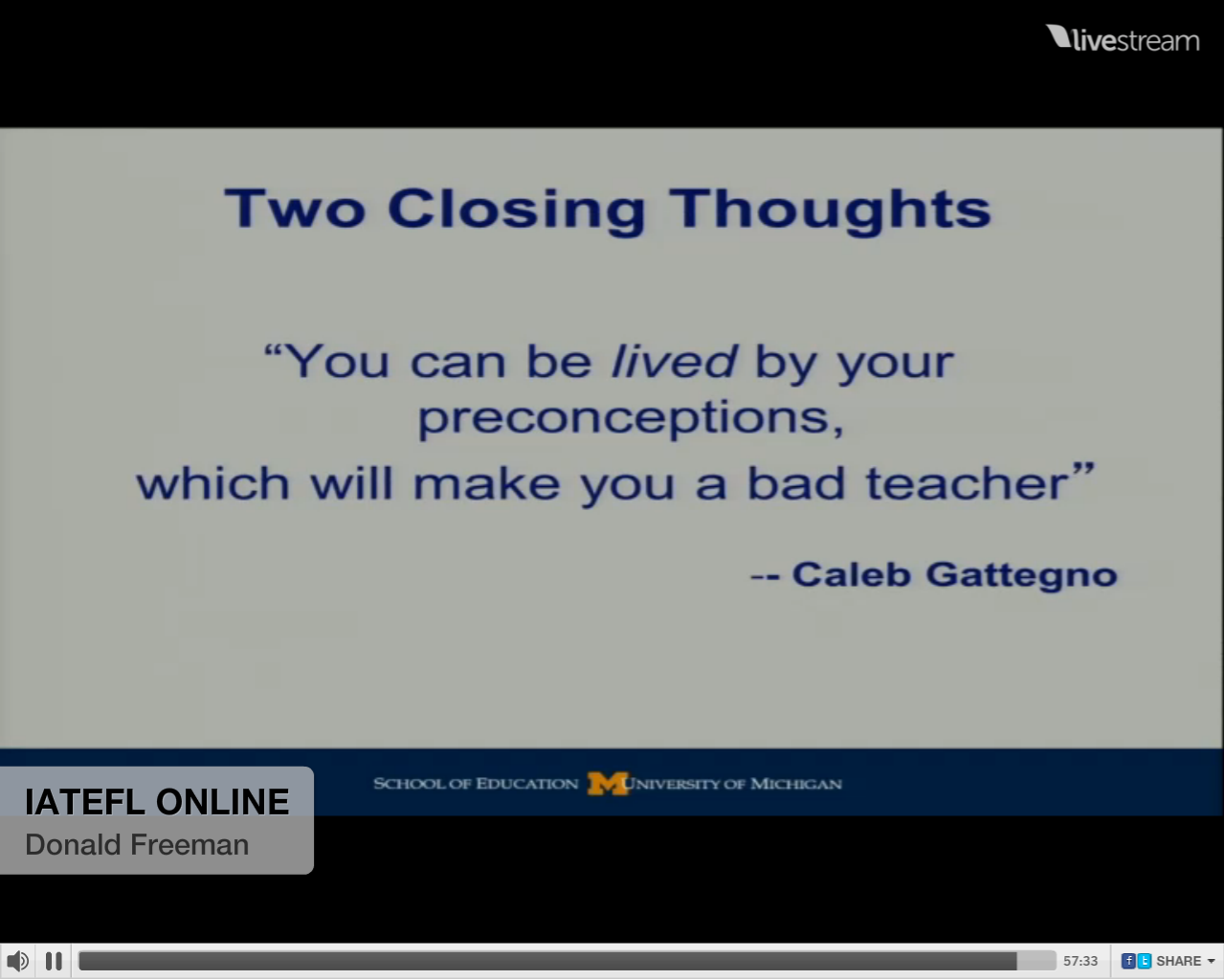
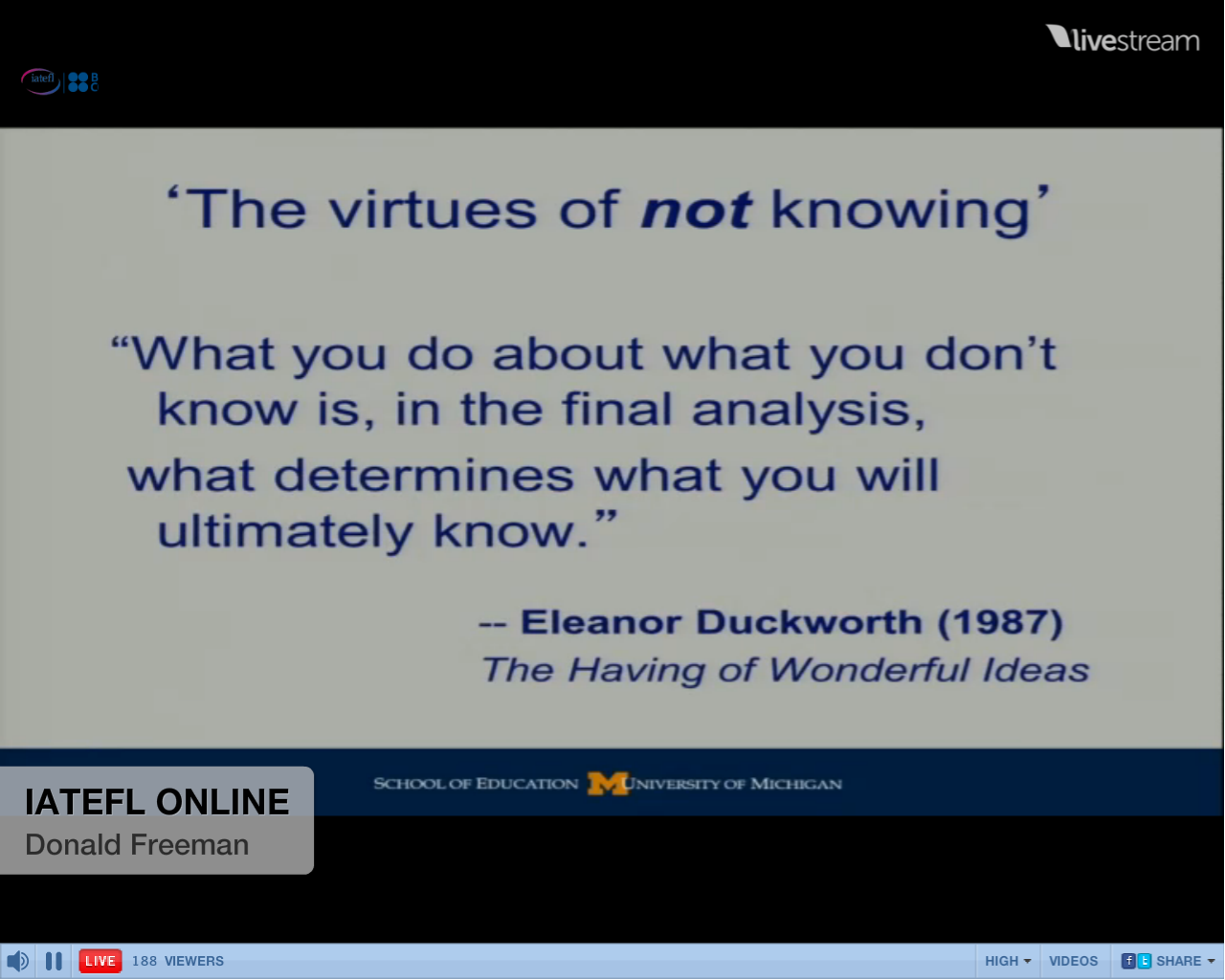
 Donald Freeman concluded his talk by pointing out that these myths have elements of truth but also elements of distraction. He concluded his talk with two final slides, food for thought..

Closing Remarks

Screenshot of Freeman's slides.

Screenshot of Freeman’s slides.

Screenshot of Freeman's slides
Screenshot of Freeman’s slides

This was my first attempt to write a blog post as a Manchester online registered blogger for the #Iatefl 2015 conference. I tried my best to give you some of the main points of Donald Freeman’s talk. For more information and to watch the video, press here

#youngerteacherself Guest post by Ageliki Asteri

Ageliki is a dear friend of mine. I met her during my Delta course. She is a very motivated person and teacher. I admire her for the hard work and passion she puts into everything. Here is her #youngerteacherself guest post.


What advice would I give my #youngerteacherself?

Well, I have been teaching English for more than fifteen years, now. When I was just a newbie, my tutor recommended that I should go by the course book, and so I did. For many years I don’t ever remember leaving anything out …the years were passing by and experience taught me as well as my everlasting professional development that I should add elements such as ‘fun’ songs, and meaningful and interesting things for the learners. My students passed their exams BUT there always was something missing…. and that was the way I taught ….dry language input!

Two years ago, I started doing the Cambridge Delta, this transformed me as a teacher and it was really a breakthrough in my teaching practices. I can say one thing to my younger self. I should have done it much earlier; I would have felt more resourceful and therefore more confident as a teacher and my students would have benefited immensely from that.  Delta made me think of the importance of providing a rather authentic context whatever I teach, the importance of learner exact needs, student centered lessons, feedback issues on a variety of performances, PRONUCIATION, how to develop as a listener, a reader and as a learner, to mention but a few! Further more, I am a musical type learner so pronunciation with its beats and stress and intonation really mean to me a lot! David Crystal clear attitude towards the evolution of the pronunciation from the Shakespearian times to global English we speak today, makes it an important chapter as well as many other scholars and authors in the field.

How languages are learned? Well, S.D. Krashen says it all, Compelling, comprehensive input!” If I knew then, what I know today, I would have done away with course books and I would teach language from everyday authentic material starting from newspapers, news broadcast, articles. Exactly, what my students do in order to get informed by the current news in their tongue language, still better, the kind of input that interests them. This is where I start, now. Teaching needs to be fun, fun and fun!


One last thing: I just hope I could become a better and better teacher/model for my students.


Bio: Ageliki works in the private sector for a language school. She is a freelance Elt teacher. She is attending a Cambridge Delta course and is also studying European civilisation at Hellenic Open University.

Flowers

Flowers in a vase


If you too want to take part in the #youngerteacherself challenge but don’t have a blog, feel free to write a guest post on my blog. If you do have a blog and write something, tweet me (@joannacre) or leave a comment here.

Till next time…..

Grammar LSA

Today, I am sharing with you my grammar background essay (LSA) for the Delta Cambridge module 2. Please keep in mind that this has been shared with you as an example. Cambridge does not take plagiarism lightly, so do not copy from this assignment. I got a Merit for this LSA.

1.Introduction

I have always had a liking for grammar teaching and the ‘traditional’ 2nd conditional is a great opportunity to engage my students in fun activities and an important part of the syllabus for intermediate level students. Although at an intermediate level learners are already familiar with the 2nd conditional (if + simple past, would), they still have trouble expressing untrue/unlikely conditions in the present/future. Understanding why a simple past may refer to the present or future (see section 2.III) may be due to L1 interference or misusing the inverted forms of conditionals (see section 2.V) because of lack of practice makes this grammar item hard for learners. Knowing how to deal with the problems (see section 2) and questioning the effectiveness of just teaching the traditional 2nd conditional basic structure (see section 2.I p.5) are reasons why I chose this topic.

1.Language Analysis

Definition of conditionals and their general form.

According to Carter and McCarthy (2006, p. 448)

”Conditions deal with imagined situations: some are possible, some are unlikely and some are impossible. The speaker/writer imagines that something can or cannot happen or have happened, and then compares that situation with possible consequences or outcomes, or offers other logical conclusions about the situation”.

Conditional clauses mainly express conditionality and they are most frequently introduced with the word if (ibid)

If they competed, they would succeed   OR    They would succeed if they competed.

Protasis (if clause)                        Apodosis (main clause)

(The Shorter Oxford Dictionary cited in George,H.V. 1997 p.161)

Conditionals can also be in the interrogative or negative form.

1.1.Form/Meaning and Usage

Theoretical grammars

Traditionally conditional clauses are divided into the 1st, 2nd and 3rd conditional (Carter & McCarthy 2006,p.748) The 2nd conditional is formed as follows: If+ simple past tense+ would/could/might (a modal with a past reference in its meaning). According to Carter and McCarthy (2006,p.748), their meaning depends on the speaker/writer, “a speaker or writer responds to a possible/hypothetical situation  by indicating a possible outcome. The speaker states that the condition must be fulfilled for the present or future to be different”. In fact, it is imperative that the condition is fulfilled for the present or future to differ (Carter & McCarthy 2006, p.748) e.g. If I knew what he wanted, maybe I could help him. Apart from this description, Carter and McCarthy (2006,p.749) mention that conditionals can refer to real or unreal situations. As they put it, “Unreal situations are things that are untrue or imagined, have not happened and are only remotely likely to happen. Unreal situations are the basis of the second and third conditionals” (ibid) and there are no differences in the way they are formed (If+ simple past tense+ would/could/might).

Murcia and Freeman mention that the description of the 1st,2nd and 3rd conditionals is an overgeneralization (1999 p.545). For them it is more accurate to talk about factual, future (predictive) and imaginative (subjunctive) conditional sentences. Imaginative conditionals (hypothetical and counterfactual) are the focus of this paper.

Imaginative Conditionals

  • Hypothetical conditional sentneces
Form Meaning Example
Present: if + simple past/present subjunctive + wouldFuture: If + were to +verb/ verb +simple past tense + would The speaker perceives something to be unlikely yet possible in the if clause.In this example: we are not sure if Joe has time now to go to Mexico- it is possible but probably unlikely. E.g. If Joe had time, he would go to Mexico (present reference).If Joe were to have the time, he would go to Mexico (future reference).
If+ should have/simple past +to have/should + infinitive +to have, would The negative quality of the if clause can be further weakened-the possibility of the result occurring becomes weaker.Here: Joe is probably not going to have time and is unlikely to go to Mexico. E.g. If Joe should have/ happened to have/should happen to have the time, he would go to Mexico
  • Counterfactual conditional sentence
Form Meaning Example
If+ simple past/ present subjunctive+ would. Impossible event or state in the if clause present/future reference.Here: My grandfather isn’t alive so this is untrue/impossible in the present / future E.g. If my grandfather were alive today, he would experience a very different world (present counterfactual)

Functions of conditionals in Murcia and Freeman (1999, p.557)

  • “Propose options for future scenarios.
  • To introduce contrasts.
  • To provide examples following generalisations.
  • To make inferences based on previously mentioned assumptions.”

Jones and Waller (2010) suggest that this notion be expressed with other forms apart from the traditional if + simple past, main clause would. After conducting research they found some more structures which expressed something unreal in the non past although, on the whole, the structures they propose are similar to what grammarians have already mentioned. Clearly, context affects the form of this notion.

If+ past simple, simple present

E.g. Even if we did, we have no drivers abroad

Meaning: They want to change their present situation but they cannot because they do not have drivers.

If+ present simple, would

E.g if two members of staff happen to fall in love, it would be churlish to be appointing blame.

Meaning: happen to lexically expresses the unlikeliness of members of staff falling in love.

Pedagogical grammars

According to Alexander’s (1998) pedagogical grammar for intermediate level students, there are cases where what is known as the 2nd conditional refers to something untrue/imaginary or unlikely.

Form                                                                  Use/Meaning

Protasis (If clause) Apodosis (Main Clause)
·       If + past/could (basic formation)e.g If you went by train, you would get there earlier


E.g. If you could run faster, you’d be a champion.

Would  Something reasonably possible but ‘more tentative’. Past tense does not refer to past.Here, it is likely that the train would take you to your destination faster)

Something totally impossible ( this is debatable though as the context is missing).

Table: adapted version from Alexander, G. L. (1998, p.208-9)

In Thornbury (2004, p.60) this structure is formed by  if+ past tense+ clause would/could.

E.g. If you were a parent, you’d understand how I feel.

Meaning: Something unlikely or impossible in the present/future which has outcomes that are hypothetical (ibid).

Inverted conditional

Inversion can occur in the 2nd conditional if the if clause has the verb to be. If can be dropped in the conditionals and the auxiliary verb is placed before the subject (formal inverted structure) for example, Were she my daughter, I’d give her some good advice (Swan, M. 2002 p.250). If cannot be dropped, if there is any other verb in the if clause.

Clearly, different grammarians propose different descriptions of this notion. There is consensus on the if clause simple past/past continuous or a modal verb (in the past) while the main clause usually has would/could in it and its meaning has to do with something likely/less possible or even impossible in the present/future. Variations of this form use tenses like the simple present. The meaning  is the same and depends greatly on the context. These structures are used to express dreams, wants and wishes, things that may or may not happen.

Spelling

The spelling of conditionals depend on the individual components which form the  2nd conditional. For instance, the spelling of the past/ irregular past or ing endings.

Phonology

Phonology is affected by the components which form the 2nd conditional, for example, the [l] in modal verbs. Knowing which word to stress may also affect the meaning of a conditional clause.

  1. Problems for learners and how to solve them
  1. Problem-The 2nd conditional: Is it enough?

Focusing on just the basic form of the 2nd conditional to present something untrue/unlikely in the present/future is not enough. In fact, this can be expressed with other if structures too (see section 1.1 p.4).

Solution and techniques

Exposing learners to more examples of if clauses and patterns that are used to express these conditions can be the first step towards teaching students the different ways of expressing real and unreal situations (Jones & Waller 2010, p.29 and Thornbury 2003, p.223). Students could be asked to identify sentences that do not fit into the traditional 2nd type conditional (Thornbury 2003, p 96 & 223) in authentic texts and then through discovery methods find the new patterns. We then discuss the variations to the rules they have learnt so far and whether the sentences they found express the ‘target’ notion. They then record these variations and add them to what is in their grammar course book and make something like a grammar journal. Building their own grammar journal will help them realize that there are many ways to express something unreal/unlikely in the present/future. Such a task solicits recognition of the form but does not guarantee correct production. It must be closely monitored though as the learners may not be sure if what they found expresses this notion while the teacher must also make clear that not everything goes and it is necessary to look closely at the context and speaker/writer intention. This activity is more appropriate for adult learners. Identifying variations would require more time if the learners were children but this does not mean that it is impossible.

2. Problem-I’d

Mistaking the contracted form I’d for I had instead of I would (Aitken 2002, p110). This may happen in my classes because I avoid using the contracted form on the board or due to overgeneralization. That is why they may produce sentences like If I were rich, I had buy a Porsche.

Solution and Techniques

Students use the contracted form I’d for I would through drilling the full and short form. Learners rewrite sentences where would is used in the full form and then in the short form. Drilling can be quite a dry, restricted method but it still makes the learners’ recognize the different I’d forms. The limitation of drilling exercises is that according to Savage et al (2010 p.6) “they reduce cognitive engagement…. activities are designed to reduce students’ errors”. Adults do not particularly appreciate drilling tasks due to this. Drills can also be used for younger learner groups in the form of choral repetition or songs e.g If I were a rich man/ if you had my love etc. were I’d is used as part of the apodosis. Clarification checks about the lyrics of the songs could ensure my learners noticed the contracted form.

3. Problem past tense referring to the present/ future

Students who have learned to associate the past tense with something that happened in the past find it hard to believe that if+ simple past/past continuous may refer to the present (Celce-Murcia & Larsen-Freeman 1999, p.545). They may have difficulty understanding how something which is translated in their L1 in the past refers to the present or future or they may be overgeneralizing the translation of the past.

Solution and Techniques

Engaging in what Willis (2005, p.14) calls ‘consciousness raising activities’ is a good first step. By looking at examples of simple past future referencing in context and figuring it out for themselves, they will better understand the unreal past reference. A good task for intermediate students is to get them into groups and give them slips of paper with phrases like win five million dollars in the lottery, get a pilot’s license and be able to fly a plane and so on. The learners work in pairs and produce sentences describing what they would do e.g. if I got a pilot’s license and could fly a plane, I would…. I would monitor my students during this task and offer feedback regarding any difficulties they have with this form (Cowan, R. 2008, p.467). This is quite a restricted task and can be used before freer production tasks where students could for example interview each other on things that would do if they could.

4. Problem-Phonology  (would)-stress patterns

Greek spelling is phonetic and has a correspondence between sound and graphic symbol (Papaefthymiou-Lytra ( p.129 cited in Swan & Smith). Greek students tend to have difficulty reading the short form I’d /aɪd/ and not saying the silent [l] in would/ could /should. Russian learners have a problem with the sound [w] as it does not exist in Russian (Monk and Burak cited in Swan & Smith 2002, p 147). This can be problematic when teaching the 2nd conditional as would is the most common word in the apodosis. Stressing the right word in a conditional clause may also affect the meaning of the sentence and should be addressed in the classroom too.

Solution and Techniques

W sound/Silent L

In order to help my learners with the [w] sound I would show them where the sound is formed (voiced velar) and then practice the sound with phonology cards with words that start with W. This type of activity would be appropriate mostly for adult learners. Although very restricted, it will lead to the outcome wanted. I would use phonological cards to practice the silent [l] too. As a self-study task I would ask my learners to record themselves  on ‘vocaroo’ and then check their performance. Practicing saying the words over and over and listening to how these words are said will make perfect.

Stressing

Role playing would be a good way to familiarize learners with stress patterns as they can provide a context and students will be able to emphasise the word which should be stressed in the protasis and apodosis. Learners actually realize that stressing the wrong word could affect the meaning of what they want to say. Stress patterns can be part of a listening task too where learners underline which words are stressed. It is necessary for students to have examples of the conditional as it is spoken in real life, so video viewing is the best approach.

5. Problem-Inversion

Ellipsis of if and subject auxiliary inversion occur more frequently in written form and more frequently in British English (Cowan 2008, p.458). Based on my experience, at an intermediate level student do not really invert their conditionals and they sometimes have difficulty recognizing the structure Were I as a conditional.

Solution and techniques

Structural drills will allow my learners to practice the structure over and over again. Then they can move on to more meaningful drills which will enable them to familiarize themselves with the inverted structure and feel more comfortable to use it in the everyday speech. These drills could be done as part of a process writing task and in order to make it more autonomous I would use some peer checking tasks of this form in my class. Although drills are very restricted they help recognition of the form and lead to usage of it in freer written tasks like a narrative or a consequence chain where the learners would have to include the inverted form as part of the task fulfillment requirements. Such a task would be appropriate for both adults/children.

3.Conclusion

Based on what I discussed in this paper, if I taught the second conditional tomorrow, I would read through this LSA to get a clearer picture of this grammar phenomenon.

References

Aitken, R (2002). Teaching Tenses. Brighton: ELB Publishing.

Alexander, L. G. (1998) Longman English Grammar Practice for intermediate students. New York:Longman.

Carter R. and McCarthy M.2006 Cambridge Grammar Of English: A comprehensive Guide Spoken and Written English Grammar and Usage. Cambridge: Cambridge University Press.

Cowan, R. 2008 The Teacher’s Grammar of English a course book and Reference guide. New York: Cambridge University Press.

George, H. V. (1997) Essays in informational English Grammar with reference to English language teaching. Victoria: Campus Graphics La Trobe University.

Jones, C. and Waller, D. (2011) If only it were true: The problem with the four conditionals ELT journal Volume 65/1, p.24-32.

Murcia-Celce, M and Freeman-Larsen, D (1999) The Grammar Book: An EFL/ESL Teacher’s Course. United States of America: Heinle and Heinle Publishers.

Savage, K. L., Bitterlin, G. and Price, D. (2010) Grammar Matters in Adult ESL Programs. NewYork: Cambridge University Press.

Swan, M. and Smith, B. (2002) Learner English 2nd edition. Cambridge: Cambridge University Press.

Swan, M. (2002) English Usage 2nd edition International student’s edition. Oxford: Oxford University Press.

Thornbury, S.(2003) About Language. Cambridge: Cambridge University Press.

Thornbury, S. (2004) Natural Grammar. New York: Oxford University Press.

Willis, D. (2005) Rules, Patterns and Words Grammar and Lexis In English Language Teaching. Cambridge: Cambridge University Press.



Who am I?

The girlie side of ELT post 5

So, I was watching a 26-year-old YouTuber the other day and  she said, “I want all of you to think about this. Who are you? Not what do you do or what do you like, but who are you?” and while this is not a new blog challenge or anything like that, it is an interesting question, isn’t it? Well, I think so, and that’s what I am gonna ramble about here.

So, back to what prompted this post. Who am I?

Flowers

I am Greek / Australian. This means that when I was in Sydney, I was an immigrant, and when I came to Greece, again, I was someone who was not born in Greece. So, actually I belong nowhere. Interesting.

I am a nerd and  I am OK with it. I like learning and when I study, I wanna get good grades (I don’t always succeed, but I still wanna).I read and blog for fun.

I am a wannabe fashionista. I like looking at fashion magazines, watching YouTubers talk about fashion and makeup. I like all this stuff. I am a girlie girl but not too girlie.

I am funny or at least I think I am funny.

I am a realist and practical. I wanna try stuff out. If they work, cool. If they don’t, big woop. I wouldn’t say I am a day dreamer but from time to time I do enjoy being in Lala land. I eventually snap out of it and get a reality check.

I am rude, blunt and sarcastic. I roll my eyes… a lot.

But I am also non confrontational, sometimes even a pushover. I do things I don’t really wanna do, just to please others, cause I am a goody-goody, as well.

I am not a risk taker. I don’t like spontaneous things. I like planning and organizing stuff. I like to know what will happen and when it will happen.

I like helping people when I can. I like sharing when I can.

I don’t believe in soul mates or the one.

I am ambitious and I try to be as professional as possible.

I am more of a listener than a talker.

Hmmm, yeah that’s about it. That’s who I think I am. Have I figured everything out?

Nope.

Trees in Paris

That’s all folks xxxx

I see yellow, you see blue

The colour blind teacher

Because I started painting lessons, I have written a few blog posts about what it’s like to paint when being partially colour blind.  Sandy Millin wrote a post about teaching from an eye height of 1 m. and also asked me if/how not being able to tell between colours affects my teaching, so people, welcome to my classroom. The classroom where colours are different.

Let me start by saying that I do see colours and shades, I just mix them up. Where you see blue, I may think it’s red or green. But how does this affect the way I teach? How important are colours for the non colour seeing teacher?

Red and yellow, pink and blue…..

For starters, I can’t teach the names of colours if the colour is not written under the colour. This means that my flash cards have a blob of a colour on them, and under the blob, it says what colour this is. As far as singing the tune and pointing to the colours, well, my students point to the colours, I just sing the song.

Colourful handouts

I do not organize my handouts based on colours. Nope. My handouts may be random colours, I just don’t say, “Now let’s go to the pink handout.” Instead, I have a title on each handout. Task 1, Task 2 etc.

Pens

I use liquid paper/permanent markers to recognise the colour of my pens. So, my pens have liquid paper/or a permanent marker and I write the colour of the pen on the pen. I don’t want to use red pen when I am doing error correction, so on my red pens you see the word ‘red’ somewhere (very often I actually choose pens that have the colour written on the cap).

Colour coding

Yeah, great fun way to give feedback but… I don’t use it cause I am scared I might mess up, and my fun error correction task will go down the drain.  So, colour codes for error correction?  Nope , nope.

Stickers

Hmm this one is probably the hardest colour-related task. I have no idea what the colours of my smiley faces are,  so sometimes my boys start laughing and say, “Miss!! This is pink!!” They know I can’t see the colour, so they don’t get upset or anything. We have an understanding when it comes to stickers.

Course books

If colours play an integral part to the way the material is organized, I avoid the course book. If there are tasks that require the use of colours, I switch to different shapes or symbols. So instead of using red for verbs, I circle the verbs.  Instead of green for adjectives, I underline the adjectives and so on.

Texts

You never think of this cause you can see colours, but people who are partially colour blind have difficulty reading texts that contrast with the background colour. What do I mean? If the text is written in black and the background colour is red, then I cannot read it. The same happens with green on blue, I see nada. There is not much I can do here cause well, material writers just assume everyone can see colours and that all texts are easy to read. When I make task sheets though, I stick to darker colours on a lighter or white background and everything is fine.

On a more personal note

Not being able to see colours the ‘right’ way affects my everyday life more than my teaching. I bought bananas today but I am not sure if they are green or yellow. When I buy clothes, I write the colour of the clothes on the tag so I know what matches with what (I have done research on which colours go with which). When I am in the bank, I cannot read the sign that shows the customer number cause it’s red on black. BUT…..

Not being able to see green or orange isn’t a problem for me. I don’t mind.  Life does go on even when you mix up your colours. I ask people to help me, and they do.  I think that because I am a teacher, I have learnt to be more flexible and resourceful. I try to find solutions to whatever makes my teaching hard for me. My colleagues help me, my students help me, I help myself. In this case, the teacher makes it hard for the teacher to teach, and the teacher, me, has to find other ways to teach.

Blobs

 Not being able to see colours is not a disability, it’s what enables me to find other ways to do the same things as you do.

A few days later, I received a tweet from the colourblind awareness. org. One in every 12 men and 1 in every 200 women are colour blind. There is one student in every classroom.  #1ineveryclassroom

They also have amazing videos you may want to show your students.

Till next time…..

Feedback on writing

Why is feedback important and how do you give feedback on writing? In this post you will find information about feedback, self- assessment and peer feedback, ideas on how to correct as well as a few suggestions on how to avoid burnout.

Feedback- some background information

“In teaching, feedback refers to comments or other information that learners receive concerning their success on learning tasks or tests, either from the teacher or other persons.” (Richards & Schmidt, 2010)

The objective of feedback is to help the learner improve his/her performance (Ur, 2004) and give appropriate praise + suggestions (Harmer, 2013). When we talk about feedback on writing we need to consider the difference between assessment and correction.

  • Assessment: the learner is informed about how s/he performed.
  • Correction: some specific information is provided on aspects of the learner’s performance (Ur, 2004).

Assessment is when we give a grade (A, B, C) and it can be quite subjective. You can have assessment without correction, but you cannot have correction without some sort of assessment.

What else do we need to consider when giving feedback on writing?

The first thing we need to consider, in my opinion, is whether this feedback is an intervention (something we do during the writing process) or if it is feedback on the final product. We also need to think about who our learner is and why the learner is writing. Also, will you be correcting a full text or a sample of the learner’s writing. If you will be correcting a sample, who decides on what to correct? The teacher? Or will the learner ask the teacher to correct something particular? Other things you should think about is the class size and how much time you have to correct a particular piece of writing.

                       Correction ideas

  1. Codes

  •  Error code:

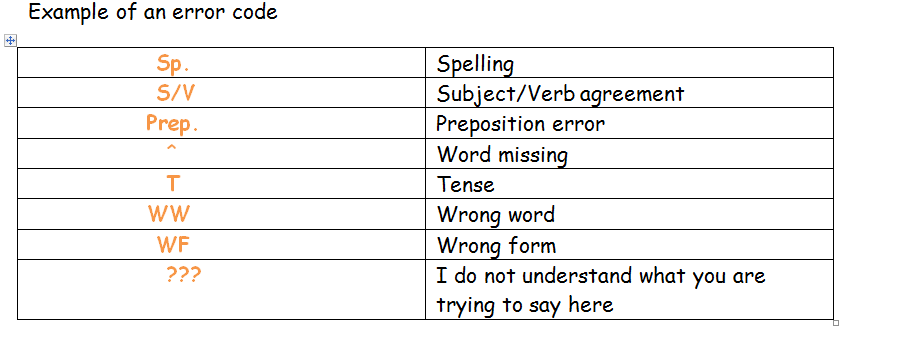
Many teachers use an error code when checking students’ writing. You collect your students’ texts and instead of correcting the mistakes, you use symbols/abbreviations which correspond to language features, you use an error code. So, for example SP. stands for spelling and WW. stands for wrong word. You can make the error code yourself or use something you have found in a book.

error code

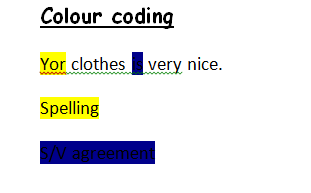
Instead of using abbreviations, you can use a highlighter pen. In this case, each colour corresponds to a type of error. This may be more suitable for children.

COLOURS

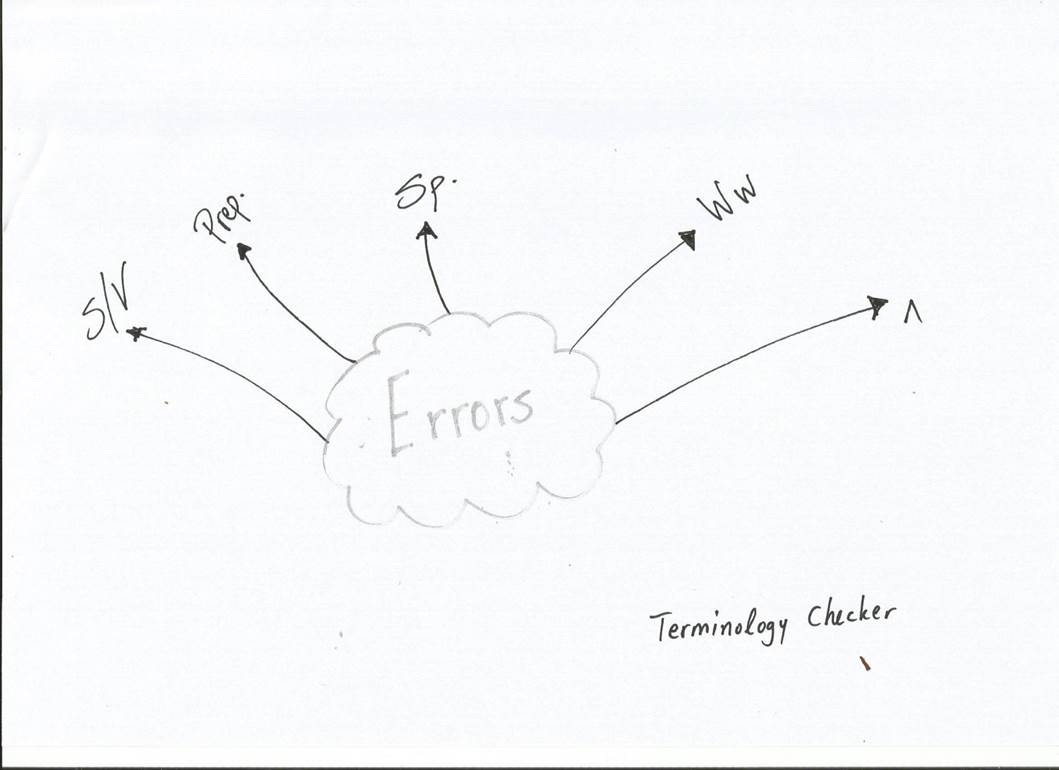
 Either way, you need to make sure that your students are familiar with the error code and know what each initial or abbreviation means. Try an error code terminology checker task. What is a terminology checker? Well, you write down the key abbreviations in bubbles and definitions under the bubbles, you then project them on the overhead projector or you use handouts. Your students then have to match the abbreviation with the definition or tell you what means what.

Picture1

One last thing you need to take into consideration is when to use an error code. Use it on mistakes the learners can correct. If you have a beginners class and you use the error code on, let’s say a verb that should have been in the passive voice, your learner will probably be unable to correct it, so you will only frustrate him/her or make him/her feel bad.

2. Comments

  • Comments in the margin+ end of text

When correcting your learner’s text it is a good idea to ask questions related to some of the information you find in the text, especially comments related to the content or lexis/grammar. Something may require more analysis, so you can make a comment bubble and ask, ”What do you mean?” or you may want to make a comment on something that you find interesting and say, ”Great idea!” or ”I totally agree”. Apart from comments in the margins you may want to make comments at the end of a text as well. Make sure the comments in the margins are connected to the comments at the end. Also, make sure that your students understand the connection. For example, if in the margin you say, “What do you mean by this?” and in your final comments (at the bottom of the page) you say, “You need to support your arguments more”, make sure that your learners understand that these two comments are connected.

  • Sandwich Feedback

Sandwich feedback is when you give a positive comment, then talk about something your learner did not do well or needs to work on, and then you write another positive comment.

You can also write feedback in a constructive way by using the

You did this……….

You didn’t do this…..

You need to do this……….  phrasing

  • Reformulation

Reformulation is when you rewrite the learner’s original text in a better way. Keep in mind that reformulation is a great way for the learners to see how they can produce a better text, just make sure that your “better version” is not beyond the learners’ abilities.

  • Online Feedback

If you are really tech savvy or if you want to be a bit more fancy, you can send your learners oral feedback or share a YouTube video. The sky is your limit fellow teacher. Online feedback suggestions:

  • Google docs
  • YouTube- screencasts (you can upload a video of you giving feedback on your learner’s work)
  • Vocaroo (website that allows you to record your feedback and email it to your learner)
  • Turnitin (plagiarism detector that also has sections for feedback)

Why use online feedback?

Your students probably like technology, and these websites have some really useful tools. Another benefit of using online feedback is that they get saved in the web so the dog cannot chew up your feedback!!

Why not?

It takes time to get used to and you or your students may not like technology.

3…………..

Write nothing. Instead of writing comments, have a tutorial with your learner. Have a short meeting where you discuss the strengths and weaknesses of the learner’s writing. Your learner will be able to ask questions and even open up to you about any difficulties regarding his/her writing.

          Individual vs. group feedback

Individual feedback is quite clear from its name. You comment on the individual’s writing.

Group feedback is when you give feedback on the whole group’s writing. You focus on common features of performance  and how these can be improved.

          Getting the learner involved

1. Self-Assessment/correction

  • Use a check list

Make a check list and ask your students to assess their work based on the items in this check list.

  • Journal writing

Your students can assess their performance in a writing journal. They  can reflect on what they have managed so far and write down anything that makes them worry. They can even use the sandwich feedback method to assess their texts.

4734a-2014-12-102b21-43-35

  • Error log

It is a good idea to get your learners to check the types of mistakes they make and see if there are errors that occur over and over again. If there are errors that recur:

1. Your learner will realise that he/she needs to address it.

2. You, the teacher, can include tasks, lessons that will help your learners with structures and language they are struggling with.

  • Rubrics/ assessment criteria

Instead of you marking your students’ work based on writing assessment criteria, why not get them to look at their work and assess it based on the writing assessment criteria? These type of activities are remarkable when working with advanced learners. It gets your students to reflect on their texts and see what needs work on. I have used criteria sheets in my exam classes and my EAP classes. I strongly recommend you try this with your learners. I would not recommend it for lower level students though because they may have language barrier issues. When you first introduce writing assessment criteria to your learners, it is a good idea to use a sample. Give them a text that has been assessed based on writing criteria but do not give them the final grades. Ask them to assess it and then show them the grades/highlighted criteria. Once they familiarise themselves with the process, they will be able to apply it to their own work.

2. Peer feedback

Peer feedback is another way to get the learners involved in assessment and correction. You can ask your learners to give peer feedback during the writing process or at the end. Your learners can give peer feedback by using:

  • criteria/rubrics
  • a specially designed form

Design a form and get your learners to check their classmates work based on what is on the form.

You can also make reading circles.  How does this work? Get your learners into groups of four and ask them to look at each other’s work and make comments, ask questions and use rubrics to assess their classmate’s writing. This way, each learner will get feedback from three people! Emphasise to your learners that they should only correct things they are sure their classmate has wrong. Your role here is  to monitor and offer suggestions when asked.

How do you know your learner understands your feedback?

We all give feedback and most of the times are probably happy with the work we have done. The question to ask though is, ” How do we know that our learners are learning from our feedback?” Well, you can do two things.

  1. Get feedback on your feedback.

Ask your learners what they think of the feedback you give them. Do they find it helpful? Is it enough? You could also make this feedback anonymous and get your students to tick boxes.

     2. Feedback Q & A

A while back I had written a post about feedback Q & A. What you do is after you correct your student’s writing, you make comments and then based on these comments you ask questions and give them tasks to practice any structures, grammar points etc. they used incorrectly. This takes a lot of time and cannot be done with big classes (unless it is group feedback) and on a daily basis. I do recommend trying it from time to time though.

                    Avoiding burnout

Feedback on writing requires a lot of time and effort and may lead to burnout. You can avoid burnout by:

  1. selective marking
  2. changing error codes
  3. involving the learners

(Harmer, 2013)

Coffeee


Feedback on writing is very important and integral to our learners’ progress. I hope you found this post helpful. Feel free to add any other ideas in the comments section below.

Till next time….


References

Harmer, J. (2013) The Practice of English Language Teaching. China: Pearson.

Richards, C. J. & Schmidt, R. (2010) Longman Dictionary of Language Teaching & Applied Linguistics. Malaysia: Pearson.

Ur, P. (2004) A course in Language Teaching. Cambridge: CUP.