Jason Fried TED talk -Lesson Plan

Today I am sharing with you another TED talk I used in my class. I teach the listening skill and my learners are adults who are studying English for academic purposes. The lesson I designed again focuses on note taking. It was very appropriate for them as most of them have work experience and they are also management students. This TED talk is appropriate for B2 upper-intermediate learners. It’s great for EAP and Business English students. Like the Amy Cuddy TED talk lesson plan I shared earlier this month, there is a lot of note taking but this time instead of getting them to write a summary, I asked them to use their notes to answer questions in their groups.

Since I was asked in the comments section, I think it’s a good idea to mention that these lessons are similar to attending mini lectures. During lectures students are asked to take notes. They then use their notes (detailed) and have little group discussions based on questions. They may even have a seminar discussion. That’s what I tried to practice with this lesson.

Jason Fried talks about distractions at work. He argues that managers and meetings are one of the biggest distractions at work and makes 3 suggestions on how to minimise distractions.

  1. Have a half day silent Thursday during which no one is allowed to talk.
  2. Go from active communication to passive communication such as emailing and I.Ms.
  3. Cancel the next meeting.

My class

My students loved this talk. They giggled quite a bit and the 3 suggestions got them talking. I actually got them to debate. The final task I chose was ”imagine your ideal office/ working environment”. This does not have that much to do with the TED talk, so you can omit it if you like. My students really had fun though, and gave mini pair presentations (which ties into what I am teaching them at this stage of the course). If you want the lesson to end with a blast, keep the ideal office task as well! This lesson took about 80 minutes. I have not included minutes in this lesson plan. The activities were done in groups.

The Video

The Tasks

Before listening

    1 You are going to watch a talk by Jason Fried called,

    ‘’Why work doesn’t happen at work’’.

    What do you think it’s about?

  1. Where do you go when you want to do something important like work or study?
  2. What kind of distractions do people have at work?
  3. If you were the manager of a company, what measures would you take in order to minimise distractions?

Watch the TED talk and take detailed notes. You will need your notes to answer questions later on.

After listening

Answer the following questions

    1. How did people answer Fried’s question about where they go to do something important.

   2. What distractions do employees have at work?

   3. What’s the connection between work and sleep?

   4. What 3 measures does Fried suggest managers take in order to minimise distractions?

Debate about measures: In your groups discuss the effectiveness of the measures. Do you agree with them?

In groups decide on your idea working environment (office). When you have finished, you will present this to the rest of the class.

You can find the TED talk tasks on PDF here Jason Fried TED talk LP

If you try this lesson, let me know how it goes. Feel free to share.

Till next time…….

#thegirliesideofelt post 8

Fun times: work, shopping, eating and dancing

You know how when you have a great day at work, you wanna tell everyone about it? And then the day at work turns into this great day and everything is just fab? I had one of those days on Friday and then I had a great weekend, so I thought I’d write a little blog post.

Friday- Work….. great

After work… great….

So, I thought I’d share a babble with you and tell you what my day was like. I left my student accommodation at 8:30 (teachers teaching at Sheffield’s pre-sessional EAP course live in this area called Ranmoore Village and it’s where students live during the academic year).

It was a nice kinda sunny day and I decided I wold walk to work. I never really walk to work cause I stress out over being late, but anyway, I thought I’d get out of my comfort zone and walk to work. And I did. I actually arrived a bit earlier so I got a bit of coffee as well.

I was teaching my main tutor group listening. We did a lot of talking before the listening tasks, we watched videos, students did their tasks, everything went smoothly. We then watched a TED talk and did a bit of writing. As there were a few minutes left, I decided to show them some tongue twisters just to get them to read a bit and practice speaking faster. They loved it. The thing about Chinese students is that they really enjoy pronunciation practice. If one student says something incorrectly, they all repeat the correct pronunciation as if they are in a choir. It’s great!

After work we went to this really nice Chinese restaurant and just ate dumpling. I have one word for you. Yummy. After dinner (which means lunch), we went for coffee at Debenhams’s, sat outside and enjoyed the sun. Afterwards, we went to the movies. We watched American Mistress. Nice film about a girl and her half-sister. Best phrase in the movie is when the guy tells the girl (the protagonist who is a writer)  ” I like you, but I wanna love someone I don’t have to always keep up with”. The movie has fast dialogues and is a nice movie to watch. Is it the best movie I have ever watched in my life? Nope. But it’s a good one.

Shef center

Sheffield City Center

My weekend was full of nice lunches (if you are in Sheffield you may want to check out the Thyne), a bit of shopping (makeup, bits and bobs-Dorothy Perkins has some nice stuff on sale) and my ,oh my, a lot of dancing (some cheesy music as well). You know the expression ”dance till you drop”? I danced and then the next day I was extremely tired (too old for an all nighter!).

Thyne

Thyne restaurant, Sheffield

So, yeah. Life is good in the UK. I am enjoying it.

Disclaimer: I don’t really know where to put these little babbles and I have decided to put them under the girlie posts. I am actually thinking of just having a second blog where I write any silly thing that pops into my mind. Dunno yet. Any suggestions?

Talk soon

xx

A fish, a thesis and ibid: Teaching (academic) writing through drawings

Drawing in the EFL class is something many teachers do in order to explain something like a grammar point or to have some fun like getting your learners to make a picture composition. I usually draw when I am teaching young learners, and I also draw when I want to show my emotions. For example, I will draw a smiley face after the Homework tasks have been written on the board to show my students that I will be happy when they do all their work.

But what about English for academic purposes? Do you draw in your EAP classes? I do, especially when I am teaching writing. I thought I’d share two of my favourite EAP pics which are on the wall somewhere in almost all my EAP classes. Keep in mind that these drawings can be used in any context where thesis statements and sources are part of a writing class, so these drawings can go beyond the EAP classroom.

The fish, the thesis and the arguments

It is quite hard for international students who are learning EAP for the first time to understand what a thesis statement is. They come from different educational backgrounds and they are trying to do a post-graduate degree in an English-speaking (that’s my teaching contexts) country. They probably have never heard or written a thesis statement before. Add the term argumentative essay, and things become even more complicated. This applies to any student who is first introduced to terms thesis and argumentative essay. That’s when  the Picasso in me takes action. I draw a fish.

The fish

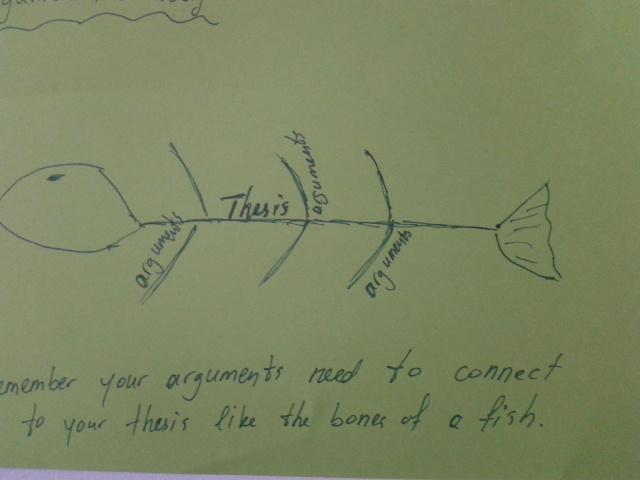
Why a fish? Well, it gives a good representation of the connection between the thesis and the arguments. The back bone of the fish is the thesis statement, and the arguments are the fish’s bones, all the bones are connected connected to the backbone. I often tell my learners that if a bone breaks, then the fish is in trouble, Just like their essays. I say, ”Your arguments need to be linked to your thesis statement and what you are trying to prove”.

Fish

Follow up task: When I am teaching writing and students have written a thesis statement and have a draft of the main body of the  essay, I ask them to go over the main body and write down the arguments (main ideas). I then tell them to look at their thesis and see if there is a connection and what that connection is. They can even draw their own fish if they want to!

The ‘referenced’ drawing

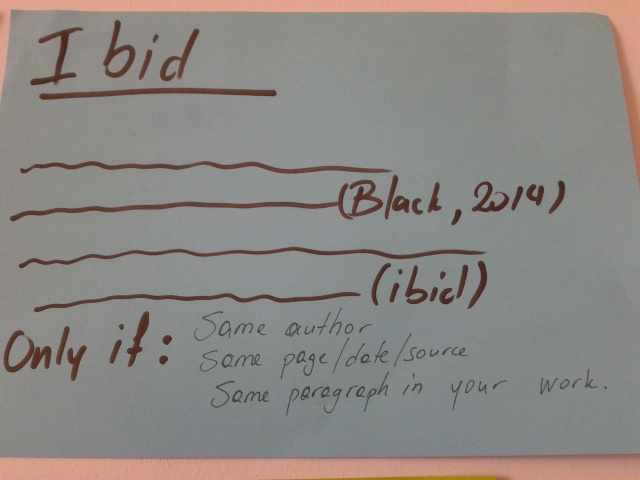
In-text citations are also quite hard for students. I find that my students get overwhelmed by the hard vocabulary in paraphrased sources or quotes (especially in academic texts) that they lose sight of the mechanics of referencing. Very often I show them how to do in-text citations by drawing. Below you can see two examples. One shows how I explain citing a secondary source and the other shows them what ibid means. So, after going through all the websites that are dedicated to referencing, I turn these concepts into visuals.

                      IBIDblack and Jackson

These pictures are all on my wall and help me explain in a very simple way some really hard things!

What do you use drawing for? Feel free to leave a comment below and share this post if you like it! Thanks for reading    🙂

Till next time…..


Amy Cuddy TED talk: Lesson Plan

Today I am sharing with you a lesson I did with my EAP students. This lesson is appropriate for adults and mature students. The language level is better for students who are  B2 (upper-intermediate) and above. The pace of the talk is quite fast but because Cuddy gives lots of examples and the topic is interesting, students did not really mind. There are subtitles you can add if you think this is necessary (YouTube).

Skills:

Listening and note taking

Speaking (expressing opinion)

Writing (summarising)

Tasks

Amy Cuddy TED talk

Your body language shapes who you are

Before listening

  1. You are going to watch a TED talk about body language (nonverbal communication). Why is body language important? Discuss in groups.(6-8 mins)
  2. Can you think of common gestures and types of nonverbal communication that are common all around the world? What do they mean? The V symbol we do with our hand, for example, means victory. Discuss in your groups (5 mins)
  3. What’s an Alpha type personality? Write down the characteristics of an Alpha type personality(5 mins)
Definition
Characteristics
  1. Look up the terms testosterone and cortisol. They are hormones. What do they affect? (6 mins)

You are now going to watch Amy Cuddy’s TED talk. Take linear notes because you will need them later on (22 mins).

After listening

5. Fill in the gaps based on your notes (3 mins)

Fake it…………………………….

Fake it ………………………….

What do these phrases mean. Discuss in pairs (4 mins)?

6. What do we learn about Amy Cuddy’s life? Talk about this with the person next to you (5 mins)

Now, summarise the talk in pairs (150 words).

You can find the task sheet with the exercises for the Amy Cuddy TED talk here

My learners really enjoyed this session. They found it very interesting. My lesson lasted for 90 minutes. They spent a lot of time summarising. If your classes are sixty minutes long, you can set the summary as a task for homework. I have not included minutes on the task sheet. Also, if you have extra time, you can talk about the different types of body language shown in class, what Amy Cuddy said regarding gambling and hormones and so on.

I hope you liked this lesson plan. Feel free to share and let me know how it went if you use it.

Off to Leeds

Sunday the 9th of August my friend Kasia and I decided it was time to go to Leeds which is about 45 minutes by train from Sheffield (that’s where I am at the mo). The plan was to leave at around 11. But, typical Joanna (that’s me), I was a bit late and by the time I put on my face (a.k.a makeup) it was 11:30.. To cut a long intro short, our train left Sheffield at around 12:15 and we arrived in Leeds one-ish.

Sheffield train station

Sheffield train station

We had made no plans, we were gonna go with the flow. Maybe hit some shops, have some food, and probably go to a gallery. Once we arrived in Leeds we needed fuel… coffee, so we went into this nice pub and had some coffee. Interestingly enough, coffee in this pub cost more than beer!

Coffee time

Coffee time

After the coffee, we started walking around and instantly I felt like I was in heaven, my city center paradise. You see, I don’t do nature. I like to stroll in nice centers that have flowers, and coffee shops and a nice vibe. I am a city girl. Leeds was exactly that! All the shops are in one area, little streets have restaurants or more stores. People walk around, there are people busking. I loved it. We didn’t do much shopping, just a few bits an bobs. We  ❤ TK Maxx.

Leeds

Leeds

We went to the Byron for a nice burger. It claims it serves proper burgers, and it does. We had a yummy meal and….check out the pic below, I asked for a burger that was well done, and I got one  🙂 . We also had a bit of good live music in the background.

well done

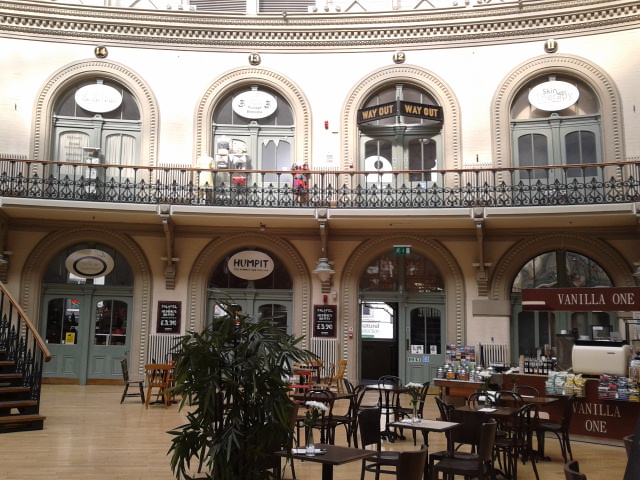
I then posted  a question on Facebook and asked for suggestions on where to go in Leeds. People suggested visiting the Corn exchange and Victoria’s quarter. Both are shopping areas (you guys…., you know me so well :p). The architecture in these particular spots is so unique (check out the pics). The Corn exchange used to be a place where grain inspections were held. Now it is a different kind of shopping place. So lovely.

Corn exchange

Corn exchange

After that we walked a bit more and found the canal. The weather was great (even though my pictures do not do it justice). We walked by the river bank and crossed this really nice bridge to have some more fuel… em… coffee.

The canal

The canal

Time flew by and we had to head home, but all in all, Leeds is a great place to go and chill. You can walk around, have a nice meal and just suck in the city’s atmosphere. Nice day with great company.

piece of art

Talk soon xx

See you at #TOBELTA

Hi everyone!

Just a quick blog post today!

Tomorrow the #TOBELTA online conference starts (8-9/8). There is a great line up of presenters. it’s free and it’s also online which means you can be in your pyjamas and develop professionally. So it’s win-win! Press here for the programme.

  tobelta_web_conference_programme_2015

Guess who else is talking? Me. I am actually preparing my PPT as we speak ( or write?).

I will talk about peer and self-assessment in different contexts and my focus will be on the writing skill. I will start off with some background info. The benefits and some drawbacks of both types of assessment and then I will talk to you about different types of activities that can be used in class to promote peer and self-assessment.

My talk is on Saturday the 8th at 17:30 CET (4:30 in the UK/6:30 in Greece).ec063-10561814_10152679793187425_481449428002127213_n

and this is the link to enter the room is: http://learningtimesevents.org/webheads

Hope I get to see ya!!

Joanna

I hate lesson plans…… with a passion

I am going to start this post by making a sweeping statement which is kinda harsh, and will definitely make some of you, my lovely readers, roll your eyes.

I hate writing lesson plans

I hate writing lesson plans which are part of a formal observation and have to be timed, have to have tasks with minutes next to them (gotcha! So, my title was a bit misleading ….).

The problem with lesson plans that are part of a formal school or diploma observation is that you get sucked in cause of the ‘minutes’, and you may lose sight of what you really should be focusing on. As far as I am concerned, lessons that had to be based on specific timing as part of the lesson plan made me feel like I am suffocating.

Maybe the timing bit is what I hate the most. Trying to figure out how many minutes you will spend on a grammar task, a reading, a group activity. So, you write up your ‘official’ lesson plan, you go into class and then you are stuck. You do not or maybe even cannot stray from what you planned in a hypothetical lesson plan.

Scenario one

You decide to do a reading task. It’s a dense semi-long reading passage and you plan ten mins for reading and four for exercises. You go into class and then you give the instructions and the students start reading.Ten minutes are up. You say, ” Has everyone finished reading? Do you need more time?” and then… some students dare to say, ” Yes, we need more time…..” .

OMG. There goes my planning… down the drain. I am behind in my minutes, and now I am gonna have to go rush rush through other stuff, or even skip other stuff which leads to more minute missing, more bad planning, more feeling like the person observing you will give you a bad grade! I have realised that when I am observed, I am ashamed to admit this, but I do lose sight of what my learners need and start dreading the tick tock of the clock.I think, ”I gotta stick to my timing. I should’ve put this setback in my anticipated problems, but I didn’t. Oh my, I am a bad teacher, I am not doing what’s on my lesson plan” (Joanna says sarcastically).

Scenario 2

You have a listening task. You decide to play the recording twice, but when the recording is over, your learners say, ” We didn’t find anything. It was too hard. We need to listen to it again”. You start sweating. You play the recording again cause that’s what the learners need and then… tick tock, tick tock.

How I normally plan lessons- my happy place

This is probably blasphemy, and the ELT Gods will probably ostracise me, but, when I am not observed and I do not have to make a detailed plan, I look at my material, start ticking what I will do, make notes, sometimes on post-it notes, I write down the minutes but very loosely, and then I walk into class. If something interesting comes up, I change my plan and go with the flow (ooooohh). If students are having difficulties, I start trying to figure out ways to explain things, and again stray from the plan. I think my lessons are good, my learners learn (most of the times) and everyone is happy. When I get observed, I may stick to my minutes, but I can’t say I am the happiest teacher on the block. My observed lessons are not my best ones, even when the feedback is really good (yes, sometimes it is…).

Beach in Chania

So, that’s why I hate lesson plans… with a passion. I dislike minutes. I wish lesson plans did not have the timing box, and we could just go with the flow or maybe I am just a bad planner….Oh! By the way, I know observations are aimed to help us, and give us suggestions on how to improve. I do really learn a lot from them. The latter does not mean though that I don’t feel trapped in my little boxes (the tables where you write your lp).

What do you guys think?

Talk soon

Jo

#Monthly Favourites July 2015

So guys, it’s that time of the month again. Time for #monthlyfavourites for July 2015. I will be talking about all the things I loved in July. You will find blog posts, websites, and lots of other random stuff in this post. So, let’s begin.

Blog posts

Hemingway or Woolf? Hana Ticha talks about this programme/app that allows you to check your writing and improve it. Really cool post. Do check it out! Post here

CPD for August and September. Read this post by Adi Rajan to see what you can do to learn more during the months August and September

How being a teacher has affected parenting. A great post by Rachael about how being a teacher influences the way she behaves as a parent.

About Games/gaming. Rose Bard shares her experiences with using games in class. The post can be found here.

Going beyond ELT in a blog post. I really enjoy reading posts by teachers, especially when they talk about where they are from or live. I read two excellent posts in July. One was by Sandy Millin and it was about Crimea and the other one was by Anna Zernova and she talks about St. Pete and what she likes doing there.

 Jamie Oliver TED talk + lesson ideas

I use the Jamie Oliver TED talk with my adult students (both BE and EAP) and they love it. You can find below the TED talk and a link to a website that has a PDF with lesson ideas and the transcript of the talk.

Software

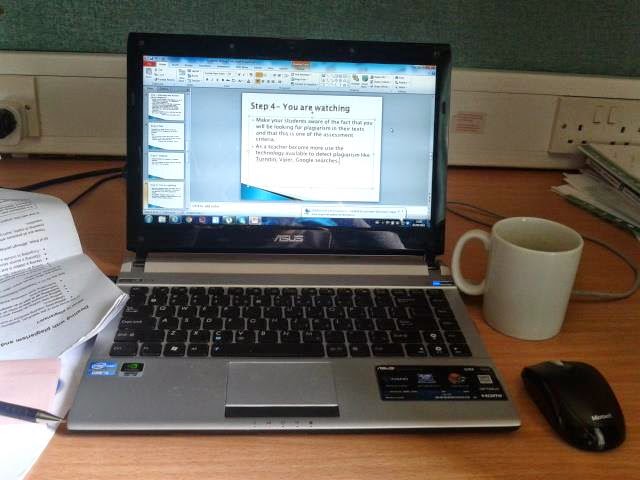
If you like Post-it notes, then you might like Windows Sticky Notes. They are like little Post-it notes you stick to your screen. Just type Sticky Notes in the Search Programs and Files in the start menu tab  of your pc and you have it!! So easy to use!!!

sticky notes

See the sticky note on my screen?

BBC program

The desert island discs. My friend Deirdre recommended this website/program. This is a show that features people who are popular/famous in their field. They talk about their life and choose songs that have some sort of sentimental value for them. I heard Jo Malone’s interview and I loved it. I think this can be used with learners as well (dunno how yet, but will be back with an idea for this).

 For the ladies

Girls!! I found the perfect foundation. The one that never budges. It just stays put all day long  :). Estee Lauder double wear. Check it out!!

2015-08-02 11.26.39

On a more personal level……….

I am in the UK!! I ❤ it here. Of course, I am freezing, cause it is coooooold, but I am having loads of fun. I went to London and spent a weekend there. I had a very informative induction week at Sheffield university and learnt a lot about EAP (if you don’t know already, I am teaching academic English at Sheffield at the moment). I went to my first time ever stand up comedy and I had a blast! Icing on the cake? My classroom! It is in a beautiful building!!

Sheffield University ( Department of Music)

Sheffield University ( Department of Music)

Final thoughts

This post takes a lot of time because I need to add links and stuff. Let me know if you enjoy these #monthly favourites posts. Feel free to share them and add your own favourites in the comments section below.

daisy

Till next time…..