Grammar LSA

Today, I am sharing with you my grammar background essay (LSA) for the Delta Cambridge module 2. Please keep in mind that this has been shared with you as an example. Cambridge does not take plagiarism lightly, so do not copy from this assignment. I got a Merit for this LSA.

1.Introduction

I have always had a liking for grammar teaching and the ‘traditional’ 2nd conditional is a great opportunity to engage my students in fun activities and an important part of the syllabus for intermediate level students. Although at an intermediate level learners are already familiar with the 2nd conditional (if + simple past, would), they still have trouble expressing untrue/unlikely conditions in the present/future. Understanding why a simple past may refer to the present or future (see section 2.III) may be due to L1 interference or misusing the inverted forms of conditionals (see section 2.V) because of lack of practice makes this grammar item hard for learners. Knowing how to deal with the problems (see section 2) and questioning the effectiveness of just teaching the traditional 2nd conditional basic structure (see section 2.I p.5) are reasons why I chose this topic.

1.Language Analysis

Definition of conditionals and their general form.

According to Carter and McCarthy (2006, p. 448)

”Conditions deal with imagined situations: some are possible, some are unlikely and some are impossible. The speaker/writer imagines that something can or cannot happen or have happened, and then compares that situation with possible consequences or outcomes, or offers other logical conclusions about the situation”.

Conditional clauses mainly express conditionality and they are most frequently introduced with the word if (ibid)

If they competed, they would succeed   OR    They would succeed if they competed.

Protasis (if clause)                        Apodosis (main clause)

(The Shorter Oxford Dictionary cited in George,H.V. 1997 p.161)

Conditionals can also be in the interrogative or negative form.

1.1.Form/Meaning and Usage

Theoretical grammars

Traditionally conditional clauses are divided into the 1st, 2nd and 3rd conditional (Carter & McCarthy 2006,p.748) The 2nd conditional is formed as follows: If+ simple past tense+ would/could/might (a modal with a past reference in its meaning). According to Carter and McCarthy (2006,p.748), their meaning depends on the speaker/writer, “a speaker or writer responds to a possible/hypothetical situation  by indicating a possible outcome. The speaker states that the condition must be fulfilled for the present or future to be different”. In fact, it is imperative that the condition is fulfilled for the present or future to differ (Carter & McCarthy 2006, p.748) e.g. If I knew what he wanted, maybe I could help him. Apart from this description, Carter and McCarthy (2006,p.749) mention that conditionals can refer to real or unreal situations. As they put it, “Unreal situations are things that are untrue or imagined, have not happened and are only remotely likely to happen. Unreal situations are the basis of the second and third conditionals” (ibid) and there are no differences in the way they are formed (If+ simple past tense+ would/could/might).

Murcia and Freeman mention that the description of the 1st,2nd and 3rd conditionals is an overgeneralization (1999 p.545). For them it is more accurate to talk about factual, future (predictive) and imaginative (subjunctive) conditional sentences. Imaginative conditionals (hypothetical and counterfactual) are the focus of this paper.

Imaginative Conditionals

  • Hypothetical conditional sentneces
Form Meaning Example
Present: if + simple past/present subjunctive + wouldFuture: If + were to +verb/ verb +simple past tense + would The speaker perceives something to be unlikely yet possible in the if clause.In this example: we are not sure if Joe has time now to go to Mexico- it is possible but probably unlikely. E.g. If Joe had time, he would go to Mexico (present reference).If Joe were to have the time, he would go to Mexico (future reference).
If+ should have/simple past +to have/should + infinitive +to have, would The negative quality of the if clause can be further weakened-the possibility of the result occurring becomes weaker.Here: Joe is probably not going to have time and is unlikely to go to Mexico. E.g. If Joe should have/ happened to have/should happen to have the time, he would go to Mexico
  • Counterfactual conditional sentence
Form Meaning Example
If+ simple past/ present subjunctive+ would. Impossible event or state in the if clause present/future reference.Here: My grandfather isn’t alive so this is untrue/impossible in the present / future E.g. If my grandfather were alive today, he would experience a very different world (present counterfactual)

Functions of conditionals in Murcia and Freeman (1999, p.557)

  • “Propose options for future scenarios.
  • To introduce contrasts.
  • To provide examples following generalisations.
  • To make inferences based on previously mentioned assumptions.”

Jones and Waller (2010) suggest that this notion be expressed with other forms apart from the traditional if + simple past, main clause would. After conducting research they found some more structures which expressed something unreal in the non past although, on the whole, the structures they propose are similar to what grammarians have already mentioned. Clearly, context affects the form of this notion.

If+ past simple, simple present

E.g. Even if we did, we have no drivers abroad

Meaning: They want to change their present situation but they cannot because they do not have drivers.

If+ present simple, would

E.g if two members of staff happen to fall in love, it would be churlish to be appointing blame.

Meaning: happen to lexically expresses the unlikeliness of members of staff falling in love.

Pedagogical grammars

According to Alexander’s (1998) pedagogical grammar for intermediate level students, there are cases where what is known as the 2nd conditional refers to something untrue/imaginary or unlikely.

Form                                                                  Use/Meaning

Protasis (If clause) Apodosis (Main Clause)
·       If + past/could (basic formation)e.g If you went by train, you would get there earlier


E.g. If you could run faster, you’d be a champion.

Would  Something reasonably possible but ‘more tentative’. Past tense does not refer to past.Here, it is likely that the train would take you to your destination faster)

Something totally impossible ( this is debatable though as the context is missing).

Table: adapted version from Alexander, G. L. (1998, p.208-9)

In Thornbury (2004, p.60) this structure is formed by  if+ past tense+ clause would/could.

E.g. If you were a parent, you’d understand how I feel.

Meaning: Something unlikely or impossible in the present/future which has outcomes that are hypothetical (ibid).

Inverted conditional

Inversion can occur in the 2nd conditional if the if clause has the verb to be. If can be dropped in the conditionals and the auxiliary verb is placed before the subject (formal inverted structure) for example, Were she my daughter, I’d give her some good advice (Swan, M. 2002 p.250). If cannot be dropped, if there is any other verb in the if clause.

Clearly, different grammarians propose different descriptions of this notion. There is consensus on the if clause simple past/past continuous or a modal verb (in the past) while the main clause usually has would/could in it and its meaning has to do with something likely/less possible or even impossible in the present/future. Variations of this form use tenses like the simple present. The meaning  is the same and depends greatly on the context. These structures are used to express dreams, wants and wishes, things that may or may not happen.

Spelling

The spelling of conditionals depend on the individual components which form the  2nd conditional. For instance, the spelling of the past/ irregular past or ing endings.

Phonology

Phonology is affected by the components which form the 2nd conditional, for example, the [l] in modal verbs. Knowing which word to stress may also affect the meaning of a conditional clause.

  1. Problems for learners and how to solve them
  1. Problem-The 2nd conditional: Is it enough?

Focusing on just the basic form of the 2nd conditional to present something untrue/unlikely in the present/future is not enough. In fact, this can be expressed with other if structures too (see section 1.1 p.4).

Solution and techniques

Exposing learners to more examples of if clauses and patterns that are used to express these conditions can be the first step towards teaching students the different ways of expressing real and unreal situations (Jones & Waller 2010, p.29 and Thornbury 2003, p.223). Students could be asked to identify sentences that do not fit into the traditional 2nd type conditional (Thornbury 2003, p 96 & 223) in authentic texts and then through discovery methods find the new patterns. We then discuss the variations to the rules they have learnt so far and whether the sentences they found express the ‘target’ notion. They then record these variations and add them to what is in their grammar course book and make something like a grammar journal. Building their own grammar journal will help them realize that there are many ways to express something unreal/unlikely in the present/future. Such a task solicits recognition of the form but does not guarantee correct production. It must be closely monitored though as the learners may not be sure if what they found expresses this notion while the teacher must also make clear that not everything goes and it is necessary to look closely at the context and speaker/writer intention. This activity is more appropriate for adult learners. Identifying variations would require more time if the learners were children but this does not mean that it is impossible.

2. Problem-I’d

Mistaking the contracted form I’d for I had instead of I would (Aitken 2002, p110). This may happen in my classes because I avoid using the contracted form on the board or due to overgeneralization. That is why they may produce sentences like If I were rich, I had buy a Porsche.

Solution and Techniques

Students use the contracted form I’d for I would through drilling the full and short form. Learners rewrite sentences where would is used in the full form and then in the short form. Drilling can be quite a dry, restricted method but it still makes the learners’ recognize the different I’d forms. The limitation of drilling exercises is that according to Savage et al (2010 p.6) “they reduce cognitive engagement…. activities are designed to reduce students’ errors”. Adults do not particularly appreciate drilling tasks due to this. Drills can also be used for younger learner groups in the form of choral repetition or songs e.g If I were a rich man/ if you had my love etc. were I’d is used as part of the apodosis. Clarification checks about the lyrics of the songs could ensure my learners noticed the contracted form.

3. Problem past tense referring to the present/ future

Students who have learned to associate the past tense with something that happened in the past find it hard to believe that if+ simple past/past continuous may refer to the present (Celce-Murcia & Larsen-Freeman 1999, p.545). They may have difficulty understanding how something which is translated in their L1 in the past refers to the present or future or they may be overgeneralizing the translation of the past.

Solution and Techniques

Engaging in what Willis (2005, p.14) calls ‘consciousness raising activities’ is a good first step. By looking at examples of simple past future referencing in context and figuring it out for themselves, they will better understand the unreal past reference. A good task for intermediate students is to get them into groups and give them slips of paper with phrases like win five million dollars in the lottery, get a pilot’s license and be able to fly a plane and so on. The learners work in pairs and produce sentences describing what they would do e.g. if I got a pilot’s license and could fly a plane, I would…. I would monitor my students during this task and offer feedback regarding any difficulties they have with this form (Cowan, R. 2008, p.467). This is quite a restricted task and can be used before freer production tasks where students could for example interview each other on things that would do if they could.

4. Problem-Phonology  (would)-stress patterns

Greek spelling is phonetic and has a correspondence between sound and graphic symbol (Papaefthymiou-Lytra ( p.129 cited in Swan & Smith). Greek students tend to have difficulty reading the short form I’d /aɪd/ and not saying the silent [l] in would/ could /should. Russian learners have a problem with the sound [w] as it does not exist in Russian (Monk and Burak cited in Swan & Smith 2002, p 147). This can be problematic when teaching the 2nd conditional as would is the most common word in the apodosis. Stressing the right word in a conditional clause may also affect the meaning of the sentence and should be addressed in the classroom too.

Solution and Techniques

W sound/Silent L

In order to help my learners with the [w] sound I would show them where the sound is formed (voiced velar) and then practice the sound with phonology cards with words that start with W. This type of activity would be appropriate mostly for adult learners. Although very restricted, it will lead to the outcome wanted. I would use phonological cards to practice the silent [l] too. As a self-study task I would ask my learners to record themselves  on ‘vocaroo’ and then check their performance. Practicing saying the words over and over and listening to how these words are said will make perfect.

Stressing

Role playing would be a good way to familiarize learners with stress patterns as they can provide a context and students will be able to emphasise the word which should be stressed in the protasis and apodosis. Learners actually realize that stressing the wrong word could affect the meaning of what they want to say. Stress patterns can be part of a listening task too where learners underline which words are stressed. It is necessary for students to have examples of the conditional as it is spoken in real life, so video viewing is the best approach.

5. Problem-Inversion

Ellipsis of if and subject auxiliary inversion occur more frequently in written form and more frequently in British English (Cowan 2008, p.458). Based on my experience, at an intermediate level student do not really invert their conditionals and they sometimes have difficulty recognizing the structure Were I as a conditional.

Solution and techniques

Structural drills will allow my learners to practice the structure over and over again. Then they can move on to more meaningful drills which will enable them to familiarize themselves with the inverted structure and feel more comfortable to use it in the everyday speech. These drills could be done as part of a process writing task and in order to make it more autonomous I would use some peer checking tasks of this form in my class. Although drills are very restricted they help recognition of the form and lead to usage of it in freer written tasks like a narrative or a consequence chain where the learners would have to include the inverted form as part of the task fulfillment requirements. Such a task would be appropriate for both adults/children.

3.Conclusion

Based on what I discussed in this paper, if I taught the second conditional tomorrow, I would read through this LSA to get a clearer picture of this grammar phenomenon.

References

Aitken, R (2002). Teaching Tenses. Brighton: ELB Publishing.

Alexander, L. G. (1998) Longman English Grammar Practice for intermediate students. New York:Longman.

Carter R. and McCarthy M.2006 Cambridge Grammar Of English: A comprehensive Guide Spoken and Written English Grammar and Usage. Cambridge: Cambridge University Press.

Cowan, R. 2008 The Teacher’s Grammar of English a course book and Reference guide. New York: Cambridge University Press.

George, H. V. (1997) Essays in informational English Grammar with reference to English language teaching. Victoria: Campus Graphics La Trobe University.

Jones, C. and Waller, D. (2011) If only it were true: The problem with the four conditionals ELT journal Volume 65/1, p.24-32.

Murcia-Celce, M and Freeman-Larsen, D (1999) The Grammar Book: An EFL/ESL Teacher’s Course. United States of America: Heinle and Heinle Publishers.

Savage, K. L., Bitterlin, G. and Price, D. (2010) Grammar Matters in Adult ESL Programs. NewYork: Cambridge University Press.

Swan, M. and Smith, B. (2002) Learner English 2nd edition. Cambridge: Cambridge University Press.

Swan, M. (2002) English Usage 2nd edition International student’s edition. Oxford: Oxford University Press.

Thornbury, S.(2003) About Language. Cambridge: Cambridge University Press.

Thornbury, S. (2004) Natural Grammar. New York: Oxford University Press.

Willis, D. (2005) Rules, Patterns and Words Grammar and Lexis In English Language Teaching. Cambridge: Cambridge University Press.



Who am I?

The girlie side of ELT post 5

So, I was watching a 26-year-old YouTuber the other day and  she said, “I want all of you to think about this. Who are you? Not what do you do or what do you like, but who are you?” and while this is not a new blog challenge or anything like that, it is an interesting question, isn’t it? Well, I think so, and that’s what I am gonna ramble about here.

So, back to what prompted this post. Who am I?

Flowers

I am Greek / Australian. This means that when I was in Sydney, I was an immigrant, and when I came to Greece, again, I was someone who was not born in Greece. So, actually I belong nowhere. Interesting.

I am a nerd and  I am OK with it. I like learning and when I study, I wanna get good grades (I don’t always succeed, but I still wanna).I read and blog for fun.

I am a wannabe fashionista. I like looking at fashion magazines, watching YouTubers talk about fashion and makeup. I like all this stuff. I am a girlie girl but not too girlie.

I am funny or at least I think I am funny.

I am a realist and practical. I wanna try stuff out. If they work, cool. If they don’t, big woop. I wouldn’t say I am a day dreamer but from time to time I do enjoy being in Lala land. I eventually snap out of it and get a reality check.

I am rude, blunt and sarcastic. I roll my eyes… a lot.

But I am also non confrontational, sometimes even a pushover. I do things I don’t really wanna do, just to please others, cause I am a goody-goody, as well.

I am not a risk taker. I don’t like spontaneous things. I like planning and organizing stuff. I like to know what will happen and when it will happen.

I like helping people when I can. I like sharing when I can.

I don’t believe in soul mates or the one.

I am ambitious and I try to be as professional as possible.

I am more of a listener than a talker.

Hmmm, yeah that’s about it. That’s who I think I am. Have I figured everything out?

Nope.

Trees in Paris

That’s all folks xxxx

Looks don’t matter…… Yeah, right!

The #girliesideofelt post 4

So, I was reading a post yesterday. Tefltastic mentioned 25 ways to get away with being a crappy teacher and while my post has nothing to do with the points he mentioned ( I agree with some, disagree with others and can add a few more), he did get me thinking. One of the points mentioned is being good-looking. If you are good-looking, you probably can get away with bad teaching (according to the post). So, today,  I am going to focus on looks, and how they can make or break a teacher (me, being a drama queen :p).

The ‘pretty’ teacher

Now, first let me start by saying that I am a normal looking teacher/woman. Nothing special, and if you ask me (and others) I could lose a bit of kilos here and there. But, I manage, and at 39,I feel fine about the way I look. Now, the next thing I want to ask is, “why do some colleagues (of both sexes) assume that if you want to look decent/good, you probably focus more on your looks and less on your teaching.?” My answer to that is, ” OM freakin G”.

Now, I am going to tell you a little story. I like girlie stuff (Really? You couldn’t have the guessed that now, could you?). I do not go to extremes, but I like a bit of makeup, my comfy heels and my nice perfumes. When I go to class, I do pay attention to the way I look. is it the most important thing? Nope. Does it matter? Sure, why not?

I was observed and it was a Friday. Friday at work in the UK also means going to dinner or the pub  (yeah, if I am going to go out, I will put in extra effort to look presentable. Sue me :p). So, I spent 5 mins using a curling iron, I put on a bit of makeup, perfume and went to work. I looked  OK.  When I walked into the office, I got a few compliments. A nice ambient atmosphere. We also talked shop. ” What are you going to teach? Can I see your lesson plan… yada, yada, yada”. And then, this. One of my (female) colleagues said, ” So, blah, blah blah will observe me. He doesn’t care about whether I look good or not” Me , “…..” .

Excuse me. Should I have gone into work with a paper bag on my head, a wrinkly shirt and smell of a cheapo deo spray? So, if I am blonde (fake blonde), wear makeup, and nice clothes, will some of you automatically think that I cannot teach? Tstststs (that’s the Greek sound of disapproval).

I wonder, do pretty boy/teachers have the same problems? They probably do. Do looks really matter? Apparently to some they do. they can open doors, or you can get slammed in the face by the door cause you are too “pretty”.

FYI: my observation went great!

Bring me the makeup people, I am going into class!!!

EAP resources

Till next time…..

Paper Post-it Presentation

This weekend I have been planning my Tesol Greece presentation. I have almost finished making my PowerPoint Presentation and I thought I would share with you one of the things I did during my planning stage.

Post-it Presentation

I teach presentation skills and when I teach them, I always read tips and helpful ideas on how to make a good presentation. One of the tips was to write what you would put on your slides on Post-it notes. Why?

Well,

  1. If it fits on a Post-it and you can read it, it will look good on your slide.
  2. You get to organize your slides/ideas based on your Post-it slides.
  3. It’s a visual representation of your presentation.

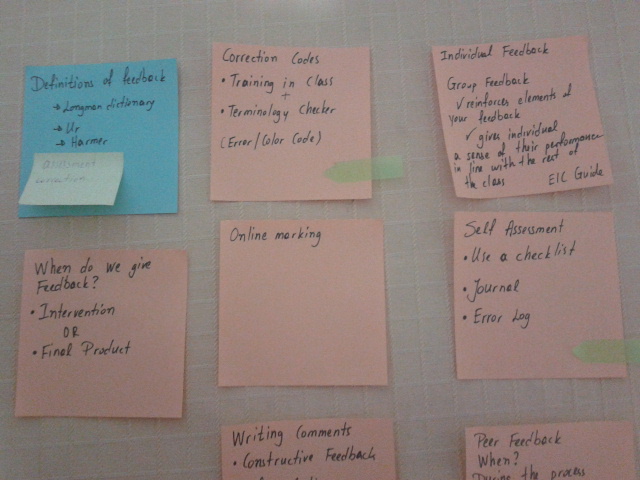
So, that’s what I did. I read, made notes and then started making my Post-it notes. Once all my mixed thoughts were on the post-its, I took a closer look and started figuring out the order in which I would put everything. I did a bit of shuffling, looked at what made sense, and in the end, I was happy with my result. I stuck all my Post-its on a piece of cardboard and placed it write next to my computer screen. I then started making my PPT.

Post-it Presentation

              1st stage of Post-it Presentation

FIY

It has taken me much less time to think of the info that should go on the slides.

√ My slides are not too wordy.

√ My presentation looks quite good.

Do you have any useful tips for the planning stage of a presentation? Feel free to share your thoughts in the comments section below.

Till next time……

Guest post: Phil Wade’s #youngerteacherself post

Phil Wade has been kind enough to write a guest blog post and took part in the #youngerteacherself challenge. So, Phil, over to you!

What would I tell my younger me?

 Before the CELTA

  1. Do the CELTA asap. Find the money, beg for the money or work more to get the money.
  2. Do a CELTA near your house so you can save travelling time.
  3. Stop your life for the 4 weeks and work, work, work.
  4. Aim for and get an A. You can do it but you don’t think you can.
  5. Don’t just focus on being good. find out what will get you an A and adapt.

During the CELTA

  1. Trust yourself and follow your instincts.
  2. Enjoy the teaching and the students will too.
  3. Don’t be a complete slave to your plans.
  4. Keep applying for jobs.

After the CELTA

  1. Prepare for a range of English classes.
  2. Don’t just redo CELTA stuff.
  3. Don’t follow every page of the book.
  4. Try to make grammar lessons more about explaining and practice. forget the fun and interactive stuff.
  5. Get into Business English asap.
  6. Do the DELTA after 2 years.
  7. Sign up for the MA TESOL after that and you can skip term 1.
  8. Apply to be an examiner and try different exams.
  9. Ask about teacher training and examiner training.
  10. Make and trademark something called an ‘app’ on smartphones and ‘elearning’.
  11. Produce and sell loads of apps and elearning courses for English then retire at 25.
  12. Look into and start a PhD before tuition fees get too high.
  13. Aim for a head of department job in an EAP section of a university.
  14. Balance teaching with research and writing.

About Phil

Phil teaches English at university and in companies, writes elearning and creates ELT Social Media content. He is the author of the Business English Teacher Development ebook series (10 ebooks).

Thanks for writing Phil

Making or breaking the learner

Let me start by saying that teachers are ‘powerful’ beings. Depending on the learner’s personality, a teacher can make a learner feel great or horrible about him/herself. Now, let me tell you a story, but before I tell you a story, let’s talk about medicine.

I am partially color blind. This does not mean that I cannot see colours, it just means that I do not see colours the same way as colourseeing people can. I can see that there is a colour, I just sometimes mix these colours up. Having said that, let’s go back to the “making or breaking” sweep statement at the beginning of this post.

As I said in an earlier post, I took up drawing and…… painting. When I started the classes, I told my trainer that I can’t tell the difference between colours and that I would need help.  Today, I finished the drawing and moved on to the painting. When I said, ” I am color blind remember?” She looked at me and said, “I don’t understand that. So, you can’t see colours? You can’t see that this is red? What do you see it as?” and then after a few seconds. “So, you really can’t see colours” I snapped. I said, ” Well, if I am colour blind, that means that no, I don’t see colours. Or actually, I do see that these (pointing to different colours) are different, I just don’t know what exactly they are” I think my face and my tone shocked her a bit.

So, me talking to my sarcastic self. If someone says, I am deaf” would you say, ” So, you can’t hear?” If someone said, “I am blind” would you say “So, you can’t see?” (you wouldn’t, you shouldn’t)

Back to class

Then, she said, “OK, I will help you with the colours then” and she did. She was very helpful. Extremely helpful. And I really liked painting.

But, what if I was a more sensitive person? What if I was not 39, had faced these kind of questions all my life, and wasn’t thick skinned? Would I really want to continue classes? When it comes to disabilities/impairments or whatever you want to call them, things we don’t know and don’t understand, what’s the right answer/reaction? I think that people in general need to be  a bit more careful. Is it a matter of training, pedagogy or just… being polite and not asking? Actually, no, scratch that, ask, but ask about how you can help. I think in this case the best thing to say would be, ” So, what can I do to make this easier for you? How can I help you?” You may also ask, ” So, if you can’t see colours, why do you want to paint?” Just cause I can’t see colours, doesn’t mean I can’t appreciate art. I am colour blind but I still wanna learn. The painting teacher’s role in this case would be to help me find ways around it, like take the time to sit me with me, tag the tubes and write the colours, or make the colours for me, with me (as she eventually did).

And that’s that. Vented. Done.

My 1st painting will be finished next week.

2015-03-12 13.34.23

Till next time……

#Youngerteacherself

I watched a few  YouTubers’ #DearMe video tags the other day. This is YouTube’s way of celebrating international women’s day and the theme is “what advice would you give your younger you?” I then thought to myself, “Hmmm, I like this! BUT let’s make it a bit different, let’s give it an educational twist. What advice would I give my #youngerteacherself?” So, I decided to write a blog post about that. I also wanted to know what advice other teachers would give their younger selves which is why I am going to tag other educational bloggers at the end of the post and of course link their posts once they are published.

(Two days later and  6 teachers  have already posted their #youngerteacherself posts. Unbelievable!)

So, here goes.

Dear 20-something  Joanna,

I am sending you this letter from the future. I am you. I have been teaching for almost 18 years now, and I think you could use some advice from me, the oldie. I am not sure you will take it, cause well, you can be a bit stubborn from time to time, but I thought I’d give it a shot! I know you love lists and bullet points which is how I will give you my advice :). So, Joanna, here’s my advice.

At University:

  • Choose your major carefully. I know you love literature, but I think it will be better if you major in linguistics and minor in literature. You are an English teacher, you will need linguistics.  Literature, of course,  will make you think and dream, but you really need to go to all the linguistics classes you hate! You need to know more about sounds (phonetics and phonology), so instead of sleeping, wake up and go to class!
  • You have the opportunity to study abroad with Erasmus. Do it. You need to see what it’s like to study in the UK.
  • On a more personal note, these are your student years, instead of staying home and watching video cassettes (yeap, I am old), go out! Meet people. These are your most carefree years.

0d84d-1009433_10151779870592425_463889720_o

Working as a new teacher

  • Interviews are important but no need to panic. If you don’t get one job, another one will come along. Just keep getting more qualified.
  • Don’t let anyone take advantage of you. Do not work for peanuts and get health insurance!
  • What you do not know about the language now, you will study and learn later on. Don’t get overwhelmed. Do not go into class unprepared either. If you do not know how to answer a question, it’s OK. You can say, “I don’t know this. I will look it up and tell you guys later”.
  • If your instincts are telling you that you won’t like teaching in public schools, follow them. Do not spend 5 years doing something that makes you miserable.

Your qualifications: MA and Delta

  • Do your Delta first, then your M.Ed in Tesol. Learn how to teach first and then become a researcher.

 In the classroom

  • Learn as much as you can about your learners. They are your syllabus (Priscilla Osborne said this. You may not quite be aware of this now, but you will totally agree later on). Don’t stick to something because it is what you “planned’. Be flexible. Your students will guide you.
  • Be yourself. Be friendly. Yes, you are a teacher, but that doesn’t mean you should act like someone you are not. Be proper but not too ‘proper’.
  • Repeating the rubric 3 times does not help your learners. Neither does asking, “Do you understand?” Or  “Is that OK?” You need to find other ways to check your learners’ understanding of something.
  • Observations are a learning tool. No one is out to get you. You will benefit from them. Don’t panic, just do your thing. Any advice that is the product of an observation is welcome cause you develop.

Your secret professional dreams/ ambitions

  • The sky is your limit. If you want to achieve something professionally, go for it. Even if you fail, you know you tried. Having said that, Joanna do not open and run a language school business (especially as in 2008 recession will hit Greece). You are a teacher, stick to what you know best. Leave ‘business’ to business people.

Connections/technology

  • There is something called the internet and a computer. Learn how to use both, ASAP! Start blogging, you will probably like it : )
  • Connect with other teachers. Don’t be shy. They will be the ones who will offer you advice and help you. Go to conferences, attend anything that will help you develop professionally. Mingle with your teacher friends. They get you!

Coffeee

And just so you know, even if you make mistakes, it’s OK. Don’t beat yourself up. Be strong. Be yourself.

Love,

Joanna (39)

xox

Final thoughts

The list goes on and on. There are so many tips I would give me, the newbie teacher. Some of the things I mentioned did end up taking up a lot of my “professional time”.  Even though I did learn, I wish I had realized how wrong things were going and taken action earlier. Then again, I am who I am now cause of the mistakes I have made.

Now, let’s hear your advice to your #youngerteacherself.

Hana Ticha’s post can be found here

Marjorie Rosenberg’ post can be found here

Theodora Papapanagiotou’s artistic post can be found here

Christina Chorianopoulou’s post is here

Sylvia Guinan’s post can be found here

Sandy Millin’s post can be found here

Angelos Bollas’ post can be found here

Zhenya Polosatova’s post can be found here

Fiona’s post can be found here

Phil Wade’s guest post can be found here

Mike Griffin’s post can be found here

Sophia Kahn’s post can be found here

David Petrie’s post can be found here

Ageliki Asteri’s post can be found here

T. Veigga’s post can be found here

Clare Fielder’s post can be found here

Timothy Hampson’s post can be found here

Vedrana Vojković‘s post can be found here

Ljiljana Havran’s post can be found here

Brad Smith’s post can be found here

James Taylor’s post can be found here

Anthony Schmidt’s post can be found here

Helen Waldron’s post can be found here

Katherine Bilsborough’s post can be found here

Vicky Loras’ post can be found here

Vicky Papageorgiou’s post can be found here

Miguel A. Cortes’s post can be found here

Marc Jones’s post can be found here

Rachel’s post can be found here

Sonya’s post can be found here

I will be sharing everyone’s posts when they are published. If you feel inspired and want to write something, do it. Send me the link and I will add you to the list of bloggers who wrote posts! If you want to write a post but don’t have a blog, no worries, just let me know and I will host your post. You can leave the link to the post in the comments area or tweet me @joannacre

A few weeks later….

The #yougerteacherself blog challenge is going to be the inspiration for a conference talk by Naomi.  For more information press here

AND

#Keltchat (which is a twitter chat) will be holding a slowburn chat session which is inspired by the #youngerteacherself blog challenge. Join in and share your advice/tweets with other teachers from around the world (for more information about the #Keltchat press here)

Date: 28th of April

Time 11 a.m. – 7 p.m.

Place : Twitter

Till next time…..

The girlie side of ELT post #3

What’s in my teacher bag?

This post is me having fun while blogging. You are not going to find any educational tips or useful class activities but something completely girlie. this post is about a bag. A teacher’s bag.

Important notice: If you are not a girlie teacher, don’t read this. I am going to bore you to death!! If you don’t like makeup, STOP READING!!! 🙂

I usually teach at home. I am an online teacher in the morning, and in the afternoon, my students come to my home. There are a few occasions where I do have to leave the house and teach and that’s what I am going to talk to you about today. What are your daily teaching essentials and what on earth fits in a teacher’s bag? So, here goes.

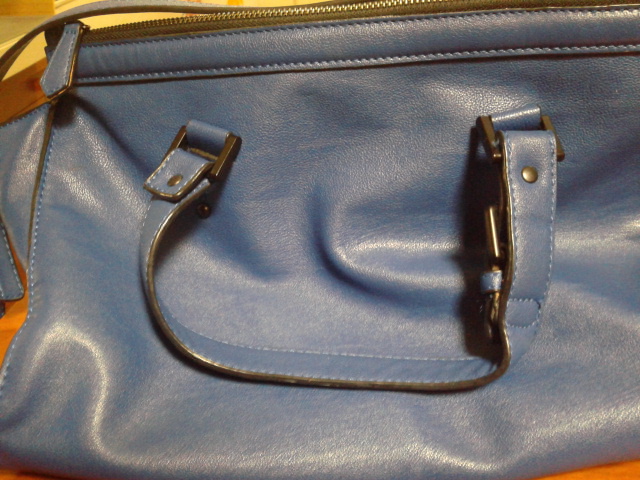
Suitable bags:The bag I use is big and fits books that are A4 size. There are pockets and it also has a shoulder strap.

Big bag

Teacher essentials:

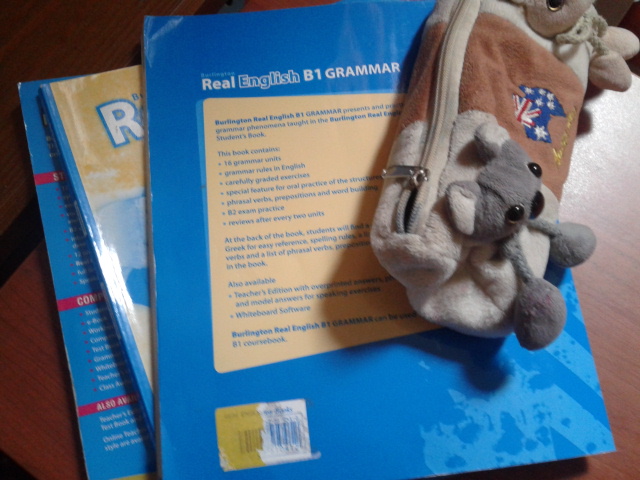
  • Books
  • Pencil case
  • CDs
  • Stickers
  • notebooks

Books and pencil case

Other Stuff- girlie clutter :p

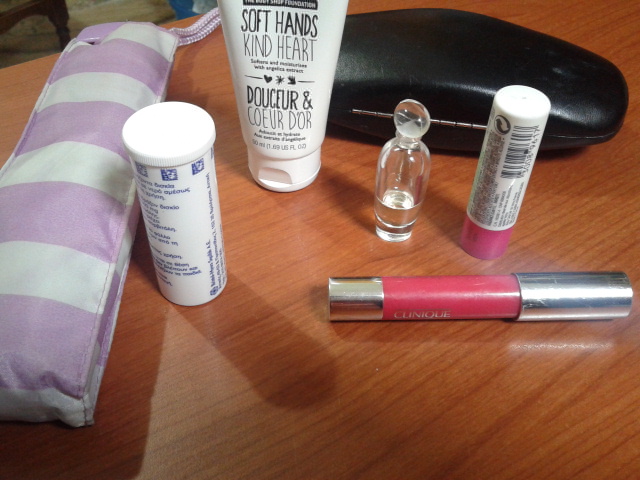
  • Paracetamol. I often get headaches ( I wonder why), so I always have Paracetamol in my bag. I like the one that dissolves in water.
  • Hand cream that smells nice. I don’t know about you guys but I think that a teacher’s hands need to be groomed and smell nice. Also, my skin is quite sensitive, so I always need to moisture them. My favorite nice scented hand creams are one I got from Boots and it’s a small size hand cream from a brand called Sanctuary and one from the Body Shop. Both smell great and very often my students say,”Can I put some on as well miss?”
  • Perfume (the little samples). My favorite perfume? Ones that smell likes roses (Chloe Rose is really nice)
  • Lip balm/ lip stick. Lip balm is necessary cause lips get dry and lip stick goes away quickly, so I need some to touch up my makeup. I am going through a chubby stick makeup phase. Chubby sticks are like pencils (just chubbier) so you don’t really need a mirror to apply them! Loads of brands are available. I like the Clinique ones.
  • Sun glasses
  • Tissues
  • An umbrella (Yes, it does rain in Crete)
  • A purse
  • My phone and the charger (those smart phones run out of battery so quickly)
  • Chewing gum (I don’t chew gum during lessons, but I do afterwards)

makeup

My bag ends up weighing 100 kilos, and then I get back pains  :p

That’s all folks.

Talk soon xx

Avoiding burnout

When the going gets tough…….

                                                    find a hobby

So, there is a fine line between being a teacher and being a normal person. Now, if you are not a teacher, you will not get this, but if you are, you will. I don’t make sense. I know. So, I will make it simple. When you are a teacher, it’s hard to switch off. So, you are a teacher 24/7.

For the past few months, I have been complaining, even whining about how I work all day, I have no free time, yada, yada, yada. It is my choice. I love my job, but yet I complain. It’s a thing I do.  I decided to find time and do something I like or at least try something new. My friends suggested taking up painting. And we did. Apart from the fact that my teacher has her studio right opposite The Body shop and Sephora (how cool is that?) which allows me to do my 2nd favourite thing, shop, I also found out that I really like painting/drawing. Seriously. Time flies. I have no idea how quickly it goes by. I spend 90 mins drawing and it is the most ‘into’ something I have been for a while.

I go to class feeling a bit idle, lazy. Then I start drawing and it’s fantastic!! Of course, I am not going to turn into a painter any time soon, but I am doing something I like and learning at the same time. My conclusion?If you find work has taken over, get a hobby. I can promise you this, when I am painting, I do not think of conditionals, the passive or CCQs.

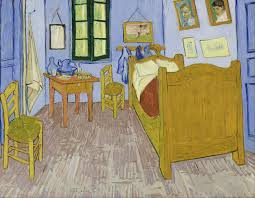
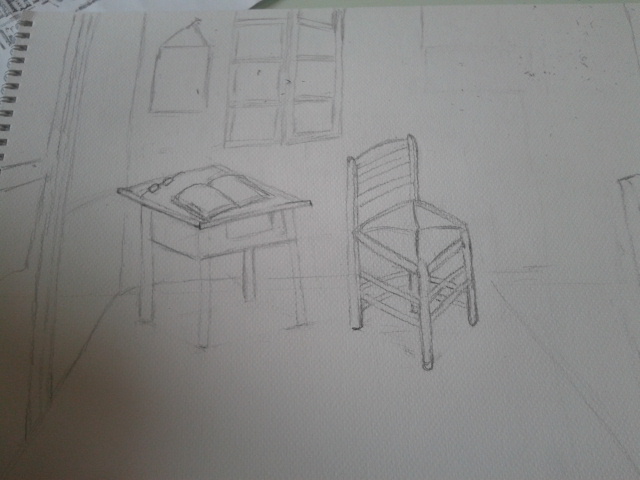
Bedroom in Arles

                                              Van Gogh’s Bedroom in Arles  Picture taken from here  

My 1st drawing

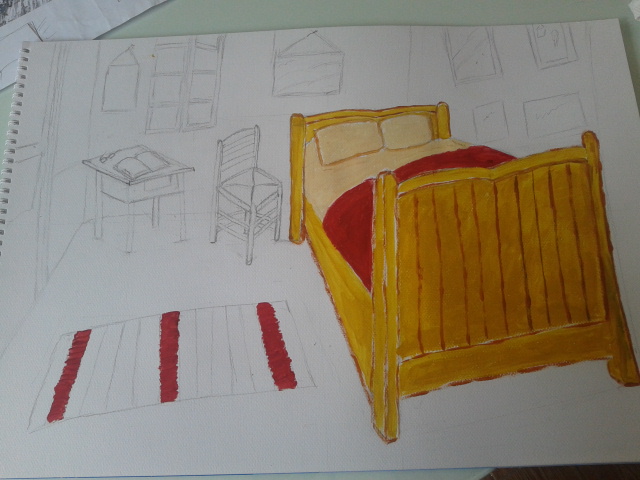
I am adapting Van Gogh’s Bedroom in Arles (picture above). Only mine is a teacher room. That’s what my painting teacher said when she saw what I had changed. Instead of drawing a glass, a jug and a brush on the table (see original), I drew a book and a pair of glasses (instinctively) which of course goes back to the first paragraph of this post. When you are a teacher, you do it 24/7. I am a ‘wannabe’ painter teacher : )

My 1st drawing My first drawing

This is what happened a few drawing/painting lessons later

Till next time……

2 years of Blogging

IMPORTANT NOTICE: My blog is called my ELT rambles. This post is just that. A big fat ramble. I take you down memory lane, I give blogging tips. I talk about a massive failure, I brag. So, consider yourself warned. If you still want to go on reading, well, thanks : )

When I decided to give my blog a makeover and move from Blogger to Word press, I realized that I have been blogging for 2 years and a few days.

My first blog post was written on the 14th of February (Valentine’s day. Maybe that’s where all the blog loving comes from). Many things have changed since I started so, I decided it was time to go down memory lane. I started blogging as a way to reflect. Now, I blog cause it’s a way to express myself, share my views.

1st blog post

                                     My first blog post

So, if someone asked me, “What advice would you give to someone who wants to start blogging about teaching?’’ This is the list of my Top Tips

Tips for newbie bloggers

  • Write systematically
  • Be yourself

Don’t write things you think will be ‘proper’ just for the sake of being ‘proper’. Be truthful, be yourself.

  • Write about things you are interested in

When you are interested in something, that’s when magic happens. When you write about something you love, your readers will know and will probably enjoy your posts.

  • Promote

If you want people to read your posts, you need to promote them on Twitter, Facebook and any other types of media. The more you promote, the more people will know about your posts.

  • Keep a notepad next to your bed

I know this sounds nuts, but after asking other fellow bloggers I know that this is something that happens to everyone. Some ideas pop into your head when it is night time, when you are sleeping. That’s why you need a note pad.

  • Etiquette

You need to be polite online, just like you are offline. It’s as simple as that.

  • Read and comment on other people’s blog posts

If you like writing posts, you will probably enjoy reading posts written by other teachers. If you like reading comments, you should comment on the stuff you like reading and share your views. Some of the comments written on my blog posts are fantastic! I  ❤  comments

  • Proof read/edit and then edit more

I am actually not the most careful of writers. I often get consumed by my enthusiasm. I am happy I have written something. I read it once, read it again, and then I publish. As a result, my posts  often have little errors, typos etc. I usually end up correcting them after a while (either cause I or someone else has noticed it).

Baby steps…. Moving to Word press

Why I moved from Blogger to Word press

I liked Blogger but after asking other bloggers, I found out that most people like and use word press, so I moved. Moving is quite easy. Blogger allows you to export all your posts and then you can import them into Word press. Unfortunately, some comments may get lost, you also lose your followers and page views (hm I do wonder about the truth in page views, but that is not really the purpose of this post). Some of your videos or embedded Pdf files  may need to be uploaded again. On the whole though, the moving process is quite easy.

I like my blog’s new home

I like the theme. It looks a bit more ‘sophisticated’. I like how there is a like button, so you can see which bloggers enjoyed reading your posts. Commenting is much easier and so is promoting your posts. I still have things to learn but I am getting there, I think and anyways, it only took me 2 years to get the grip of blogger. Don’t expect miracles!!!

Tooting me own horn

Yeah, I am going to brag a bit here, so bear with me. I am not doing it in the bad way, just a good way. Just trying to inspire you, the non-blogger, to turn into a blogging monster like me : p. Since I started blogging, some really cool things have happened.  First of all, I have learnt loads and have pushed myself to get informed more about ELT related topics. I think blogging has made me a better teacher or at least a teacher with more ideas!

Other bragging points

My blog posts have been shared, linked to other websites and re tweeted. I really appreciate the time and effort that takes. All teachers are busy, so when someone takes the time and shows they have appreciated something I have written, that makes me really happy. I have never won a blogging award, but I have been nominated for a couple. I have written a few articles for newsletters (all of them will be published this year. That’s really exciting) and I was also asked to write a really exciting guest blog post (to be shared soon). My online friends have also increased. I am ‘meeting’ people from around the world and they are sharing their views with me. This is amazing! I also get to talk about girlie  ELT stuff (yeap, I am making this tab a regular, so beware). I was sent a book to review as well. That’s cool (haven’t read it yet, but I am getting there, too). What am I trying to point out with this Me, Me, Me fest? Well, blogging may lead you to places you did not expect.

Adsense+ Jo = complete failure

Now, this part of my blogging history is embarrassing but hey, who cares? I added Adsense to Blogger. If you don’t know what Adsense is, it is a way to make money from your blog. How do you make money? People click on the ads on your blog. So, I had it for a week. That’s how long it lasted. I was banned for wrongful clicks or sth.  No more AdSense. Not a big deal though.  I don’t blog cause I wanna make money. If I wanted to make money, I would be teaching the extra hours I spend blogging.

Blog history

My least read article is this one: Teacher in La La Land (87 people read it according to Blogger. I liked writing it, not many people read it though).

Most popular blog post: Teaching Grammar like math (12.500 views according to Blogger. It was shared on the Teaching English British Council Facebook page which is why it was viewed by so many people).

So, what have I learnt these 2 years?

❤ ❤ ❤ ❤ I really like BLOGGING ❤ ❤ ❤ ❤

37098-pink2bcider