Video-Based session: Kindergartener’s ABCs save dad’s life

I am sharing with you an adaptation of a lesson I did for my Delta. This is a video-based lesson which is appropriate for learners who are upper intermediate level and above. It was part of a Task based learner lesson but now I have made adaptations so it does not really follow the stages of TBL. It is great for upper-intermediate learners. I used this lesson with my Ielts class and a Business English class in order to jazz things up. The skill practiced is speaking/listening(story telling ). Lesson length: 45-50 minutes.

You will find a downloadable detailed lesson plan, a PPT and a handout. I have also embedded the video. The video is from the webpage http://www.nbcnewyork.com and can also be found here

Sorry folks but my editing skills are not great + I am not aware of how you cut off codes which means that I was unable to cut the add off : (. On the bright side? The commercial only lasts for 14 seconds so keep that in mind when showing the video.

Task 1: T shows key words and asks sts for quick guesses about this story.    (5 mins)

Task 2: In pairs, sts plan the story based on the prompts and report back to the rest of the class. Once stories have been reported back to the rest of the class, they watch the story.    (10mins+4 mins video)

Task 3: Ss watch video again and make notes of the features of telling a story. This is followed by input about what makes a good story.  (9 mins)

Task 4:  Ss plan and tell their own story- theme: an emergency.  (12 mins)

Task 5: Setting H/W

Material

Here is the video

Here is the lesson plan:

TBL lesson plan (2)

Here are the task sheets:

Experimental session Task based learning (1)

* There is a little typo on the task sheet. Where I talk about story-telling skills I say “on chronological order” it is supposed to be in chronological order.

Here is the PPT:

Kindergarteners ABCs helps save Dad’s life

cropped-06976-10568955_10152692437432425_8792508551216274600_n.jpg

Till next time…….

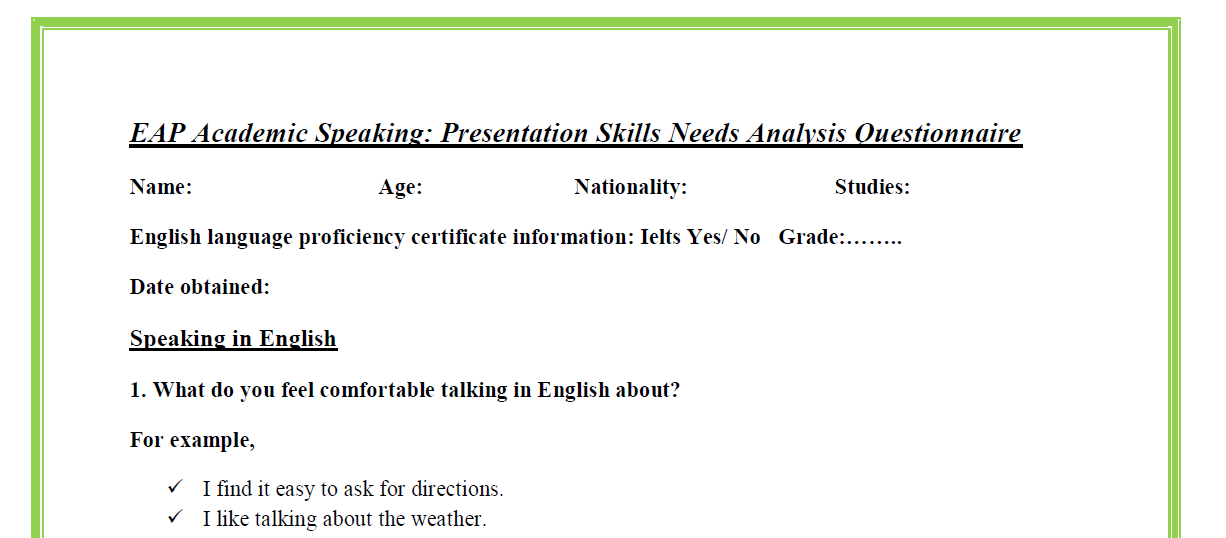
EAP Academic Speaking: Presentation Skills Needs Analysis Questionnaire

Here is a needs analysis questionnaire you may want to use with your EAP students when teaching presentation skills.  I teach pre-sessional EAP in the UK and my learners are international students who are doing an MA. I based the questions on this particular context. You may be able to use it with your learners as well if you teach EAP presentation skills. This questionnaire can probably be used with Business English learners as well, after a few adaptations are made to some of the questions.

Untitledeap questionnaire

You can find the questionnaire here:

EAP Academic Speaking (press open, save or save as)

Till next time……

Article-based lesson for Business English students

In today’s post I am using one article for two speaking lessons or conversational sessions. Before I move on, let me explain what I mean by a conversational session.  This is a lesson during which you share an article with your learner, and you just talk about the article. It is a freer type of lesson. If you see opportunities for linguistic development, seize them. If your learner asks questions about words or grammar points, go ahead and answer them. The main goal is to get the learner to talk though, have some sort of chit-chat session. This is for those days when your BE students are tired and want something more laid back. The fact that this is a lesson based on authentic material makes it more motivating for your learners.

You can use this material with your Business English students or even adult learners. It is more appropriate for learners who are B1+ and above. When I used it, we spent about 30-40 minutes reading and talking about it. The lesson is based on the BBC news article which can be found here
Lesson 1
Brief lesson description:
The lesson begins with some warmer questions and questions related to a picture. Students then move on to read the article in sections and answer the questions following each section.
Lesson 2 
Brief lesson description.
If you have two or more learners, why not try jigsaw reading? What you can do is cut the text in two pieces. Put your students in pairs. One student reads one part of the article and takes notes, the other student reads the other half of the article and then takes notes. Once both students have read and taken notes of their halves, you take away their articles and then tell them to summarise the whole text and tell it to you.My experience  using this article:

This article got my learners talking initially about the Barbie doll and information related to this childhood toy (contoversial and non-controversial). We then talked about big companies making mistakes in marketing, the marketing of toys etc. We also discussed the Chinese market and the difference between the Chinese and European customer/ market.


The Lesson

Warmer
questions:
1. When you
think of childhood toys which ones come to your mind? Are there any you
associate with girls?
2. Look
at the picture. What do you think the article is about?
3. The
title of the article is
Can Barbie conquer China. Tell your teacher what you think the
article is about.
4. What
steps would you take in order to promote the Barbie doll in China?
 
Can
Barbie conquer China article from BBC news (Business) link found here
At 36,000 sq ft it
must have been the biggest Barbie house ever created.
In 2009 the world’s
largest toy maker, US firm Mattel, set its sights firmly on the Chinese market,
opening a flagship store in Shanghai.It was using a toy
that in her 50 years had conquered all before her.
Created in 1959,
Barbie is today sold in 150 countries and has won the hearts and minds of
little girls as far afield as Mumbai and Buenos Aires.
She has thrived
almost everywhere, despite regular criticism from feminist groups who have
decried her influence on young girls’ body image and ambitions. Even in markets
where she is triumphant Barbie
continues to court controversy.But it is in China,
arguably the most important consumer market in the world, where the
all-conquering doll has stumbled on her kitten heels.
The Shanghai Barbie store closed in 2011, just two years
after its grand opening.
Now, as Barbie
attempts to crack China once again, has Mattel learnt from its earlier failure?
 
Questions
1. When did Mattel
first open a store in China?
2. Was the opening
of the store successful?
3. Think of reasons
why the launching of the store was not successful and tell your teacher.
 
Now read the next
part of the text


Barbie’s CV
  • On 9 March 1959 Barbie was unveiled at the New
    York Toy Fair; the date is her official birthday
  • Barbie’s full name is Barbara Millicent
    Roberts
  • Mattel claims she has had more than 150
    careers
  • She became a business executive for the first
    time in 1985 and an astronaut in 1965
  • More than one billion Barbie dolls have been
    sold around the world
Questions:
1. When’s Barbie’s
birthday?


2. How many careers
has she had? Can you name a few?
Now, read on.


Trouble in store
The 2009 opening of
the Shanghai store was not done by half measures.
It was not so much
a shop as a lifestyle concept.
A grand spiral
staircase surrounded by more than 800 different Barbies climbed the building.
And it was not just aimed at children.
                           The entrance to the spa at the now
closed Shanghai Barbie store
Mattel was
marketing the Barbie lifestyle to women in their 20s.
Clothing lines for
women as well as young girls were part of the key products. 
Real life
brides-to-be were invited to coo over a Vera Wang Barbie wedding dress. 
“It was
confusing,” says Benjamin Cavender of China Market Research Group. 
“No-one knew
what the brand stood for and so instead of going for cute they went towards
sexy.” 
As well as clothes
and design-your-own dolls, shoppers could eat in the Barbie restaurant, relax
in the Barbie Spa and drink in the Barbie cocktail lounge.
But the problem was
not enough people knew who Barbie was. 
“It wasn’t
like in other countries where generations of women had grown up with
Barbie,” Mr Cavendar says.
“They created
this massive experience but not enough people came to find out about it as the
concept of Barbie wasn’t a pre-existing draw in China.”


Question
1. What were some
of the problems with the Barbie store?
Now, read on.


Don’t think pink
The massive store
was located on Huaihai Road, one of the most prestigious shopping streets in
Shanghai.
But on the ground
floor it was not clear to anyone passing exactly what was inside – you had to
enter the store and climb an escalator to feel the impact of the design.
Plus a pink light
shone outside. In China, a pink light district is associated with a much more
adult style of trade than selling toys and clothes.
And despite the
location being sought after, it wasn’t easily accessible for shoppers.
“There was
nowhere to park your car and it was not near a subway station,” says Mr
Cavender. 
“If you can’t
get to it and you don’t already know about Barbie, you’re just not going to
go.”
 
Question:
1. What was the
problem with the colour of pink?


2. Are there any
other problems regarding the location of the store mentioned in the article?
Now, read on.


Too frivolous?
“Joy and
learning are like oil and water in China,” a Mattel executive recently
told the Wall Street Journal.
His point was that
the first time round Barbie may have been too frivolous for the Chinese market.
The toy market in
China, however, is big – and growing.
Between 2009 and
2013, it nearly doubled in size to be worth about £5.5bn (53.8bn yuan; $8.7bn),
according to Euromonitor.
Video games are far
and away the biggest category in the market.
But Mattel has done
well – as a company it is the fifth biggest toy maker in China with 1.4% of the
overall market.
Its most successful
offering is the more learning-oriented Fisher Price brand, the 14th biggest toy
brand in China, according to Euromonitor. And Barbie could be going the same
way.
 
Question
1. What do you
understand by the phrase “Joy and learning are like oil and water in
China”
a. oil and water
mix well.
b. oil (learning)
is heavier/ more important than water (joy)
c. learning and joy
do not go together


2. What games are
popular in China?
Now, read on.


Barbie’s back
In 2013 Mattel
brought Barbie back to the Chinese market. Only this time instead of clothes by
Oscar De La Renta she had a violin and you could buy Barbie for the much more
affordable price of $13 (£8.20).
This year there was
another launch – a “specialty” Barbie doll in the likeness of Chinese
actress Fan Bingbing.
Heralding the
launch of the doll Mattel declared: “[Fan Bingbing’s] collaboration with
Barbie will give purpose and meaning to play and help ignite the spark inside
girls across China to ‘Shine Your Way’.”
So it’s clear that
Barbie has learnt that to succeed in China today you have to have a sense of
purpose, but then she didn’t get the keys to the super-deluxe dreamhouse and
the perfect boyfriend Ken by being just a pretty face. 
                                                                           Fan Bingbing, the
face of Barbie in China in 2014
 Question
List the changes Mattel made to the
launching of the Barbie doll in China

The article and pictures were taken from the BBC news website. The Questions are my own creation.Enjoy the session and please let me know how it went : )

Sorry for the formatting and layout of this post, but it was originally posted on my other blog (Blogger). As I am moving everything to my wordpress blog, I moved it here and this is what it looks like!!

Till next time…..

My melt down

Blogging is cathartic, it liberates you. Big phrases eh? Well, blogging for me is like writing in my own professional diary!! So, here is my melt down. Here is my story. It ain’t pretty.

Have you ever had a lesson that was your “worst lesson ever” ?OK, so keep that in mind. Now, think of how that lesson could have been worse. Do you have the image in your head? OK, so I am trying to create an atmosphere. Get your mug of coffee and read on.

I had one of those lessons the other day. One of those lessons where you feel like it can’t get worse than this!! The  bad-est lesson eva! I think the word badest needs to exist cause you get bad and then the suffix -est accentuates it!

So, I, the super duper teacher, sat on my super duper chair, in front of my super duper pc to give a super duper online grammar lesson. I do consider myself kinda a grammar queen. I thrive when it comes to teaching grammar or do I?

My learner hates grammar. He is a B1 level adult learner and we have online lessons once a week. My learner has said this (I hate grammar) many, many times, but this learner ended up requesting a grammar lesson, and we had one. It was an overview of the tenses. Unfortunately, this grammar overview did not end in one teaching hour. We had to finish it off in the next lesson. My learner was fine with that. Second grammar lesson day came. Everything was going great until the learner got tired of the lesson and half way through decided he was not going to move to the production stage. The question I asked was, ” What did you eat yesterday?” No answer. In fact, my learner said, ” I want to think about this”

Me: ” OK”

Learner: ……. thinking….. thinking……

4 mins later

Learner: ” No, I cannot answer this question. I have not revised the tenses.”

Me: “Oh! That’s OK. Don’t worry about mistakes. I just want to see how you talk about things that happened yesterday, in the past.”

Learner: “No. I haven’t revised”.

Me: ” OK. Let’s talk about something else then. What will you do on the weekend?”

Learner: ” I cannot answer the question because I have not revised the grammar”.

Me…. starting to sweat in my super duper chair. I needed to do something otherwise we would have a staring contest….. online.What did I do? I completely changed the lesson. I dropped the questions cause I felt like a dentist pulling out my learners tooth and moved on to an article based lesson. We read an article and answered a few questions that were based on the article.

The lesson came to an end and we both went our separate ways. I went and made a big cup off coffee and grabbed a box of cookies. I was going to eat my sorrow and think.

Thoughts

Maybe I shouldn’t have turned a one hour lesson into a two hour grammar lesson with this particular learner. I should have treated the lesson like a Band-Aid and pulled it off quickly, but I am not a rush- rush teacher. I spend time on tasks and timing as in, sticking to the lesson plan/syllabus,  is not as important as understanding.

When my learner said, ” I don’t want to talk because I haven’t revised” I should have gotten the message. My learner actually is not very talkative and gets frustrated when I correct mistakes anyhow. Big mistake Joanna!! Seriously, what were you thinking?!?!?!?!

Maybe I should have done more controlled tense practice activities like gap filling. Well, my excuse here is that I panicked. I heard no to a simple question ( simple in my mind) and then stopped thinking clearly.

I think changing the focus of the lesson, allowing the learner to revise, and moving on to something completely different was the best solution in this case. This was an online lesson, so I could not  move around and ‘see’ my learner. Difficult teaching moments can be a bit more difficult when online. If I was in a class and saw that my learner was frustrated, I would stand up and say, ” OK! Let’s go outside and take a breather”.

I so dread the next lesson with this learner because he said he will revise and then he wants to do some more grammar. I think I will try to find a few alternatives though, just in case!!!

In retrospect, I think I still do not know how to properly react when a learner says, “I don’t want to do this”. Especially when this is something we have done as an ice breaker/warmer/chitchat, but never as a production stage of a grammar lesson.

Reflecting in front of the beach (Chania, Crete)

Reflecting in front of the beach (Chania, Crete)


I need to reflect…….

A few weeks later I wrote a blog post about what I ended up doing with this learner in the following lesson. If you want to read that post, press here

Till next time…..

100 Blog Posts later

1 is for the first time I blogged (February 2013).

0 is for the minutes I spent second guessing my posts ( my posts are me-no regrets).

0 is like a circle- it shows connecting. I am connecting with you, wherever you are.

Be real, be truthful, be myself (my motto these days). Accept and move on (this year’s motto).

Love writing, love blogging.

O M G the things I write in here (sometimes I wonder……I bet you do too!).

Going to keep going for as long as I can (that’s a warning   :p).

Please bear with me and be patient with my typos, my rambles, my wordiness, my silliness.

Oh! I have no idea what to write here    😀

Smiley faces and comments is what I like seeing in the comments section (comments-me like ’em).

Two hundred blog posts is the next goal.

So happy to be blogging and sharing my 100th post (Yay).

Yeap, yeap!! I reached 100 blog posts (if you count the guest posts it’s more) and I really don’t know how time flew by. I started without really knowing what I was getting into. I started in Blogger now I am in WordPress. I have written about my teaching, my life. I have been silly and serious.I am still here and I already know what my next post is going to be about! And because my previous post was “I know who I am, but who are you?” I added a bit of sound to my post! So, now you know what I sound like as well    😀

http://vocaroo.com/player.swf?playMediaID=s1jm7Huh93Ni&autoplay=0
Voice Recorder >>

daisy

Till next time…….

I know who I am, but who are you? : D

I attended Sandy Millin’s talk a few hours ago. It was about blogging and professional development. Among other things, she made suggestions about what to blog about, and one of her tips was to ask questions on your blog. This gave me an idea. In this post, I ain’t going to say much. I am going to ask a few questions, I have asked myself many times. Who are you? Yes, you, the person reading this post. I mean, I see numbers when I look at my blog’s stats. I know there are some courageous people in the world who actually read my posts, but in this post (my 99th post. Yay!), I would really appreciate it, if you took a minute to say hello, tell me where you are from/about yourself, and what you like reading in the ELT blogs you read.

Today’s post is for you, the reader. 

I am doing this cause I want to get to know the people who actually read my posts. Reading your comments really puts a smile on my face!

Oh! If you blog, add your blog in the comments section!!!!If you like reading blogs, mention them in the comments  section.


2015-05-17 20.07.07

I am really curious about this one………Also, kinda risky cause no one might comment :p.

Never say never

This is going to be short and sweet and of course non ELT-related. Even if someone tells you that you can’t do something, but you feel you can, do it. This is what my painting looks like. I have no idea what the colours are any more. I do not know how well they match. I used what I learnt about colours, my teacher helped me and I made something, even though I thought I couldn’t! Yes, there are loads of imperfections, and of course it could be ten times better but.. who cares? I did it 😀 Here is my first painting, and as I am colour blind, this is ‘my mountain’ and I kinda climbed it! Yay!

2015-05-19 13.16.41

Till next time…..

#Youngerteacherself Katherine Bilsborough’s Guest post

Thank you to Joanna Malefaki for inviting me to contribute to her ‘A letter to my younger teacher self’ blog project. I love writing. I work as a writer so am privileged to be doing my dream job. But this project gave me an opportunity to do some serious ‘thinking’ too (and some not so serious), which is always a valid pastime if you ask me. This letter is to my younger teacher self, when my children were toddlers, we were living in Madrid and the Basque Country and were rushing around like blue-arsed flies, trying to teach enough classes to make enough money to make ends meet.

Katherine old

 Hi Kath,

How are you doing? What do you mean you haven’t got time to read a letter? Make time! Life isn’t all work, work, work … and this is from Me, the most important person in your life! Besides, it’s about work … ah, that got your attention. I’m here to help. Advice from an older you/me. Read on, take heed … and life might be a tad easier. If I remember rightly, you’re obsessed with numbers right now so I might keep your attention if I organise this letter into 10 neat points. Are you still reading? … Good, thatta girl!

You might want to invest some time practising your board drawings in your spare time. If you haven’t got much time, just concentrate on your ‘bananas’ and ‘sausages’ … and maybe use a flashcard when you want to show a rocket.

banana

Ditch that paranoia! Your teenage students are not whispering about you and they aren’t laughing at you either. In fact you are one of the least important people in their lives right now … however important you might think you are.

Speak up when something isn’t right! Your silence will be taken as complacency and the people    around you are probably feeling the same. Change won’t happen until someone speaks out.

Get a Spanish teacher otherwise it will take you approximately 25 years to master the subjunctive. Seriously, get a Spanish teacher! No, seriously …

Keep a diary of your own children’s bilingual and trilingual developments. I know you think you’ll remember everything but you aren’t as super human as you think you are … and memories are selective.

You are spelling ‘pronunciation’ wrong! Yes, that’s right … there is no ‘o’ after that ‘n’. How can you be so daft? Don’t worry too much though. Someone will take great delight in telling you in about 20 years’ time and it’s always nice to brighten someone’s day.

And while we’re on the subject of spelling and pronunciation …

It isn’t ‘gaze bow’, it’s ‘ga zee bo’. And (you might find this bit hard to believe) you’ll actually say this word one day … in a very public place!

Coming back to the classroom …

Don’t worry so much about your students using their mother tongue in class. It is happening in every English classroom all over the country. If anyone tells you differently, don’t believe them! They lie!

Speak to experienced teachers about ‘the O word’. The main objective of an observation isn’t to catch you out … and the more O’s you have, the better teacher you will become.

And just to finish …

Don’t worry about spending approximately three hours preparing materials for each one-hour lesson. In the future there will be course books and resource books and a whole load of ready-made supplementary materials.

And besides, all this experience in materials writing might even come in handy one day!

Have a great life!

Me, XX

p.s. You’re doing an excellent job!

Katherine

Biography

Katherine is an ELT author. She writes for OUP, Macmillan, Richmond, Burlington and others. She also writes English courses for the BBC and the British Council. In her spare time she writes other stuff. She doesn’t write her own blog at the moment but she’s made an art of hijacking other bloggers’ blogs.

Thanks for writing Katherine

#Youngerteacherself Helen Waldron’s Guest post

A letter to my younger teacher self.

Dear Younger Helen,

Age writing to youth inevitably involves giving advice. So here goes.

Hold your head up high. You are doing better in a complex world than you give yourself credit for. After all, your generation never writes the rulebook.

Forget the acne, puppy fat, cheap clothes etc. too. You’re young and therefore automatically beautiful.

Hold your head up in your job too. There’s a lot that needs changing in EFL, but it’s rarely the teachers. Now as then, EFL is a profession full of highly dedicated individuals being dragged through the mud and exploited at every turn. This is partly because of the fragmentation of the profession, and unfortunately not much has changed here. Many of us are still working freelance in foreign countries, still struggling to find out our rights and exercise them. You know how hard it is to frame the right questions in a foreign language and to be heard and taken seriously. The good news is that there will be something called the internet, which will mean untold free resources, less professional isolation, and the chance to hear and read English again. Remember when you despaired of your own ability to speak and write, let alone teach, your mother tongue? The internet will be the lonely EFL teachers’ friend.

Don’t worry, I’m not going to advise you to form a union for teachers’ rights because you’re still going to be teaching English in Germany 30 years later. What twenty-something wants to know that?

Well done for working at one of the more famous language schools for a year and then leaving. Once you learn some German, the management can’t thrust long, incoherent documents at you to sign, and you’ve done your apprenticeship, so it’s a win-win situation. Tell other teachers to do the same. Go. Do your own thing. One lesson without the middleman may see you earning the same money as a morning of language school classes. You will meet teachers in their 70s who insist that they still teach because they love it. Fair enough, maybe it is their hobby, but if the real reason is that they are poor, despite decades of working like a dog and living like a student, well, maybe they should be more honest. They need to hold their heads up too. Maybe they should be forming a union for the next generation.

Regrets, Young Helen, I’ve had a few, but then again, too few to mention.

  1. Do you have to be so bad at maths that you will shy away from negotiations that would further your career?
  2. Do you have to retreat into “ladylikeness” when all around you are letting rip (and getting heard)? It’s the culture, stoopid. People say what they mean in Germany, and if women aren’t supposed to have opinions – oh well, I suppose you’ll learn with time.

Congratulations on your perseverance and not walking out in disgust when Unknown HR decides to replace you with a language school (and later a computer program). Your students will stick up for you and Unknown HRs have a habit of changing jobs every two weeks anyway.

I’m happy you always try to understand your students and work out how best to adapt the lesson to their needs. After that first language school year, you will always be lucky enough to be able to teach in your own style, with the confidence to pick and choose your own resources.

You’ll be lucky enough to have children too, so have a break! There is a downside to perseverance, you know. You’ve no idea how hard it will be, holding down a contract-free job in white, male, corporate Germany. Your students will be sweet, but they won’t understand that you have been up all night with the baby before standing in front of a class at 7.30am. And going to work again at 5p.m. seems even more like a ten day week without sleep. You’ll end up paying the childminder more than you earn. It will make you ill and young mothers can do without the ignominy of trying to deny pregnancy and motherhood when Unknown HR is looking for reasons to reduce the number of freelance teachers in the company. (This is not a criticism: Unknown HR will arguably save the parent company up to €3.50 a year, which will be converted into some miraculously aspirational statistic and lead to Unknown HR’S next promotion).  Without a job to return to you will be fearful for the future, but you owe it to yourself to hold your head up as a mother too.

Try to learn something new once a year. Try to be creative despite working in a conservative environment. Be open to new ideas, but don’t forget your common sense. Don’t be ashamed if you can’t afford the courses you would like to be taking because you have to i) pay for them yourself and ii) take time off work (and thus not get paid). This is not your fault and you can learn a lot by reflecting on your own experience and on the experience of those around you.

And that’s about it.

Just do your best.

The Older Helen

 helen

Biography

Helen Waldron www.helenwaldron.com is an English Language Coach working in-company in the Hamburg area of Germany. She writes a blog (www.speakeasyandwritewell.wordpress.com) about two fictional English trainers.

Thanks for writing such a lovely post Helen.

Joanna

When the going gets tough, it’s TTG


Nice title, eh? I guess you are wondering what TTG means. It’s Time To Go. So, that’s my title. When the going gets tough, it’s time to go. Today I will tell you a story about a girl who wanted to be a big boss, to conquer the world of  business. But we don’t always get what we want, do we?

In 2007, after more than 10 years of teaching, I thought it was time to take the next step. Go up the career ladder and open up my own private language school. I was very excited, so was my sister. We were going to be partners. We were going to make something that was ours. We looked for a building to rent. We found one close to my house. We then furnished it and opened the school in September of 2007. During our first year we had 27 students. That was great. We had small sized classes, we did lots of extra curricular activities with students like parties for Christmas, birthday parties etc. I spent lots of Sundays teaching exam classes. They were free lessons aiming at helping my learners. It was a successful year. We were happy, our students were happy. Things were going to be super the next year.

They weren’t. While there was a small increase in the number of new students, I also had losses. Students finished their training or moved away. I pretty much had the same number of students. This is when some of my student/ customers started having money issues. recession and the financial crisis in Greece was knocking on the door. People started owing money/tuition. I did not send them home though, they were my kids. I kept them in their classes and continued to issue receipts for money I was not earning. The law  says that you must issue a receipt for the student at the end of every month, even if the student has not paid. You also pay tax for this student. This policy is based on the assumption that you will eventually get your money. I wasn’t.

To make matters worse, my expenses were piling up. My school was open 9 months a year and shut during the summer. I still had to pay rent for the months the school was shut.

2009-2013 were pretty much the same story. I now had about 40 students but the competition was killing me. There were new language schools in my area, charging peanuts for classes. I had to do the same. Of course, Greece was going through the financial crisis and people stopped taking language classes. This is when I started to lose my drive, so did my sister.

I was trying, trying and not seeing any results. Don’t get me wrong, I was happy with my lessons and my kids were great, but I couldn’t make ends meet and that was very disappointing. I did not have any more energy. I had had enough. I tried for 7 years and was not going to try anymore. In September 2014, my sister and I decided we were going to shut down the business. And we did.

I actually found myself ‘mourning’ the business. I had put my heart and soul into something that failed. I felt like a failure.

In retrospect, I think I approached the whole language school with a lot of enthusiasm but no marketing or business skills.

My mistakes……..

I opened a business in an area that already had many language schools. I was far away from actual schools. I was paying a high rent and a lot of tax. When I started the business, I did not have a financial plan. I did not do any market research. I did not actually do any research. I was naïve.

I found it very difficult to ‘sell’ my services. I was not at all aggressive. I was probably a pushover business woman.

I treated my students as my kids, not customers. This is nice and fuzzy, but it does not pay for the bills. Love alone, does not cover the expenses.

What about my teaching? Had I done enough? I thought I was doing a good job, but was I? Was this why the business was not successful?  I will never know.

I am aware of the fact that I am casting blame on everything else and not really myself, but the latter is hard. I am stubborn in that way.

Today

It is about 8 months later, and now the language school is a memory of the past. I tried it, it didn’t work, I moved on. On the plus side, I have more free time, and financially I am much better!!! I am free of something that was a dream and at the end, became a burden. Oh well, life is all about trial and error, isn’t it? Been there, done that.

Acknowledgements

Vedrana asked me what it was like to run a business and suggested I write a post, so here it is.

TTG is Eri’s phrase. I like it. I use it 🙂

2015-05-10 15.17.41

Till next time…..