The 2nd Conditional Lesson Plan

This is a grammar lesson which focuses on teaching the 2nd conditional to intermediate level students. What ties the lesson together is this grammatical structure. There are different themes and it practices listening, speaking and writing.

Props:

Youtube video of Jennifer Lopez’s song.

Picture of a cave.

Pictures of random items that can ( or cannot) be used when stranded in a cave.

You may also want to download a very detailed lesson plan (adaption of one of my Delta lesson plans), the handouts, the PPT.

So, let’s have a look at today’s lesson plan.

Very brief lesson plan:

Level: intermediate/upper intermediate

Length of lesson: 45-50 minutes

Task 1: Teacher plays 40 seconds of Jennifer Lopez song  “If you had my love'”and asks students to fill in the missing gaps (time 4 minutes).

Task 2: Teacher shows students the lyrics of the song (2 minutes).

Task 3: Teacher gives students handout 2 and asks them to fill in the formation of the 2nd conditional based on the song (2 minutes).

Task 4: Students  say what they think the guy would say to JLo  and practice forming the affirmative and negative form of the 2nd conditional (5 -6 minutes).

Task 5: Teacher shows the formation of the 2nd conditional on PPT and elicits students’ understanding of the meaning of the 2nd conditional (3 minutes).

Task 6: Teacher gives handout 3 which is a matching exercise that practices the 2nd condtional (3 minutes). Teacher shows answers on PPT.

Task  7: Students do a consequence chain task (10 minutes). Instructions+ example available on PPT. Teacher collects consequence chains and offers feedback in a following class.

Task 8:  Simulation activity: Students imagine they are stranded in a cave. Students use the picture cards the teacher has given them and say how they would use these items to get out of the cave or to survive in the cave (13-15 minutes).

Material

Find the PPT here

Find the tasks here

pdf task 3

Find lesson Plan here

Lesson Aims

Find word cards here

Items

Let me know what you think of this 1st lesson plan, will you? Make suggestions for the next lesson plan if you wish.

Till next time………

Video-Based session: Kindergartener’s ABCs save dad’s life

I am sharing with you an adaptation of a lesson I did for my Delta. This is a video-based lesson which is appropriate for learners who are upper intermediate level and above. It was part of a Task based learner lesson but now I have made adaptations so it does not really follow the stages of TBL. It is great for upper-intermediate learners. I used this lesson with my Ielts class and a Business English class in order to jazz things up. The skill practiced is speaking/listening(story telling ). Lesson length: 45-50 minutes.

You will find a downloadable detailed lesson plan, a PPT and a handout. I have also embedded the video. The video is from the webpage http://www.nbcnewyork.com and can also be found here

Sorry folks but my editing skills are not great + I am not aware of how you cut off codes which means that I was unable to cut the add off : (. On the bright side? The commercial only lasts for 14 seconds so keep that in mind when showing the video.

Task 1: T shows key words and asks sts for quick guesses about this story.    (5 mins)

Task 2: In pairs, sts plan the story based on the prompts and report back to the rest of the class. Once stories have been reported back to the rest of the class, they watch the story.    (10mins+4 mins video)

Task 3: Ss watch video again and make notes of the features of telling a story. This is followed by input about what makes a good story.  (9 mins)

Task 4:  Ss plan and tell their own story- theme: an emergency.  (12 mins)

Task 5: Setting H/W

Material

Here is the video

Here is the lesson plan:

TBL lesson plan (2)

Here are the task sheets:

Experimental session Task based learning (1)

* There is a little typo on the task sheet. Where I talk about story-telling skills I say “on chronological order” it is supposed to be in chronological order.

Here is the PPT:

Kindergarteners ABCs helps save Dad’s life

cropped-06976-10568955_10152692437432425_8792508551216274600_n.jpg

Till next time…….

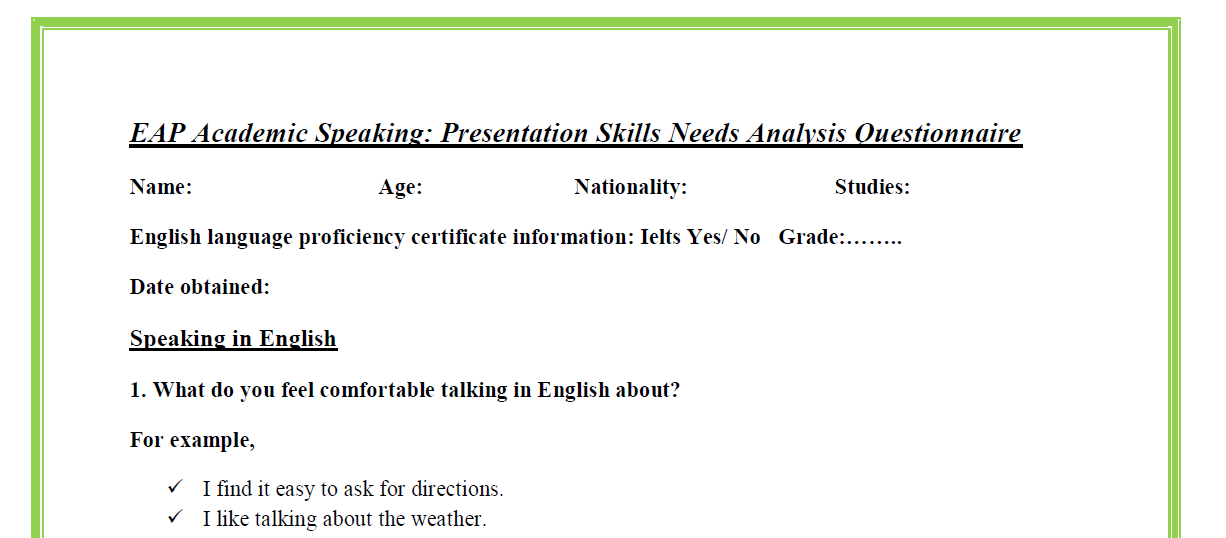
EAP Academic Speaking: Presentation Skills Needs Analysis Questionnaire

Here is a needs analysis questionnaire you may want to use with your EAP students when teaching presentation skills.  I teach pre-sessional EAP in the UK and my learners are international students who are doing an MA. I based the questions on this particular context. You may be able to use it with your learners as well if you teach EAP presentation skills. This questionnaire can probably be used with Business English learners as well, after a few adaptations are made to some of the questions.

Untitledeap questionnaire

You can find the questionnaire here:

EAP Academic Speaking (press open, save or save as)

Till next time……

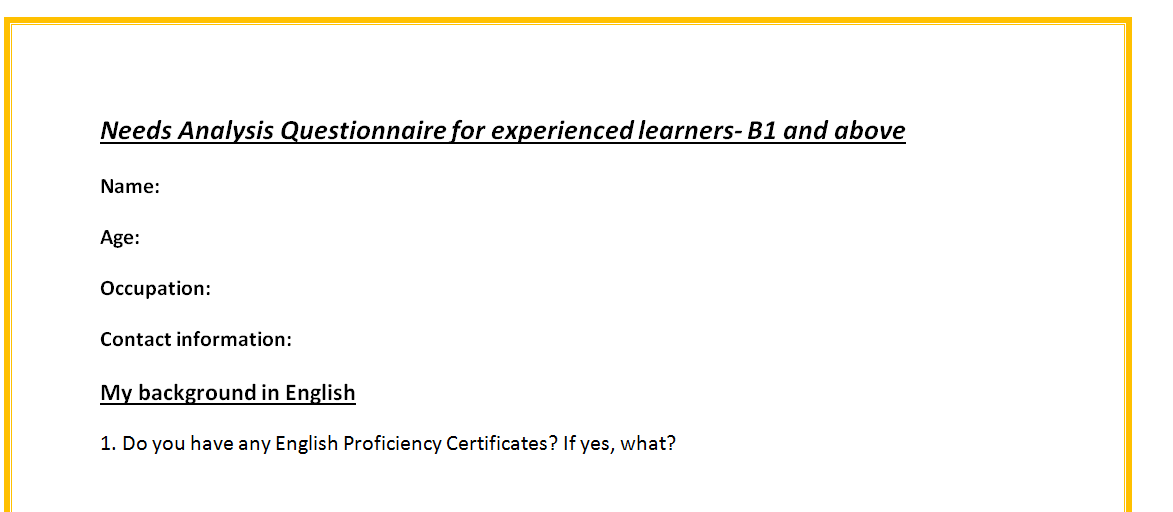
Needs Analysis Questionnaire

Here is an example of a short  questionnaire you can give your learners before the first or during the first lesson.

Context: Experienced learners who are B1 level and above (most likely adults who have had English lessons before) . They have probably already had lessons and have contacted you because they want to improve/review their English. This is a very basic questionnaire. I have included a few open-ended questions in order to see the learners’ writing skill as well.

Needs analysis pic

Questionnaire

The questionnaire can be found here: Needs Analysis Questionnaire for experienced learners.


Till next time…..


Article-based lesson for Business English students

In today’s post I am using one article for two speaking lessons or conversational sessions. Before I move on, let me explain what I mean by a conversational session.  This is a lesson during which you share an article with your learner, and you just talk about the article. It is a freer type of lesson. If you see opportunities for linguistic development, seize them. If your learner asks questions about words or grammar points, go ahead and answer them. The main goal is to get the learner to talk though, have some sort of chit-chat session. This is for those days when your BE students are tired and want something more laid back. The fact that this is a lesson based on authentic material makes it more motivating for your learners.

You can use this material with your Business English students or even adult learners. It is more appropriate for learners who are B1+ and above. When I used it, we spent about 30-40 minutes reading and talking about it. The lesson is based on the BBC news article which can be found here
Lesson 1
Brief lesson description:
The lesson begins with some warmer questions and questions related to a picture. Students then move on to read the article in sections and answer the questions following each section.
Lesson 2 
Brief lesson description.
If you have two or more learners, why not try jigsaw reading? What you can do is cut the text in two pieces. Put your students in pairs. One student reads one part of the article and takes notes, the other student reads the other half of the article and then takes notes. Once both students have read and taken notes of their halves, you take away their articles and then tell them to summarise the whole text and tell it to you.My experience  using this article:

This article got my learners talking initially about the Barbie doll and information related to this childhood toy (contoversial and non-controversial). We then talked about big companies making mistakes in marketing, the marketing of toys etc. We also discussed the Chinese market and the difference between the Chinese and European customer/ market.


The Lesson

Warmer
questions:
1. When you
think of childhood toys which ones come to your mind? Are there any you
associate with girls?
2. Look
at the picture. What do you think the article is about?
3. The
title of the article is
Can Barbie conquer China. Tell your teacher what you think the
article is about.
4. What
steps would you take in order to promote the Barbie doll in China?
 
Can
Barbie conquer China article from BBC news (Business) link found here
At 36,000 sq ft it
must have been the biggest Barbie house ever created.
In 2009 the world’s
largest toy maker, US firm Mattel, set its sights firmly on the Chinese market,
opening a flagship store in Shanghai.It was using a toy
that in her 50 years had conquered all before her.
Created in 1959,
Barbie is today sold in 150 countries and has won the hearts and minds of
little girls as far afield as Mumbai and Buenos Aires.
She has thrived
almost everywhere, despite regular criticism from feminist groups who have
decried her influence on young girls’ body image and ambitions. Even in markets
where she is triumphant Barbie
continues to court controversy.But it is in China,
arguably the most important consumer market in the world, where the
all-conquering doll has stumbled on her kitten heels.
The Shanghai Barbie store closed in 2011, just two years
after its grand opening.
Now, as Barbie
attempts to crack China once again, has Mattel learnt from its earlier failure?
 
Questions
1. When did Mattel
first open a store in China?
2. Was the opening
of the store successful?
3. Think of reasons
why the launching of the store was not successful and tell your teacher.
 
Now read the next
part of the text


Barbie’s CV
  • On 9 March 1959 Barbie was unveiled at the New
    York Toy Fair; the date is her official birthday
  • Barbie’s full name is Barbara Millicent
    Roberts
  • Mattel claims she has had more than 150
    careers
  • She became a business executive for the first
    time in 1985 and an astronaut in 1965
  • More than one billion Barbie dolls have been
    sold around the world
Questions:
1. When’s Barbie’s
birthday?


2. How many careers
has she had? Can you name a few?
Now, read on.


Trouble in store
The 2009 opening of
the Shanghai store was not done by half measures.
It was not so much
a shop as a lifestyle concept.
A grand spiral
staircase surrounded by more than 800 different Barbies climbed the building.
And it was not just aimed at children.
                           The entrance to the spa at the now
closed Shanghai Barbie store
Mattel was
marketing the Barbie lifestyle to women in their 20s.
Clothing lines for
women as well as young girls were part of the key products. 
Real life
brides-to-be were invited to coo over a Vera Wang Barbie wedding dress. 
“It was
confusing,” says Benjamin Cavender of China Market Research Group. 
“No-one knew
what the brand stood for and so instead of going for cute they went towards
sexy.” 
As well as clothes
and design-your-own dolls, shoppers could eat in the Barbie restaurant, relax
in the Barbie Spa and drink in the Barbie cocktail lounge.
But the problem was
not enough people knew who Barbie was. 
“It wasn’t
like in other countries where generations of women had grown up with
Barbie,” Mr Cavendar says.
“They created
this massive experience but not enough people came to find out about it as the
concept of Barbie wasn’t a pre-existing draw in China.”


Question
1. What were some
of the problems with the Barbie store?
Now, read on.


Don’t think pink
The massive store
was located on Huaihai Road, one of the most prestigious shopping streets in
Shanghai.
But on the ground
floor it was not clear to anyone passing exactly what was inside – you had to
enter the store and climb an escalator to feel the impact of the design.
Plus a pink light
shone outside. In China, a pink light district is associated with a much more
adult style of trade than selling toys and clothes.
And despite the
location being sought after, it wasn’t easily accessible for shoppers.
“There was
nowhere to park your car and it was not near a subway station,” says Mr
Cavender. 
“If you can’t
get to it and you don’t already know about Barbie, you’re just not going to
go.”
 
Question:
1. What was the
problem with the colour of pink?


2. Are there any
other problems regarding the location of the store mentioned in the article?
Now, read on.


Too frivolous?
“Joy and
learning are like oil and water in China,” a Mattel executive recently
told the Wall Street Journal.
His point was that
the first time round Barbie may have been too frivolous for the Chinese market.
The toy market in
China, however, is big – and growing.
Between 2009 and
2013, it nearly doubled in size to be worth about £5.5bn (53.8bn yuan; $8.7bn),
according to Euromonitor.
Video games are far
and away the biggest category in the market.
But Mattel has done
well – as a company it is the fifth biggest toy maker in China with 1.4% of the
overall market.
Its most successful
offering is the more learning-oriented Fisher Price brand, the 14th biggest toy
brand in China, according to Euromonitor. And Barbie could be going the same
way.
 
Question
1. What do you
understand by the phrase “Joy and learning are like oil and water in
China”
a. oil and water
mix well.
b. oil (learning)
is heavier/ more important than water (joy)
c. learning and joy
do not go together


2. What games are
popular in China?
Now, read on.


Barbie’s back
In 2013 Mattel
brought Barbie back to the Chinese market. Only this time instead of clothes by
Oscar De La Renta she had a violin and you could buy Barbie for the much more
affordable price of $13 (£8.20).
This year there was
another launch – a “specialty” Barbie doll in the likeness of Chinese
actress Fan Bingbing.
Heralding the
launch of the doll Mattel declared: “[Fan Bingbing’s] collaboration with
Barbie will give purpose and meaning to play and help ignite the spark inside
girls across China to ‘Shine Your Way’.”
So it’s clear that
Barbie has learnt that to succeed in China today you have to have a sense of
purpose, but then she didn’t get the keys to the super-deluxe dreamhouse and
the perfect boyfriend Ken by being just a pretty face. 
                                                                           Fan Bingbing, the
face of Barbie in China in 2014
 Question
List the changes Mattel made to the
launching of the Barbie doll in China

The article and pictures were taken from the BBC news website. The Questions are my own creation.Enjoy the session and please let me know how it went : )

Sorry for the formatting and layout of this post, but it was originally posted on my other blog (Blogger). As I am moving everything to my wordpress blog, I moved it here and this is what it looks like!!

Till next time…..

My melt down

Blogging is cathartic, it liberates you. Big phrases eh? Well, blogging for me is like writing in my own professional diary!! So, here is my melt down. Here is my story. It ain’t pretty.

Have you ever had a lesson that was your “worst lesson ever” ?OK, so keep that in mind. Now, think of how that lesson could have been worse. Do you have the image in your head? OK, so I am trying to create an atmosphere. Get your mug of coffee and read on.

I had one of those lessons the other day. One of those lessons where you feel like it can’t get worse than this!! The  bad-est lesson eva! I think the word badest needs to exist cause you get bad and then the suffix -est accentuates it!

So, I, the super duper teacher, sat on my super duper chair, in front of my super duper pc to give a super duper online grammar lesson. I do consider myself kinda a grammar queen. I thrive when it comes to teaching grammar or do I?

My learner hates grammar. He is a B1 level adult learner and we have online lessons once a week. My learner has said this (I hate grammar) many, many times, but this learner ended up requesting a grammar lesson, and we had one. It was an overview of the tenses. Unfortunately, this grammar overview did not end in one teaching hour. We had to finish it off in the next lesson. My learner was fine with that. Second grammar lesson day came. Everything was going great until the learner got tired of the lesson and half way through decided he was not going to move to the production stage. The question I asked was, ” What did you eat yesterday?” No answer. In fact, my learner said, ” I want to think about this”

Me: ” OK”

Learner: ……. thinking….. thinking……

4 mins later

Learner: ” No, I cannot answer this question. I have not revised the tenses.”

Me: “Oh! That’s OK. Don’t worry about mistakes. I just want to see how you talk about things that happened yesterday, in the past.”

Learner: “No. I haven’t revised”.

Me: ” OK. Let’s talk about something else then. What will you do on the weekend?”

Learner: ” I cannot answer the question because I have not revised the grammar”.

Me…. starting to sweat in my super duper chair. I needed to do something otherwise we would have a staring contest….. online.What did I do? I completely changed the lesson. I dropped the questions cause I felt like a dentist pulling out my learners tooth and moved on to an article based lesson. We read an article and answered a few questions that were based on the article.

The lesson came to an end and we both went our separate ways. I went and made a big cup off coffee and grabbed a box of cookies. I was going to eat my sorrow and think.

Thoughts

Maybe I shouldn’t have turned a one hour lesson into a two hour grammar lesson with this particular learner. I should have treated the lesson like a Band-Aid and pulled it off quickly, but I am not a rush- rush teacher. I spend time on tasks and timing as in, sticking to the lesson plan/syllabus,  is not as important as understanding.

When my learner said, ” I don’t want to talk because I haven’t revised” I should have gotten the message. My learner actually is not very talkative and gets frustrated when I correct mistakes anyhow. Big mistake Joanna!! Seriously, what were you thinking?!?!?!?!

Maybe I should have done more controlled tense practice activities like gap filling. Well, my excuse here is that I panicked. I heard no to a simple question ( simple in my mind) and then stopped thinking clearly.

I think changing the focus of the lesson, allowing the learner to revise, and moving on to something completely different was the best solution in this case. This was an online lesson, so I could not  move around and ‘see’ my learner. Difficult teaching moments can be a bit more difficult when online. If I was in a class and saw that my learner was frustrated, I would stand up and say, ” OK! Let’s go outside and take a breather”.

I so dread the next lesson with this learner because he said he will revise and then he wants to do some more grammar. I think I will try to find a few alternatives though, just in case!!!

In retrospect, I think I still do not know how to properly react when a learner says, “I don’t want to do this”. Especially when this is something we have done as an ice breaker/warmer/chitchat, but never as a production stage of a grammar lesson.

Reflecting in front of the beach (Chania, Crete)

Reflecting in front of the beach (Chania, Crete)


I need to reflect…….

A few weeks later I wrote a blog post about what I ended up doing with this learner in the following lesson. If you want to read that post, press here

Till next time…..

Fun activities for the 2nd conditional

Let me begin this blog post by saying that conditionals are not the easiest phenomenon to teach, especially since there are lots of combinations which are used in natural speech, but are not really covered in text books. After having shared with you my fun activities for the first conditional, I thought it was about time to move on to what is traditionally known as the 2nd conditional and suggest a few fun activities which practice the 2nd conditional. First, let’s have a look at the form (keep in mind that there are many other forms not mentioned here). 

Form:

If + simple past , would + base verb

E.g. If we went by train, we would get there earlier.

(Also possible:  would+ base verb +if+ simple past)

Meaning:

Something reasonably possible but ‘ more tentative’. Past tense does not refer to past. Here, it is likely that the train would take you to your destination faster. 

                                                      Alexander, G. L. (1998, p.208-9)

                     Activities

Stranded in a cave
Tell your students that they are stuck in a cave. Put them in groups of four. Give them different pictures or word cards with random items on them e.g. a chocolate bar, a chewing gum, a rope, a dog, a magazine, a plastic bag and so on. Each student has their own set of cards and each member of the group has different cards. Ask them to tell you how they would use these items in the cave. Would they also use them to get out of the cave? How? Each group should decide on the two or three most necessary items. They should use the 2nd conditional when saying how they will use this.
For example,
Item on picture card:
Chewing gum
Student response:
If I had a chewing gum, I would chew it in order to feel less stressed.daisy

2nd conditional songs + Karaoke
You can do listening activities with the following two songs and then do Karaoke with your students!
If you could see me now  The Script (official video)
If you had my love Jennifer Lopez (official video)
Karaoke version
Also, why not get your students to change the lyrics and sing their own versions?
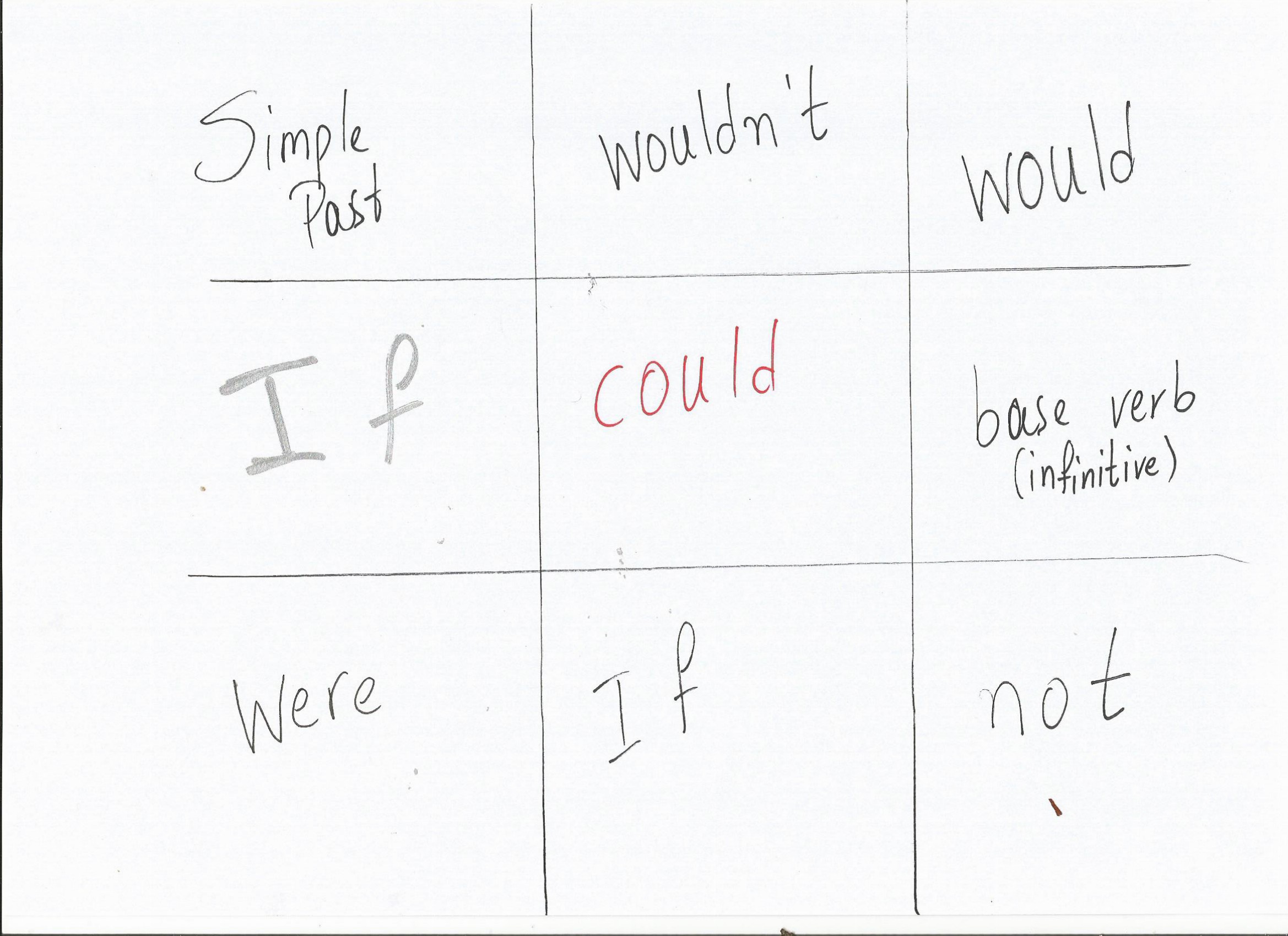
Conditionals noughts and crosses
We have all played noughts and crosses, so why not put words that are used in the 2nd conditional in the box? In order for you students to get an X or O in the table, they need to make a sentence using the word in the box and of course this sentence needs to be in the 2nd conditional.Scan0081
Consequence chain story
A consequence chain is like writing a chain story but the learners must use the 2nd conditional and write about consequences (for more about this go here). How do you set this up? Well, get your students to sit in rows. One student from each end of the room must write a sentence in the second conditional. Then, hand it to the student next to him/her. That student uses the previous student’s main clause to form an if clause, and then adds his/her own main clause and so on.

 Student A: If you arrived here early, you would meet Peter. Next student: If you met Peter, you would probably end up going on a date.
cece3-2014-04-0217-21-07

My students’ consequence chain (level: A1)


Finish my sentence-Ball game
If you have learners who like moving around, you should play this game. One student stands in the front of the class and says half a conditional. The learner then throws the ball to a student and that student needs to finish off the sentence. You can even turn this into a team game where each student’s correct answer adds points to the team. This is great for the summer, you can play outside!

Let’s do some math
Give your students math tasks and ask them to write down what they see.

For example,
If I had 3 cows and they produced 5 kilos of milk every day, how much milk would each cow produce?

If scenarios

Get your learners to talk or write about what they would do in each of these scenarios. You can jazz things up by getting them to draw pictures while doing so, like a little picture composition.
If I won 1 million euros, I would……..

If I had one day left to live, I would……

If I could fly anywhere in the world, I would…..

If I could choose any famous person to date, I would…….

Dating game

You choose three students and give them three I.D cards ( you can make these cards up or you can use information about famous people). You also choose a bachelor or bachelorette. The bachelorette/bachelor cannot see the three candidates. He/she asks questions like, ” What would you do if you were on a deserted island?” and the candidates need to answer using the 2nd conditional as well(if you press the title of this idea you can watch another teacher describing this game in more detail). 43105-valentine

Card game
You need an hour glass or some sort of timer and some cards with either an if clause or a main clause. Once you hand your students their cards, they need to write the rest of the conditional clause on a sheet of paper. When the timer goes off, the student that has the most correct sentences is the winner.

Where I looked for some ideas

References
Alexander, L.G. (1998). Longman English Grammar Practice for Intermediate Students. New York.: Longman.
 
Hope you liked this post.
Till next time…..

100 Blog Posts later

1 is for the first time I blogged (February 2013).

0 is for the minutes I spent second guessing my posts ( my posts are me-no regrets).

0 is like a circle- it shows connecting. I am connecting with you, wherever you are.

Be real, be truthful, be myself (my motto these days). Accept and move on (this year’s motto).

Love writing, love blogging.

O M G the things I write in here (sometimes I wonder……I bet you do too!).

Going to keep going for as long as I can (that’s a warning   :p).

Please bear with me and be patient with my typos, my rambles, my wordiness, my silliness.

Oh! I have no idea what to write here    😀

Smiley faces and comments is what I like seeing in the comments section (comments-me like ’em).

Two hundred blog posts is the next goal.

So happy to be blogging and sharing my 100th post (Yay).

Yeap, yeap!! I reached 100 blog posts (if you count the guest posts it’s more) and I really don’t know how time flew by. I started without really knowing what I was getting into. I started in Blogger now I am in WordPress. I have written about my teaching, my life. I have been silly and serious.I am still here and I already know what my next post is going to be about! And because my previous post was “I know who I am, but who are you?” I added a bit of sound to my post! So, now you know what I sound like as well    😀

http://vocaroo.com/player.swf?playMediaID=s1jm7Huh93Ni&autoplay=0
Voice Recorder >>

daisy

Till next time…….

I know who I am, but who are you? : D

I attended Sandy Millin’s talk a few hours ago. It was about blogging and professional development. Among other things, she made suggestions about what to blog about, and one of her tips was to ask questions on your blog. This gave me an idea. In this post, I ain’t going to say much. I am going to ask a few questions, I have asked myself many times. Who are you? Yes, you, the person reading this post. I mean, I see numbers when I look at my blog’s stats. I know there are some courageous people in the world who actually read my posts, but in this post (my 99th post. Yay!), I would really appreciate it, if you took a minute to say hello, tell me where you are from/about yourself, and what you like reading in the ELT blogs you read.

Today’s post is for you, the reader. 

I am doing this cause I want to get to know the people who actually read my posts. Reading your comments really puts a smile on my face!

Oh! If you blog, add your blog in the comments section!!!!If you like reading blogs, mention them in the comments  section.


2015-05-17 20.07.07

I am really curious about this one………Also, kinda risky cause no one might comment :p.

Never say never

This is going to be short and sweet and of course non ELT-related. Even if someone tells you that you can’t do something, but you feel you can, do it. This is what my painting looks like. I have no idea what the colours are any more. I do not know how well they match. I used what I learnt about colours, my teacher helped me and I made something, even though I thought I couldn’t! Yes, there are loads of imperfections, and of course it could be ten times better but.. who cares? I did it 😀 Here is my first painting, and as I am colour blind, this is ‘my mountain’ and I kinda climbed it! Yay!

2015-05-19 13.16.41

Till next time…..